Does NAD+ help with hair growth? 2026 evidence
NAD+ for hair and skin: claims vs studies
NAD+ has not been shown to help hair growth in people. Lab and animal studies link NAD+ to cell aging, but no human trial shows injections regrow hair or improve skin, so get hair loss checked for its actual cause.

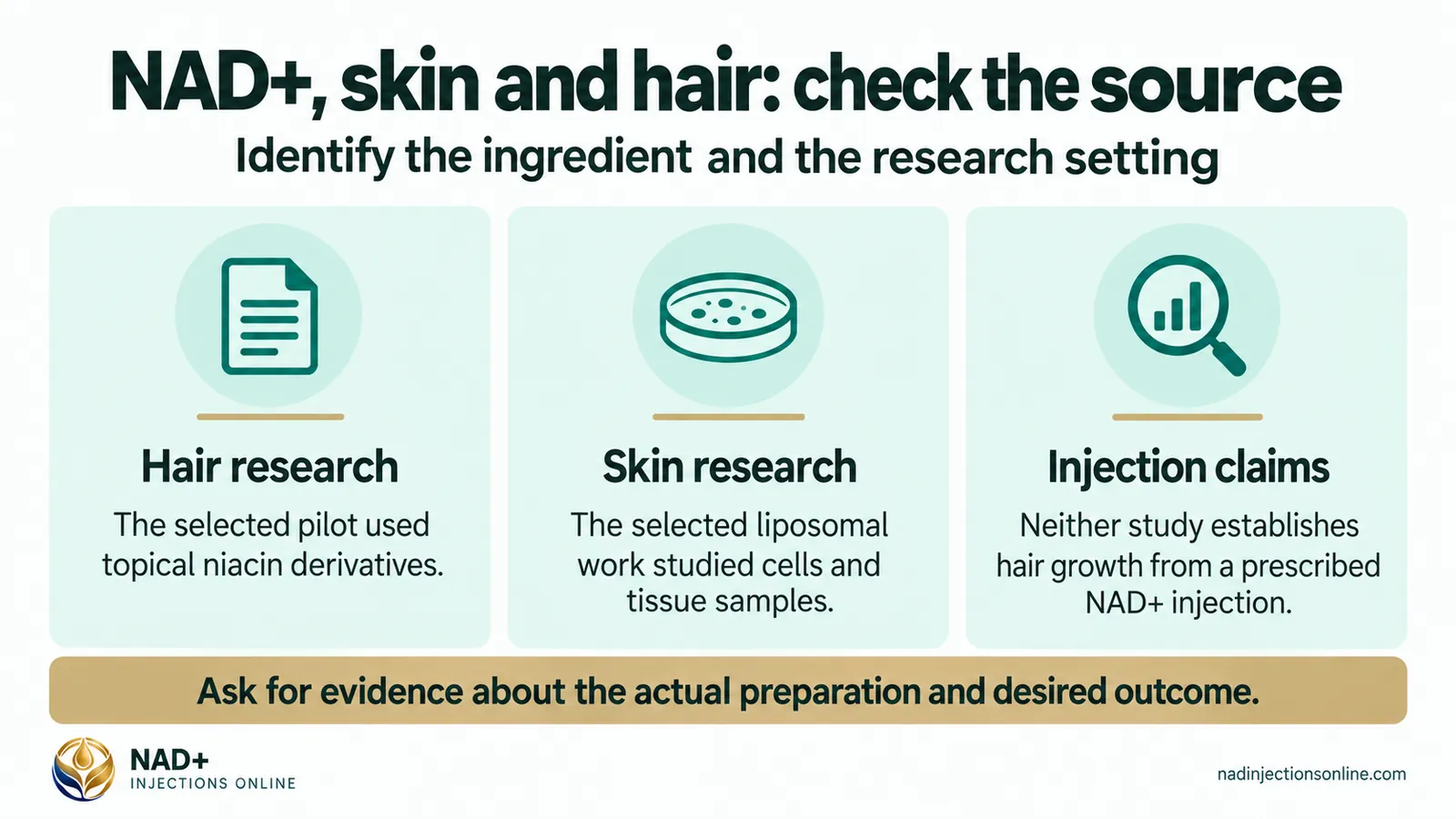
Does NAD help with hair growth? The selected hair pilot tested topical niacin derivatives, not nicotinamide adenine dinucleotide (NAD+) injections. A separate liposomal NAD+ paper studied cells and skin samples. These sources do not establish that a prescribed NAD+ injection produces hair growth in a person.
- Topical hair pilot: specific niacin derivatives applied to participants, not NAD+ injections.
- Skin-model paper: liposomal NAD+ in laboratory cells and tissue samples.
- Proposed prescription: a different preparation requiring its own evidence explanation.
- Individual concern: the reason for seeking assessment, rather than an assumed product indication.
Identify the ingredient behind the claim
Ask for the name of the product used in the cited research. In the selected hair pilot, the intervention was topical octyl nicotinate and tetradecyl nicotinate. Describing it only as NAD-related research would omit the distinction most relevant to an injection claim.
The selected skin-model paper used liposomal NAD+ in a laboratory setting. That is another specific formulation and research context. Neither reference should be rewritten as a trial of the particular injected preparation a reader is considering.
Compare the ingredient and route in the paper with the proposed product label. If they differ, ask which source supports the actual prescription claim. A similar word in two product names does not establish that their clinical results can be transferred.
The prescribed NAD+ overview explains the broader prescribing context. This guide concentrates on the source behind a hair claim and the questions needed to keep different preparations separate.
Read the topical hair pilot narrowly
The selected pilot involved female participants and topical niacin derivatives. Its identity as a pilot and its route are part of an accurate description. A statement about its findings should not quietly change the intervention to injected NAD+.
Ask whether the claimed outcome is the one the paper actually measured. A product page can cite a real publication while attaching a broader conclusion to it. Checking the methods as well as the title helps reveal when that has happened.
Population details should also stay visible. A selected pilot in female participants is not a universal recommendation for every hair concern. This guide does not use it to diagnose a reader or choose a treatment.
If the paper is relevant only as background, that should be stated. Background research can explain why a question is being investigated without proving that a different product produces a result. Ask the clinician to make that distinction explicit.
Keep skin models in their category
The selected liposomal NAD+ paper examined cultured human cells and skin samples outside the body. Human-origin material does not make it a clinical trial in people receiving injections. The laboratory setting limits the conclusion that can be drawn for a prescription decision.
NAD+ is a coenzyme found in every living cell, and its levels in many tissues decline with age. That biological fact is separate from a claim about a person’s hair or skin. It does not supply a missing clinical endpoint from the selected model study.
A paper can provide a meaningful laboratory observation while leaving a patient question unanswered. Recognizing that boundary avoids both overstating the result and dismissing the research. Keep the model, formulation and measured endpoint attached to the description.
The liposomal NAD+ guide addresses formulation differences. Use it to clarify the product category, rather than assuming that a delivery-related explanation establishes an appearance outcome. Glutathione is often sold alongside it; see NAD+ and glutathione.
Bring the hair concern to assessment
Explain the concern that prompted the search before assuming a product is the answer. FDA’s medicine-use guidance recommends understanding why a medicine is being considered and what its expected effects and risks are. Ask how that rationale relates to your actual question.
Bring the names and ingredient lists of current hair products, supplements and medicines. FDA’s interaction guidance supports a complete review before adding another product. A topical label or a supplement label is useful information even when it is not part of a prescription list.
Describe any existing evaluation so the discussion fits the care already underway. Ask what needs clarification before a product decision. A general guide can organize those questions but cannot identify the cause of an individual’s hair concern.
Keep any separate hormone question explicit rather than folding it into an NAD claim. The hormone guide explains why one molecular discussion cannot establish a different treatment outcome. Shared marketing language is not an evidence bridge.
Ask how the outcome is supported
Request evidence matching the actual ingredient, route and intended outcome. The selected topical pilot and skin-model paper do not establish a hair-growth result from prescribed NAD+ injections. That conclusion is limited to these references and does not claim every related publication is absent.
Ask which uncertainty remains when the support is indirect. An explanation should not move from a laboratory observation to a personal result without naming the evidence for that step. A technical description alone cannot answer what an individual will notice.
Discuss how the clinician would assess the proposed purpose and what follow-up would involve. FDA recommends discussing expected effects and possible risks before deciding about a medicine. A clinical contact plan should remain separate from any claim that appearance will change on a particular date.
Do not construct a regimen from a topical study or another person’s experience. The preparation and route are part of what was tested. Ask the prescriber and dispensing pharmacy about the actual instructions if any prescription is issued.
Check the word human carefully when it appears in a skin claim. The selected liposomal study used human-origin cultured cells and skin samples outside the body, rather than participants receiving injections. That is a meaningful distinction for a prescription discussion. Similarly, the selected hair pilot’s topical niacin derivatives should not be relabeled as injected NAD+. Ask for the source that addresses the actual product and outcome before transferring either finding.
Retain the injection safety context
Compounded medications are prepared by a licensed pharmacy for an individual patient and are not FDA-approved. No approved label lists its uses or side effects, so the physician works from your history and clinical judgment, tells you what is known and what is uncertain, and sets how often you check in.
Any injectable can cause a reaction at the injection site or an allergic reaction, and NAD+ infusions are known for flushing and nausea when given quickly. Report anything unexpected to the physician the same day, and tell the physician about every medicine and supplement you take before anything is prescribed.
Treatment requires a prescription. A licensed clinician evaluates you by telehealth and decides whether any medication is appropriate. Booking does not guarantee a prescription.
FDA reports of NAD injectable drugs include severe chills, shaking, vomiting and fatigue, sometimes requiring medical treatment. Its reminder concerns unsuitable sterile-compounding ingredients and possible excessive endotoxins. The reports do not establish a reaction rate for every preparation or the cause of every event.
Ask who dispenses the product and how preparation-related concerns and unexpected effects are handled. A hair claim does not establish product quality or individual suitability. Keep the actual label available when contacting the responsible professionals.
Breathing difficulty or throat swelling can be signs of a severe allergic reaction; call 911. Other unexpected changes should be reported through the clinician’s instructions. Do not interpret an adverse experience as proof that a hoped-for result is occurring.
What a physician weighs
Ask the physician to explain whether the cited paper concerns topical niacin derivatives, a laboratory skin model or the actual prescribed preparation. Bring the underlying hair concern and current product list, with expectations tied to evidence rather than a shared ingredient theme.
NAD for hair growth: common questions
What did the selected hair pilot use?
It used topical octyl nicotinate and tetradecyl nicotinate in female participants. It did not test NAD+ injections.
Was the skin paper a patient injection trial?
No. The selected liposomal NAD+ paper involved laboratory work with cultured human cells and skin samples outside the body.
Can a lab result establish a hair benefit?
The selected laboratory paper does not establish hair growth from prescribed NAD+ injections in people. Keep its model and endpoint identified.
Should I bring topical product labels?
Yes. Ingredient lists help the professional review the full medicine and supplement picture before another preparation is added.
Can I use a topical study as injection instructions?
No injection regimen follows from the selected topical pilot. Ask about the actual prescription and pharmacy directions instead.
What is the most useful evidence question?
Ask whether the study tested the ingredient, route and outcome being claimed for the actual product. Request an explanation of any remaining gap.
Keep the hair question specific and require a product-specific explanation before treating a related study as support for an injection claim.
Where this guide comes from
The register citations and the public sources behind the text.
Sources (8)
- Ministrini S, Liberale L, Erle HE, et al. A Liposomal Formulation Enhances the Anti-Senescence Properties of Nicotinamide Adenine-Dinucleotide (NAD(+)) in Endothelial Cells and Keratinocytes. Curr Issues Mol Biol. 2025;47(9). (pubmed.ncbi.nlm.nih.gov)
- Draelos ZD, Jacobson EL, Kim H, Kim M, Jacobson MK. A pilot study evaluating the efficacy of topically applied niacin derivatives for treatment of female pattern alopecia. J Cosmet Dermatol. 2005;4(4):258-61. (pubmed.ncbi.nlm.nih.gov)
- Covarrubias AJ, Perrone R, Grozio A, Verdin E. NAD(+) metabolism and its roles in cellular processes during ageing. Nat Rev Mol Cell Biol. 2021;22(2):119-141. (pmc.ncbi.nlm.nih.gov)
- FDA: medicine benefits and risks (fda.gov)
- FDA: Drug interactions (fda.gov)
- FDA: Compounding questions and answers (fda.gov)
- FDA: ingredients suitable for sterile compounding (fda.gov)
- MedlinePlus: Anaphylaxis (medlineplus.gov)
Put the question to a physician
The guides explain; the physician decides. Start from home, with a wellness consultant explaining the steps and the cost first.
Currently available to adults physically located in Florida at the time of their consultation. For adults 18 and older. Contacting NAD Injections Online does not guarantee treatment and creates no obligation.