NAD+ injection dosage in 2026: how the dose is set
NAD+ injection dosage guide: dose, route and schedule
There is no standard NAD+ injection dosage, because no FDA-approved label exists. The prescribing physician sets your dose, route and schedule, and the pharmacy label shows the concentration, often 100 mg/mL, so you can see exactly how much each injection contains.

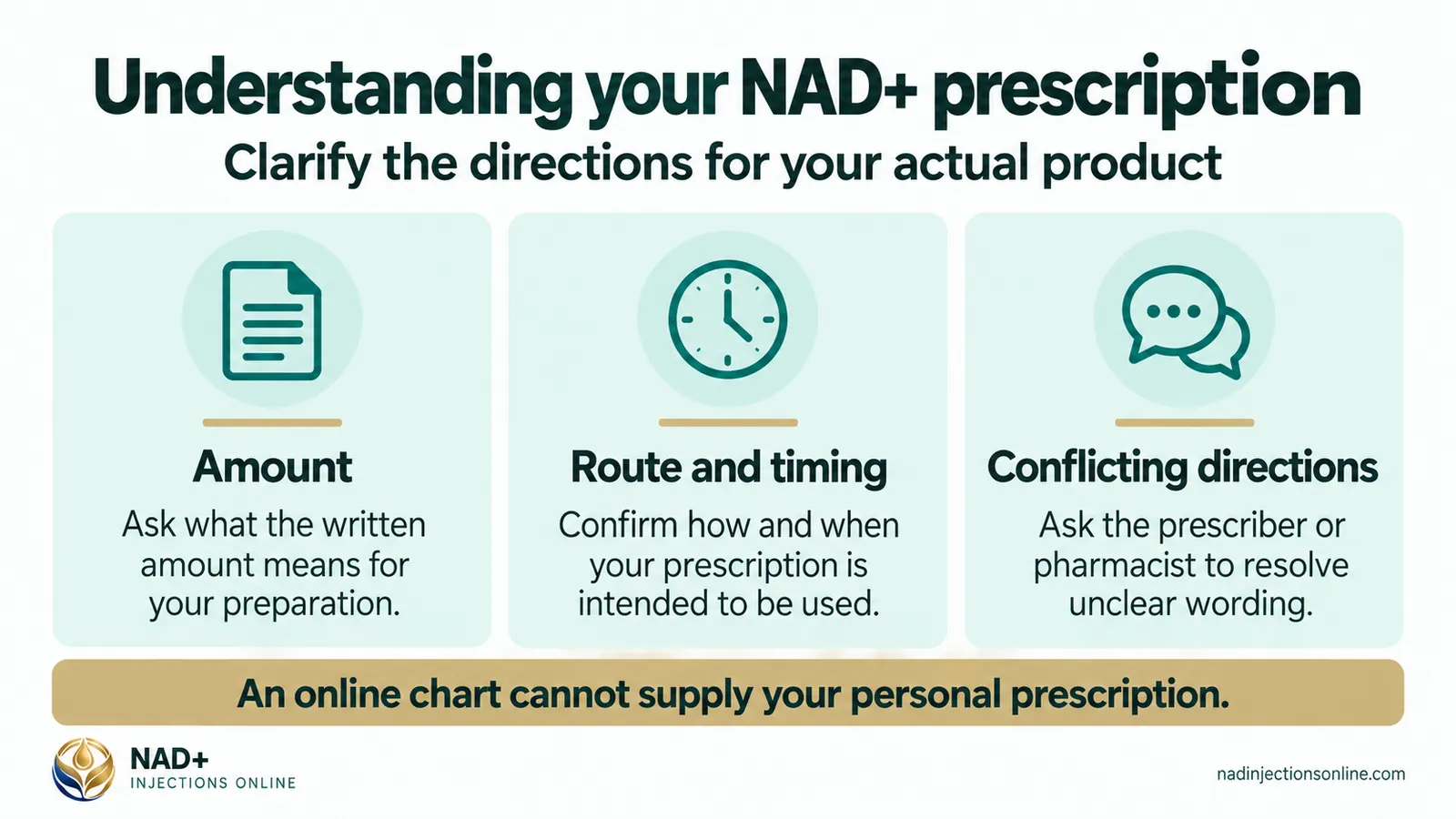
NAD+ injection dosage is a question for the prescribing physician and dispensing pharmacist, using your actual medicine and written directions. Nicotinamide adenine dinucleotide (NAD+) has no FDA-approved compounded dosing label. An online chart cannot supply your prescription. This guide explains how to get the amount, route, timing and follow-up questions clarified without giving a personal regimen.
What should my directions tell me?
Your own written prescription and pharmacy directions should be the starting point, rather than a figure selected from a search result. Ask the physician and pharmacist to explain any wording you cannot interpret. Name the actual product when you ask, and keep the dispensing document available. The purpose is to understand authorized instructions, not to create a different routine from an article.
It helps to separate the questions about amount, route and timing. If one is unclear, identify it directly instead of asking whether a general online protocol looks reasonable. A reply about the molecule may not resolve a label question. Keep asking for the specific clarification that is missing until the responsible professional has explained the applicable directions.
A useful clarification request quotes the confusing phrase exactly. For example, explain that the label and consultation note appear to describe different timing, rather than asking which internet routine is most popular. Ask the professional to identify the current authorized instruction and to explain it in words you understand. If the reply introduces a different product name, ask whether that is the preparation actually dispensed. The goal is one understandable direction, not a collection of plausible alternatives.
A small pilot study measured how a six-hour intravenous NAD+ infusion changed NAD+ and related metabolites in blood and urine.1
Why do online charts differ?
An online chart may describe a different preparation, a different route or a routine chosen by its publisher. Read its assumptions before treating it as relevant to your medicine. A chart should not acquire authority merely because it includes decimals or cites a paper somewhere on the page. Ask whether that paper actually supports the proposed use and the directions being discussed.
Information about what a vial contains is not itself an instruction about what you should receive. A supply description and a personal direction answer different questions. This article does not convert between them, because the applicable explanation needs to concern the product actually dispensed. The dispensing pharmacist is the contact for a question about the actual label.
Do not let a discussion about supply size silently answer a question about frequency. A label can identify the contents of a container without explaining every part of a treatment plan. Likewise, a service description can explain access to follow-up without setting a use interval. Write the questions separately and take them to the appropriate professional. This makes it easier to see whether the answer concerns the medicine, the clinical decision or the service arrangement.
Use the medicine according to its label and the instructions of the physician or pharmacist; ask about interactions and monitoring.
Can research give me a schedule?
The selected infusion experiment studied an intravenous preparation and metabolite changes. It is research context, not a personal schedule for a different home-use route. Ask what the reference actually tested before accepting a recommendation drawn from it. An observation period in a paper should not silently become the interval between your injections.
If a recommendation depends on evidence from another form, ask the physician to explain the mismatch in plain language. What was the molecule, how was it given, who took part and what did investigators measure? Those questions make the uncertainty specific. They avoid assuming that every study with NAD in its title supplies directions for every NAD-related product.
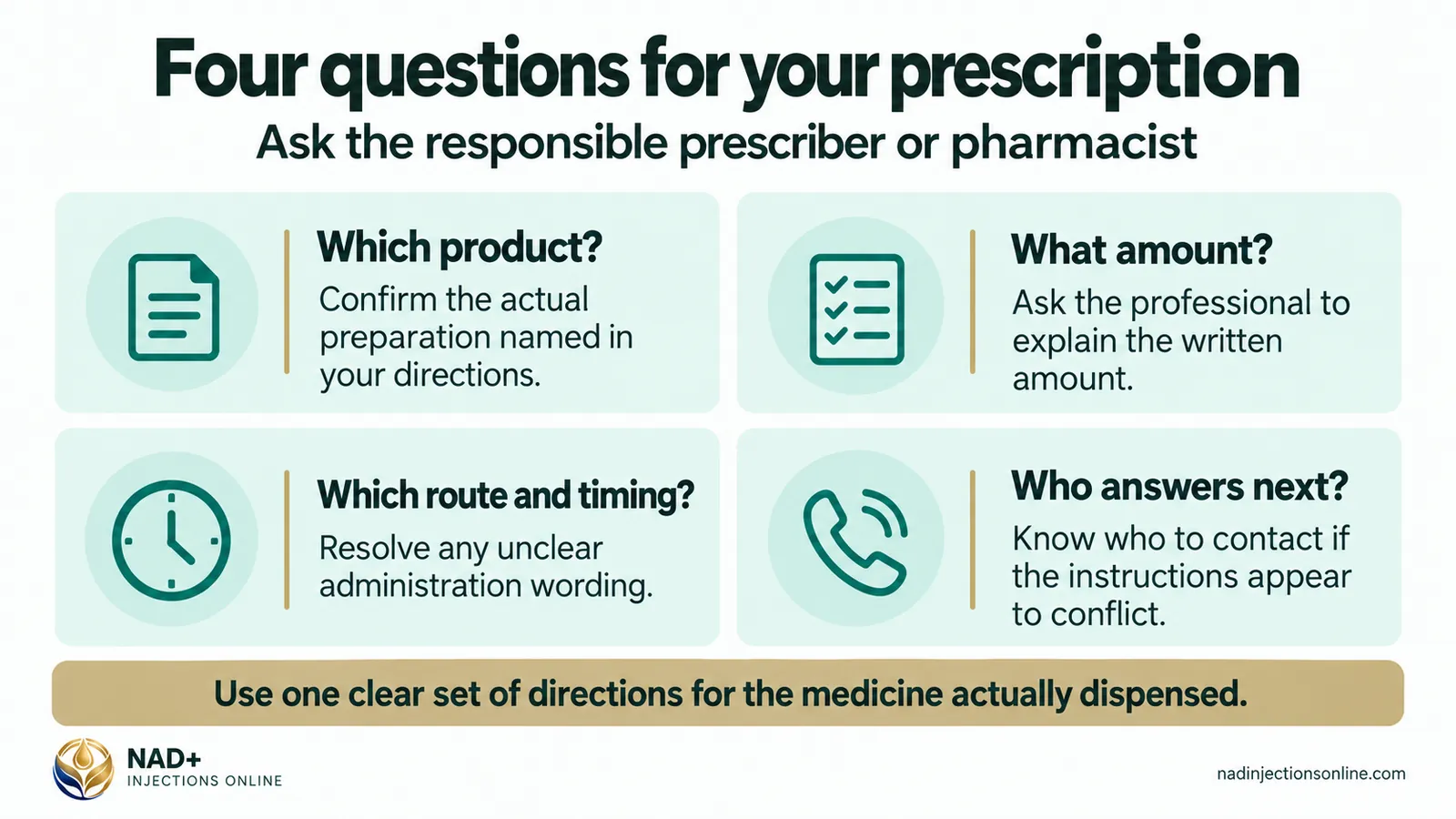
At follow-up, explain which question remains unresolved rather than reporting only that the routine seems confusing. You might need clarification of a changed instruction, the meaning of a label term or who should receive a later question. Bring the most recent written direction and identify any previous version still in your records. Ask how the current explanation will be documented. Clear communication is the intended result of this guide; it does not select an amount or schedule for you.
What if the instructions conflict?
Contact the physician and pharmacist and read back the conflicting wording. Identify which message or document each instruction came from. Do not choose between them by copying a familiar routine or by assuming another person’s product is identical. A written reconciliation is more useful than a series of general assurances about how simple the medicine is to use.
When the directions are revised, ask which earlier version is being replaced. Keep the current information with the dispensing label so that your next question can be explained accurately. If the uncertainty concerns a missed use or an error, describe what actually happened rather than looking for a general catch-up schedule. The response needs to concern your prescription and circumstances.
How should I prepare for follow-up?
Bring the original reason you considered NAD+, the current instructions and the specific questions or experiences you want to discuss. Ask what the physician is reviewing at that appointment and how a later concern should be raised. Do not assume that a check-in necessarily means changing the amount or frequency. The prescribing decision remains individualized.
Keep a current medicine and supplement list available for the discussion. Ask whether a new product or a change in your health history affects the proposed plan. This guide cannot clear a combination or supply a replacement regimen. Its practical purpose is to help you give the physician and pharmacist the information needed to answer your actual question.
- Written direction: identify the instruction authorized for your actual prescription.
- Research duration: identify when an experiment observed participants or collected samples.
- Supply description: identify the dispensed contents without inventing a personal schedule.
What a physician weighs
Put the specific question from this guide into your own words when discussing nad injection dosage. Explain what you want clarified, identify the actual preparation and bring the written information you have been given. Ask the physician to separate what the selected evidence supports from what remains a clinical judgment. If the answer depends on a product detail, ask how that detail will be confirmed with the pharmacist.
Compounded medications are prepared by a licensed pharmacy for an individual patient and are not FDA-approved. No approved label lists its uses or side effects, so the physician works from your history and clinical judgment, tells you what is known and what is uncertain, and sets how often you check in.
Any injectable can cause a reaction at the injection site or an allergic reaction, and NAD+ infusions are known for flushing and nausea when given quickly. Report anything unexpected to the physician the same day, and tell the physician about every medicine and supplement you take before anything is prescribed.
For severe allergic symptoms, including breathing difficulty or throat swelling, seek emergency care and call 911. This emergency advice takes priority over a routine same-day report.
Treatment requires a prescription. A licensed clinician evaluates you by telehealth and decides whether any medication is appropriate.
The current NAD+ product information explains this site’s prescribed pathway. For related questions, read how nad injections are given and nad injection side effects.
NAD+ injection dosage: common questions
Is there one standard NAD+ injection dosage?
Use the written directions for your own medicine. This guide does not choose a schedule from general online protocols.
Does a daily or weekly keyword imply a recommendation?
A search phrase such as daily or weekly does not establish a personal prescribing instruction.
Can I copy the schedule from an IV study?
The intravenous pilot examined a different route and laboratory outcomes; it does not provide your home-use directions.
What if the label and my notes disagree?
Read the discrepancy back to the prescribing physician and dispensing pharmacist and request a consistent explanation.
Can a calculator choose a personal dose?
Arithmetic cannot determine whether the preparation or proposed routine is appropriate for you.
Who should answer a missed-use question?
Describe the event to the responsible physician or pharmacist using your current label and prescription information.
Where this guide comes from
The register citations and the public sources behind the text.
Sources (4)
- Grant R, Berg J, Mestayer R, et al. A Pilot Study Investigating Changes in the Human Plasma and Urine NAD+ Metabolome During a 6 Hour Intravenous Infusion of NAD. Front Aging Neurosci. 2019;11:257.
- FDA: medicine benefits and risks (fda.gov)
- Grant R, Berg J, Mestayer R, et al. A Pilot Study Investigating Changes in the Human Plasma and Urine NAD+ Metabolome During a 6 Hour Intravenous Infusion of NAD. Front Aging Neurosci. 2019;11:257. (frontiersin.org)
- MedlinePlus: Anaphylaxis (medlineplus.gov)
Put the question to a physician
The guides explain; the physician decides. Start from home, with a wellness consultant explaining the steps and the cost first.
Availability depends on your state: you must be located in a state where an independent physician is licensed to treat you at the time of your consultation. For adults 18 and older. Contacting NAD Injections Online does not guarantee treatment and creates no obligation.