NAD+ injections at home in 2026: how they are given
How NAD+ injections are given at home: route, storage and directions
NAD+ injections at home are usually given just under the skin (subcutaneous) or into a muscle, following the physician’s written directions. The pharmacy ships the vial with storage instructions, and you follow its label for dose, injection site and timing rather than a generic chart.
NAD+ injections prescribed for home use require instructions for the actual medicine, not a general technique taken from another product. For nicotinamide adenine dinucleotide (NAD+), clarify the route, product information and access to the responsible professionals. This guide describes the questions to resolve without teaching injection technique, calculating amounts or giving preparation steps.
Which instructions apply to my medicine?
Use the directions for the preparation actually dispensed to you and ask the physician or pharmacist about unclear wording. A generic demonstration or article about another medicine cannot identify the correct directions for your prescription. This guide explains what training and clarification should resolve, without selecting a needle, teaching an injection technique or supplying a preparation recipe.
Ask which route is prescribed and whether the pharmacy information describes the same route. If the product, supplies or messages look different from what you expected, identify the discrepancy rather than guessing. A good clarification request quotes the relevant wording and names the actual dispensing information, so the professional can answer the specific issue.
Ask the dispensing pharmacist which written information belongs with the actual medicine and how to obtain clarification if part of it is missing. Keep that answer with the current label rather than saving an unrelated online demonstration as a substitute. If a consultation and a dispensing document appear to describe different routes, identify the discrepancy explicitly. The professional needs the exact wording to resolve it; a general statement that injections are straightforward does not settle the issue.
Check an online pharmacy’s state license, prescription requirement and access to a licensed pharmacist.
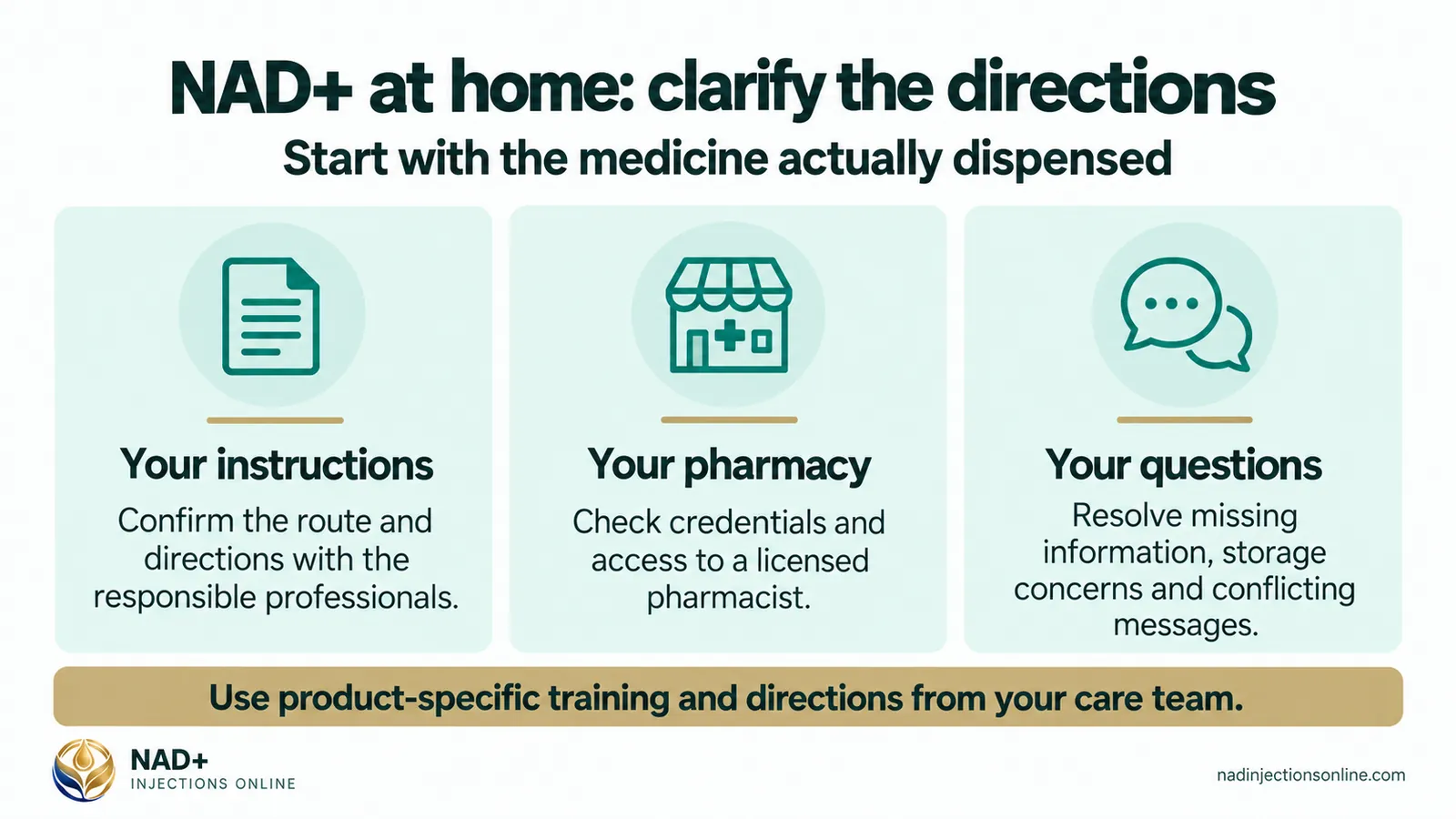
What should I check about the pharmacy?
FDA recommends checking an online pharmacy’s state license, prescription requirement and access to a licensed pharmacist. Ask which pharmacy will dispense the medicine and how to contact its pharmacist. A service brand and a dispensing pharmacy can have different roles, so keep the names and contacts distinct.
A pharmacy credential does not establish clinical effectiveness or FDA approval of a compounded NAD+ product. Ask the physician about the reason for the prescription and the evidence for the intended purpose. Ask the pharmacist about the dispensed preparation and product instructions. Those two conversations address related but different questions.
Before travel or a delivery question, locate the product’s actual storage instructions and the contact that can assess an event outside them. A question about temperature exposure should include what is known and what is uncertain, rather than a conclusion that the product is acceptable. FDA storage and excursion guidance supports obtaining product-specific advice. This article cannot inspect the medicine or infer its condition from a photograph, a familiar container or an estimated arrival time.
Follow the medicine’s specific storage instructions and ask the pharmacist about storage questions.
What should arrive with clear directions?
Ask the dispensing pharmacist to identify the actual medicine, the applicable instructions and the storage and beyond-use information. Keep those documents with the product details. If an item you expected is missing or unfamiliar, contact the pharmacy instead of substituting a supply mentioned in another person’s tutorial.
Product-specific training and local-disposal questions belong with the professionals responsible for your prescription and the relevant local service. Ask what instruction you need before use and which authority or local service should answer a disposal question. Do not improvise from an incomplete general description.
Home use also requires an understandable plan for questions. Ask which contact handles a label problem, a product concern or a clinical symptom, and how each can be reached. Do not wait until an event occurs to discover that a general service message is the only contact you recorded. This is about knowing the responsible professionals and their instructions. It does not turn a public article into training for a particular preparation or a replacement for individual assessment.
FDA has received reports of severe chills, shaking, vomiting and fatigue after NAD+ injectable drugs, sometimes requiring medical treatment, and warns about ingredients unsuitable for sterile compounding.
How should storage concerns be resolved?
Follow the actual medicine’s storage instructions and ask the pharmacist about uncertainty. General FDA storage guidance does not provide an NAD-specific shelf life or temperature for every preparation. A product that shares the ingredient name can still have different written handling information. The label for the dispensed medicine is the relevant starting point.
If delivery, travel or a power interruption may have taken the medicine outside its recommended conditions, contact the pharmacist or healthcare professional about the actual event before use. Do not infer that returning it to its usual storage condition settles quality concerns. Record what is known and what remains uncertain so the professional can address the question.
What if I have a symptom or error?
For a possible use error or unclear instruction, describe the actual event to the physician or pharmacist. This page cannot supply a catch-up plan or tell you how to alter the directions. Keep the product and dispensing details available, and identify any other medicines involved. Do not replace a specific account with an assumption about what normally happens.
Severe allergic symptoms such as breathing difficulty or throat swelling require emergency care; call 911. Routine prescription contacts are not a substitute for that response. FDA has also reported serious events after NAD+ injectable drugs and warned about unsuitable sterile-compounding ingredients, so home use should not be presented as an assurance that every risk has been removed.
- Medicine question: locate the dispensing pharmacist and the current product instructions.
- Clinical question: identify how to reach the prescribing physician about your circumstances.
- Unclear direction: quote the conflicting wording instead of improvising from a generic tutorial.
If the available materials assume knowledge you do not have, tell the pharmacist or physician which part is unclear. Ask what instruction is needed for the prescribed product and how that instruction will be supplied. Do not treat recognition of a medicine name as confirmation that another preparation’s technique applies. The written information and professional explanation should concern the actual prescription, with a clear route for further questions when something still does not make sense.
What a physician weighs
Put the specific question from this guide into your own words when discussing how are nad injections given. Explain what you want clarified, identify the actual preparation and bring the written information you have been given. Ask the physician to separate what the selected evidence supports from what remains a clinical judgment. If the answer depends on a product detail, ask how that detail will be confirmed with the pharmacist.
Compounded medications are prepared by a licensed pharmacy for an individual patient and are not FDA-approved. No approved label lists its uses or side effects, so the physician works from your history and clinical judgment, tells you what is known and what is uncertain, and sets how often you check in.
Any injectable can cause a reaction at the injection site or an allergic reaction, and NAD+ infusions are known for flushing and nausea when given quickly. Report anything unexpected to the physician the same day, and tell the physician about every medicine and supplement you take before anything is prescribed.
For severe allergic symptoms, including breathing difficulty or throat swelling, seek emergency care and call 911. This emergency advice takes priority over a routine same-day report.
Treatment requires a prescription. A licensed clinician evaluates you by telehealth and decides whether any medication is appropriate.
The current NAD+ product information explains this site’s prescribed pathway. For related questions, read does nad need to be refrigerated and nad injection side effects.
NAD+ injections at home: common questions
Does this page teach how to inject NAD+?
This page does not provide an injection tutorial. Use product-specific directions and training from the responsible physician and pharmacist.
Can I copy another medicine’s injection instructions?
Do not copy another medicine’s instructions. Ask which route and directions apply to your actual prescription, and resolve conflicting wording with the physician and pharmacist.
What pharmacy details should I check?
FDA recommends checking the online pharmacy’s state license, prescription requirement and access to a licensed pharmacist. Ask for the actual dispensing pharmacy’s identity and contact details.
Does a licensed pharmacy prove clinical benefit?
No. A pharmacy credential does not establish a compounded product’s clinical effectiveness or FDA approval status.
Who should answer a storage question?
Ask the dispensing pharmacist about the actual medicine’s label, storage conditions and any temperature excursion.
What if breathing becomes difficult?
Breathing difficulty or throat swelling can indicate a severe allergic reaction. Call 911 and obtain emergency care rather than waiting for routine physician or pharmacy advice.
Where this guide comes from
The register citations and the public sources behind the text.
Sources (7)
- FDA: medicine benefits and risks (fda.gov)
- FDA: buying medicine online (fda.gov)
- FDA: expired medicines and storage (fda.gov)
- FDA: temperature-sensitive medicines (fda.gov)
- FDA: ingredients suitable for sterile compounding (fda.gov)
- MedlinePlus: Anaphylaxis (medlineplus.gov)
- FDA: Compounding questions and answers (fda.gov)
Put the question to a physician
The guides explain; the physician decides. Start from home, with a wellness consultant explaining the steps and the cost first.
Availability depends on your state: you must be located in a state where an independent physician is licensed to treat you at the time of your consultation. For adults 18 and older. Contacting NAD Injections Online does not guarantee treatment and creates no obligation.