What are NAD+ injections? A 2026 guide
NAD+ injections explained: the molecule and the medicine
NAD+ injections are a prescription form of nicotinamide adenine dinucleotide (NAD+), a coenzyme every cell uses to turn food into energy. A licensed pharmacy compounds the injection for one patient after a physician prescribes it. It is not FDA-approved, and research in people is still limited.

NAD+ injections are preparations containing nicotinamide adenine dinucleotide, a coenzyme, supplied here through an individualized prescribing and pharmacy pathway. The molecule’s normal cellular role and the effects of a medicine containing it are separate questions. This guide explains the basic terminology, compounded status and limits of the selected research before you discuss a specific preparation.
What is NAD+ in plain language?
NAD+ means nicotinamide adenine dinucleotide, a coenzyme discussed in normal cellular biology. The molecule’s endogenous role and a medicine containing it are different subjects. Understanding the name explains what the ingredient is; it does not establish what a person will experience after receiving a particular preparation.
A familiar molecule and an individualized compounded prescription should not be confused. Ask which part of a description concerns biology and which part makes a clinical claim. The latter needs evidence about the relevant intervention and outcome, not just a general explanation of the ingredient.
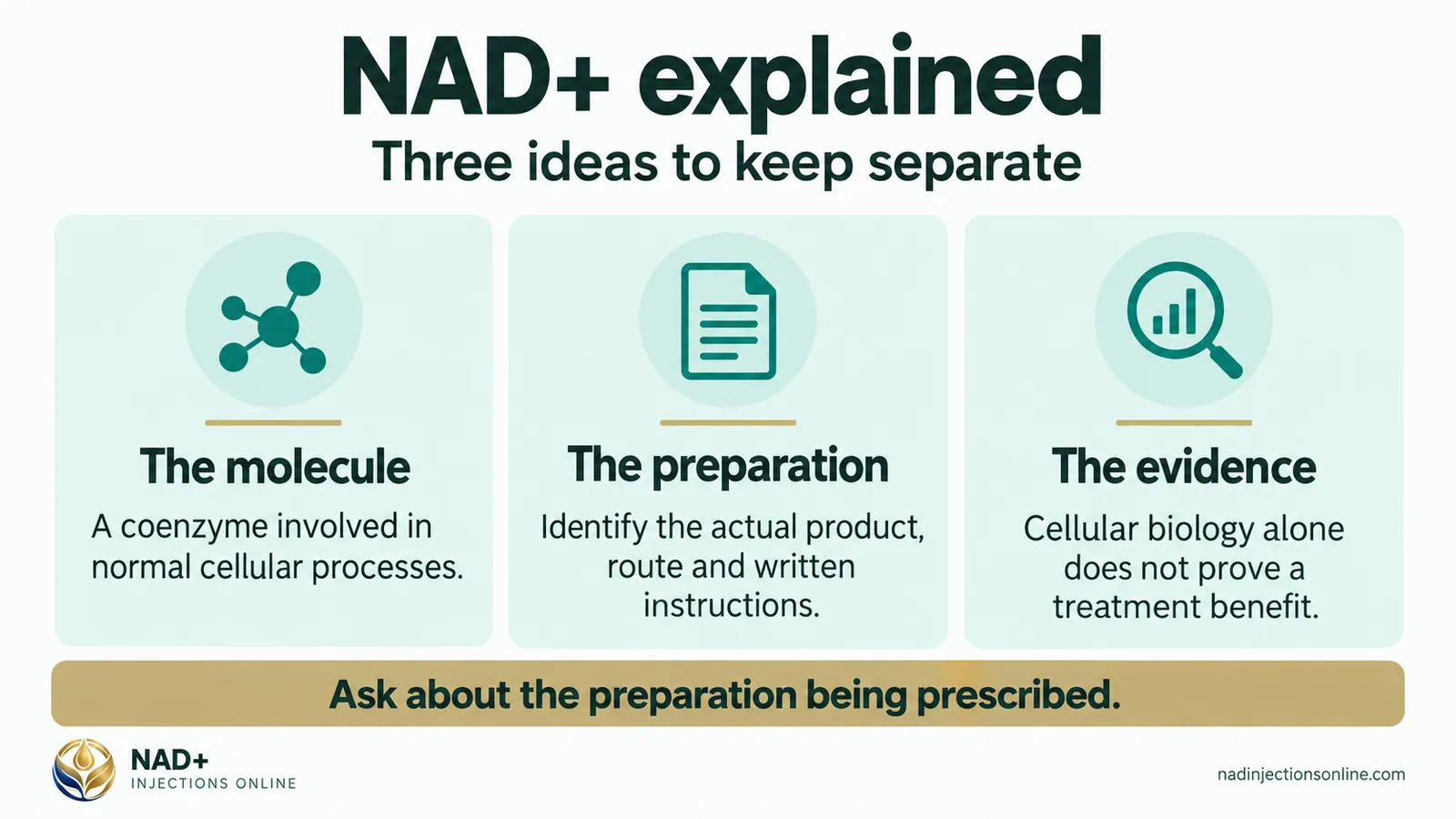
When a page uses NAD+ in a heading, read the sentences underneath to identify what it actually claims. Keep the ingredient identity separate from marketing words about the experience of using it. Ask which preparation is being discussed and which evidence concerns that preparation. A clear definition is useful because it prevents a familiar abbreviation from standing in for several different assertions about a product, a service and a possible clinical purpose.
NAD+ is a coenzyme found in every living cell, and its levels in many tissues decline with age.1
How is a preparation different from biology?
A medicine description needs the ingredient, preparation and route, not just the letters NAD+. The prescribed compounded pathway discussed here involves a physician’s decision and pharmacy dispensing. It does not mean the product is FDA-approved or that every preparation sharing the ingredient name has the same evidence.
FDA explains that compounded drugs are not FDA-approved and that it does not verify their safety, effectiveness or quality before marketing. Keep that statement separate from pharmacy licensure and individualized prescribing. Both roles can be described accurately without presenting either as FDA endorsement of the finished preparation.
A prescription description should identify more than a molecule. Ask what form and route are under consideration, who makes the clinical decision and which pharmacy dispenses the medicine. The pathway described on this site involves separate physician and pharmacy roles. Those roles should be clear even before a specific prescription is issued. They do not remove the need to explain compounded status or the limits of the evidence supporting the proposed purpose.
In a study of healthy middle-aged and older adults, oral supplementation with an NAD+ precursor (nicotinamide riboside) raised blood NAD+ levels and was well tolerated.2
Does oral research apply to an injection?
The selected Martens trial used oral nicotinamide riboside, a precursor, rather than an NAD+ injection. A blood NAD+ finding from that study does not establish a symptom benefit from another preparation. Ask what was actually administered and measured before accepting a claim that “human research” proves a broad treatment result.
NIH’s niacin information also discusses the body’s conversion of absorbed niacin into NAD. That is nutritional and biochemical background, not an injection outcome trial. It should not be used to suggest that everyone needs additional injected NAD+ or that normal dietary physiology establishes the medicine’s clinical effects.
As you read related guides, notice when the question changes. A definition asks what the ingredient is. A dosage question asks about directions for an actual prescription. A benefits question asks what an intervention has been shown to change. An approval question asks about regulatory status. One answer cannot settle all four. Bring the unresolved question to the appropriate professional instead of treating a biological definition as permission to choose a product or copy a routine.
A small pilot study measured how a six-hour intravenous NAD+ infusion changed NAD+ and related metabolites in blood and urine.3
What does the IV study contribute?
The selected pilot measured NAD+ and related metabolites around intravenous administration in healthy volunteers. It does not provide a home-injection onset time, duration of benefit or personal directions. The paper includes safety observations in its monitored setting; those observations and evidence of a particular symptom benefit are different questions.
Ask the physician to explain any proposed application of infusion research to another route. The actual preparation and intended outcome should be named in that explanation. The study can be useful context while still leaving your clinical question open. A definition page should not hide that uncertainty behind the simplicity of the molecule’s name.
What should a first discussion cover?
Bring your reason for considering NAD+, your medicine and supplement list, and the specific claims you would like assessed. Ask what preparation is being considered, why it is being considered and which evidence is relevant. Ask which questions remain unanswered rather than assuming every biological mechanism has a demonstrated clinical effect.
Check the dispensing source and access to professional clarification. FDA recommends verifying an online pharmacy’s state license, prescription requirement and pharmacist availability. Once a medicine is dispensed, its actual directions govern use. The useful next step after understanding the definition is a clear conversation about the real proposal, not a borrowed routine from a general article.
- Identity: understand what the molecule’s name refers to.
- Preparation: identify the actual medicine and administration route.
- Clinical claim: ask what evidence supports the particular proposed purpose.
What a physician weighs
Put the specific question from this guide into your own words when discussing what is nad. Explain what you want clarified, identify the actual preparation and bring the written information you have been given. Ask the physician to separate what the selected evidence supports from what remains a clinical judgment. If the answer depends on a product detail, ask how that detail will be confirmed with the pharmacist.
Compounded medications are prepared by a licensed pharmacy for an individual patient and are not FDA-approved. No approved label lists its uses or side effects, so the physician works from your history and clinical judgment, tells you what is known and what is uncertain, and sets how often you check in.
Any injectable can cause a reaction at the injection site or an allergic reaction, and NAD+ infusions are known for flushing and nausea when given quickly. Report anything unexpected to the physician the same day, and tell the physician about every medicine and supplement you take before anything is prescribed.
For severe allergic symptoms, including breathing difficulty or throat swelling, seek emergency care and call 911. This emergency advice takes priority over a routine same-day report.
Treatment requires a prescription. A licensed clinician evaluates you by telehealth and decides whether any medication is appropriate.
The current NAD+ product information explains this site’s prescribed pathway. For related questions, read is nad a peptide and nad benefits.
NAD+ injections: common questions
What does NAD stand for?
It means nicotinamide adenine dinucleotide, a coenzyme; that definition does not establish a medicine’s clinical effects.
Are NAD+ injections FDA-approved?
Compounded preparations discussed here are not FDA-approved, even when individually prescribed.
Does a normal cellular role prove an injection benefit?
The normal role of a molecule and the effects of administering a particular preparation are different questions.
Is oral NR the same treatment?
The Martens trial used an oral precursor, so its blood finding should not be described as an injection outcome.
Is an IV pilot a home-use schedule?
It measured NAD+ and related metabolites around intravenous administration, not a personal home-use response timetable.
What should a first discussion clarify?
Ask about the actual preparation, the reason for considering it, relevant evidence and access to professional clarification.
Where this guide comes from
The register citations and the public sources behind the text.
Sources (10)
- Covarrubias AJ, Perrone R, Grozio A, Verdin E. NAD(+) metabolism and its roles in cellular processes during ageing. Nat Rev Mol Cell Biol. 2021;22(2):119-141.
- Martens CR, Denman BA, Mazzo MR, et al. Chronic nicotinamide riboside supplementation is well-tolerated and elevates NAD(+) in healthy middle-aged and older adults. Nat Commun. 2018;9(1):1286.
- Grant R, Berg J, Mestayer R, et al. A Pilot Study Investigating Changes in the Human Plasma and Urine NAD+ Metabolome During a 6 Hour Intravenous Infusion of NAD. Front Aging Neurosci. 2019;11:257.
- Covarrubias AJ, Perrone R, Grozio A, Verdin E. NAD(+) metabolism and its roles in cellular processes during ageing. Nat Rev Mol Cell Biol. 2021;22(2):119-141. (pmc.ncbi.nlm.nih.gov)
- FDA: Compounding questions and answers (fda.gov)
- FDA: buying medicine online (fda.gov)
- Martens CR, Denman BA, Mazzo MR, et al. Chronic nicotinamide riboside supplementation is well-tolerated and elevates NAD(+) in healthy middle-aged and older adults. Nat Commun. 2018;9(1):1286. (pubmed.ncbi.nlm.nih.gov)
- NIH ODS: Niacin (ods.od.nih.gov)
- Grant R, Berg J, Mestayer R, et al. A Pilot Study Investigating Changes in the Human Plasma and Urine NAD+ Metabolome During a 6 Hour Intravenous Infusion of NAD. Front Aging Neurosci. 2019;11:257. (frontiersin.org)
- MedlinePlus: Anaphylaxis (medlineplus.gov)
Put the question to a physician
The guides explain; the physician decides. Start from home, with a wellness consultant explaining the steps and the cost first.
Availability depends on your state: you must be located in a state where an independent physician is licensed to treat you at the time of your consultation. For adults 18 and older. Contacting NAD Injections Online does not guarantee treatment and creates no obligation.