Is NAD+ a peptide? The 2026 answer
NAD+ vs peptides: a coenzyme, not an amino-acid chain
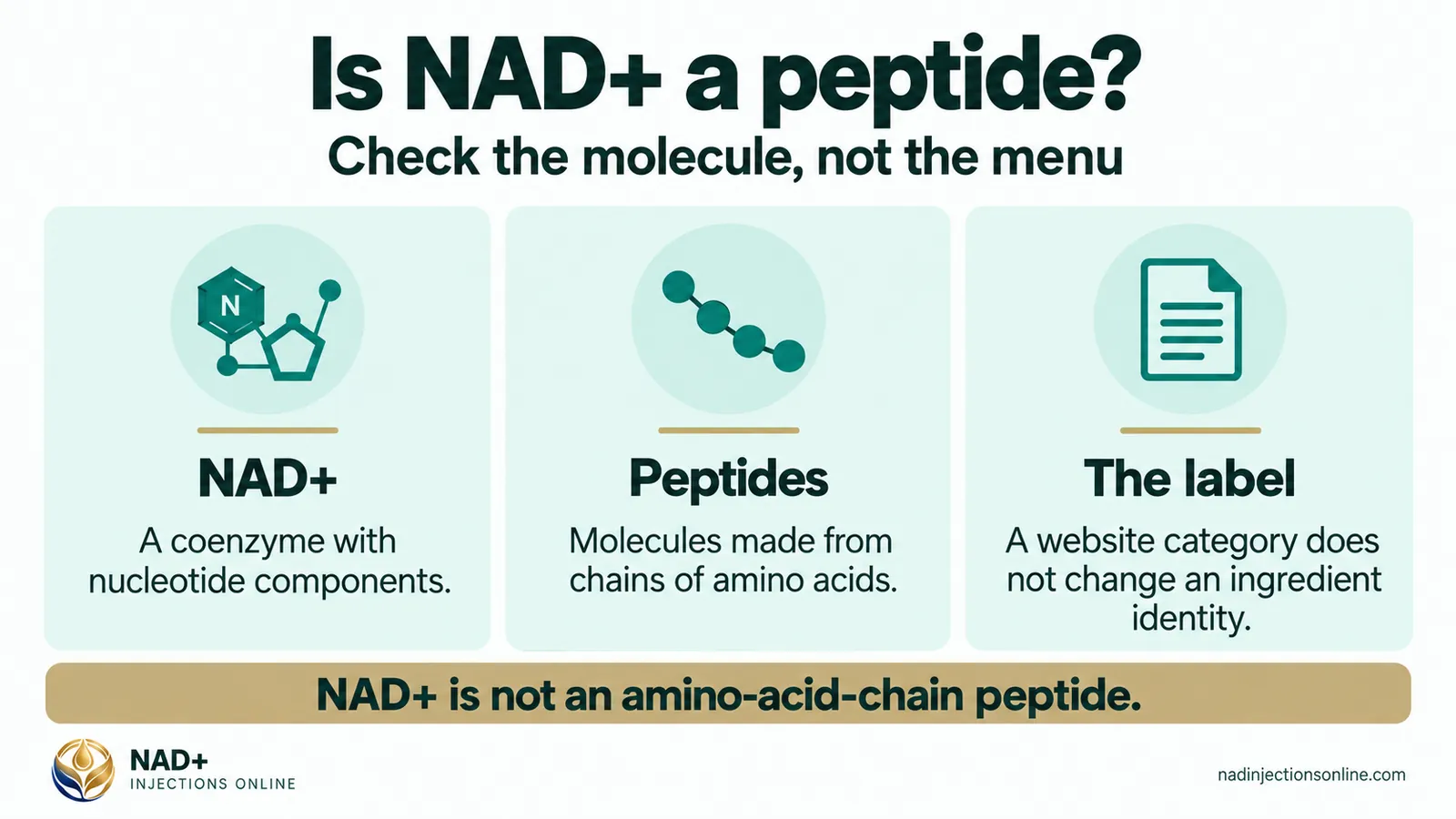
No, NAD+ is not a peptide. Nicotinamide adenine dinucleotide is a coenzyme built from two nucleotides, while peptides are chains of amino acids. Clinics sometimes list NAD+ on peptide menus, but the molecule and its rules are different.
Is NAD a peptide? NAD+ is nicotinamide adenine dinucleotide, a coenzyme with nucleotide components, rather than an amino-acid chain. If you see NAD described as a peptide, the category wording does not change the molecule’s identity. Check the exact ingredient before drawing conclusions about a product.
This guide helps you make sense of the name on a website, label or consultation list. For the prescribed-product pathway, start with the NAD+ injection information and bring any unclear wording to the clinician or pharmacist.
What does the ingredient name mean?
Nicotinamide adenine dinucleotide identifies the coenzyme discussed in the Covarrubias review. Dinucleotide describes nucleotide components, while peptide describes an amino-acid chain. These words concern molecular identity. They do not describe a certain response to a prescribed preparation.
Copy the full ingredient name from the actual product information when preparing a question. If a label and a sales page appear to use different names, ask the dispensing pharmacy to explain the difference. Do not decide that the names are interchangeable simply because the initials look familiar.
Is the abbreviation enough?
Initials are a starting point, not a complete product description. Ask which ingredient, formulation and route the abbreviation represents in that particular conversation. You should not have to reconstruct a prescription from a menu heading.
Keep the website description and the pharmacy information available together if the wording is confusing. That gives the person answering your question a specific discrepancy to address, rather than a general question about what sellers call a category.
What makes something a peptide?
A peptide is built from amino acids. Glutathione is a tripeptide, which gives a concrete example of a molecule in that category. The Forman reference describes glutathione biochemistry; its classification does not make it identical to NAD+.
You do not need to memorize structural chemistry to ask a useful question. The practical distinction is whether the explanation describes the actual ingredient accurately. A confident answer about the category should be followed by a separate explanation of the preparation being considered.
Are all peptides interchangeable?
Glutathione and sermorelin illustrate different biological roles within peptide-related discussions. Sermorelin is described in its registered reference as a synthetic form of GHRH. That description is not the chemical identity of NAD+.
Ask about each named substance individually. Avoid treating a broad category as a single medicine with one purpose. A clinician’s explanation should remain specific enough that you know which ingredient is under discussion.
Why might a website say peptide?
A website can group products by how people browse, by packaging or by consultation topic. The grouping can make an unfamiliar name seem like a member of the neighboring category. It is still worth asking the publisher to distinguish a navigation label from a chemical statement.
The phrase NAD peptide also leaves an important practical question unresolved: does the page mean NAD+ alone, or is it describing some other product? Request clarification rather than assuming an ingredient has been added or removed. A category label cannot resolve that uncertainty.
What information should I request?
Ask for a plain description of the exact ingredient and the preparation. If the page discusses multiple products, ask which one the answer applies to. Keep a record of that clarification so you can use the same name during the consultation.
Helpful comparisons include:
- Ingredient identity: the full name rather than the menu category.
- Product information: the actual preparation rather than a stock photograph.
- Evidence: research on that ingredient and route.
- Prescription decision: the clinician’s reasoning for your individual situation.
Does the category prove a benefit?
The review of NAD metabolism concerns biological mechanisms and research across different settings. It does not establish that a compounded injection has the same effects as a peptide product. Molecular classification and product-specific clinical evidence answer different questions.
Ask what the cited research actually studied before accepting a category-based conclusion. If the answer shifts from the ingredient in your question to a different molecule, request the missing connection. You can acknowledge a valid scientific finding while asking whether it applies to the proposed prescription.
The guide to NAD+ evidence explains how to separate background biology from treatment claims. Use it to prepare questions, rather than to choose a product based on an appealing category name.
What should a physician weigh?
The useful consultation starts with your reason for asking and the exact product you have in mind. Explain whether the confusion came from a label, a website or a recommendation. Then ask the clinician to identify what is known about the preparation and which questions remain open.
Compounded medications are prepared by a licensed pharmacy for an individual patient and are not FDA-approved. No approved label lists its uses or side effects, so the physician works from your history and clinical judgment, tells you what is known and what is uncertain, and sets how often you check in.
Any injectable can cause a reaction at the injection site or an allergic reaction, and NAD+ infusions are known for flushing and nausea when given quickly. Report anything unexpected to the physician the same day, and tell the physician about every medicine and supplement you take before anything is prescribed.
The infusion wording above concerns infusions and should not be read as a measured reaction rate for another route. Breathing difficulty or throat swelling needs emergency care, rather than a routine message. This page explains terminology and cannot assess a reaction.
Treatment requires a prescription. A licensed clinician evaluates you by telehealth and decides whether any medication is appropriate. Booking does not guarantee a prescription.
Is NAD a peptide: common questions
Is NAD+ an amino-acid chain?
No. NAD+ has nucleotide components and is classified as a dinucleotide coenzyme.
Does the plus sign mean peptide?
No. The notation NAD+ does not describe a peptide category.
Can I identify ingredients from the bottle?
Ask for the ingredient information. A photograph or container style is not a reliable way to resolve an unclear name.
Does a peptide menu establish approval?
No. A menu category does not establish FDA approval of a compounded preparation.
What if my prescription wording differs?
Ask the dispensing pharmacist to clarify the actual prescribed ingredient before making assumptions about the product.
Should I ask about every neighboring product?
Focus on the specific ingredient being considered. You can request separate explanations for other products if they become relevant to your consultation.
Where this guide comes from
The register citations and the public sources behind the text.
Sources (8)
- Covarrubias AJ, Perrone R, Grozio A, Verdin E. NAD(+) metabolism and its roles in cellular processes during ageing. Nat Rev Mol Cell Biol. 2021;22(2):119-141. (pmc.ncbi.nlm.nih.gov)
- Forman HJ, Zhang H, Rinna A. Glutathione: overview of its protective roles, measurement, and biosynthesis. Mol Aspects Med. 2009;30(1-2):1-12. (pmc.ncbi.nlm.nih.gov)
- Walker RF. Sermorelin: a better approach to management of adult-onset growth hormone insufficiency?. Clin Interv Aging. 2006;1(4):307-8. (pubmed.ncbi.nlm.nih.gov)
- FDA: Compounding questions and answers (fda.gov)
- Grant R, Berg J, Mestayer R, et al. A Pilot Study Investigating Changes in the Human Plasma and Urine NAD+ Metabolome During a 6 Hour Intravenous Infusion of NAD. Front Aging Neurosci. 2019;11:257. (frontiersin.org)
- FDA: Drug interactions (fda.gov)
- MedlinePlus: Anaphylaxis (medlineplus.gov)
- FDA: buying medicine online (fda.gov)
Put the question to a physician
The guides explain; the physician decides. Start from home, with a wellness consultant explaining the steps and the cost first.
Availability depends on your state: you must be located in a state where an independent physician is licensed to treat you at the time of your consultation. For adults 18 and older. Contacting NAD Injections Online does not guarantee treatment and creates no obligation.