NAD injection benefits in 2026: what studies measured
NAD+ injection benefits: energy, aging and the evidence
NAD injection benefits are still mostly unproven in people. Small studies show injections and infusions raise NAD+ levels in the blood, and research on energy, metabolism and aging continues, but no large trial has confirmed clinical benefits yet.

NAD injection benefits should be assessed against a study of the relevant preparation and outcome. Nicotinamide adenine dinucleotide (NAD+) biology, oral-precursor results and an IV metabolite pilot are not interchangeable evidence. This guide separates those sources and prepares questions about a proposed clinical purpose without promising symptom changes or claiming an exhaustive research review.
What is a benefit claim asking?
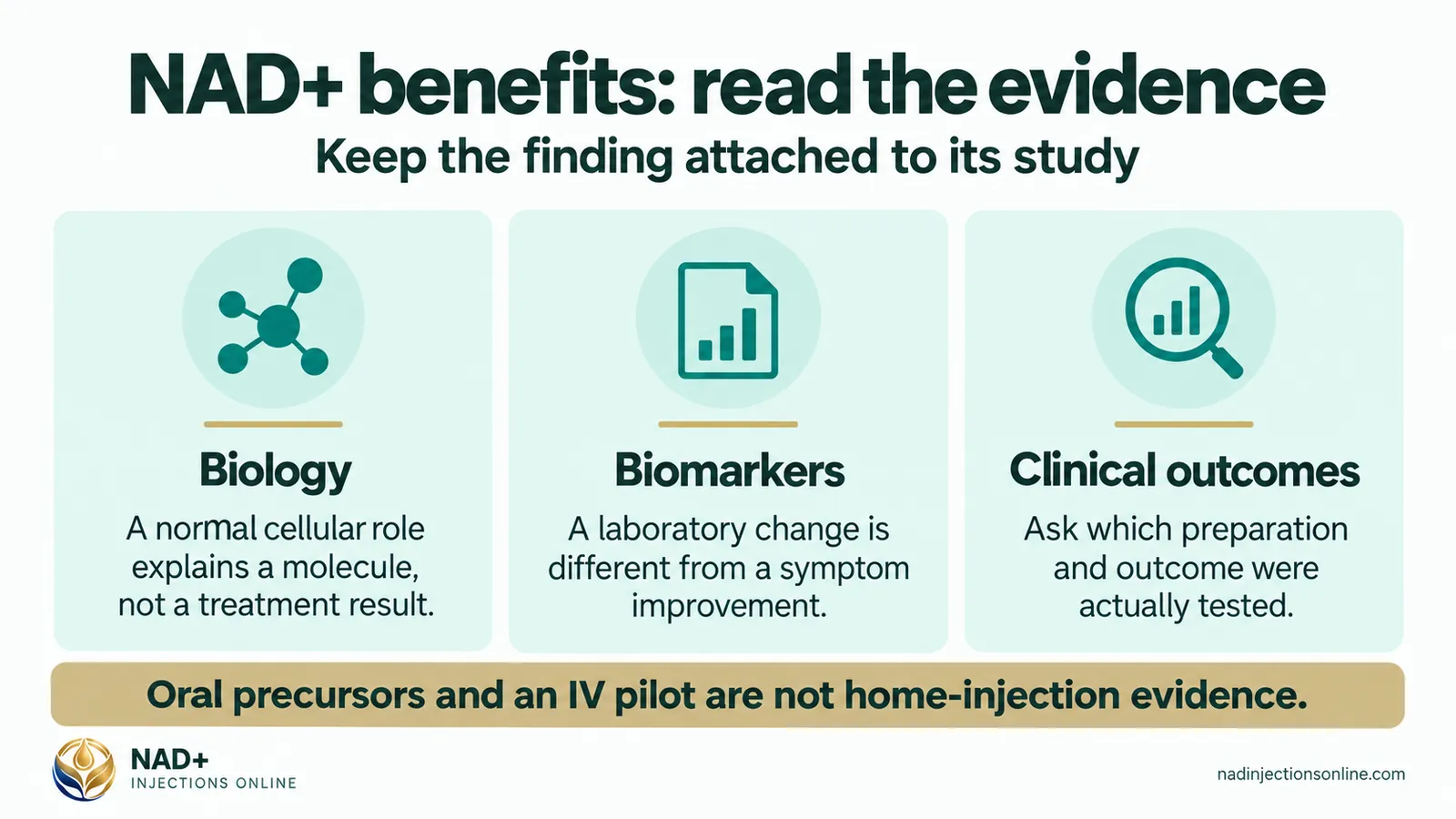
Name the outcome rather than accepting a broad claim about wellness. A biological explanation, a laboratory measurement and a change a person notices are different things. Ask which one the page actually describes. The fact that NAD+ has a normal cellular role does not establish that administering a particular preparation changes the outcome you care about.
Mechanism and clinical benefit require separate explanations. This guide describes the selected sources and their limits without treating them as an exhaustive review of all published research. If a new paper is offered, its preparation, participants, endpoint and limitations need to be assessed before it supports a new claim.
A useful evidence summary names the intervention before the outcome. If a statement begins with NAD research but later refers to an oral precursor, keep that distinction visible. If it refers to an infusion, retain the intravenous route and the measured endpoint. The question is whether the result supports the specific claim being made for the proposed preparation. A broad category label should not erase the details that determine the answer.
NAD+ is a coenzyme found in every living cell, and its levels in many tissues decline with age.1
What can the selected review establish?
The Covarrubias review explains endogenous NAD biology. Its registered statement identifies NAD+ as a coenzyme and describes tissue-level patterns with age. That is background physiology, not a controlled outcome trial of a home prescription. Ask where the proposed treatment claim begins and what additional source supports that step.
A mechanism can explain why a question is scientifically interesting without answering it clinically. Keep the two parts of the explanation separate. You can acknowledge the molecule’s biological importance while still asking what evidence supports the actual preparation for the intended purpose. No list of appealing outcomes should be filled in from mechanism alone.
Ask what would count as meaningful evidence for the outcome you hope to discuss. A plausible mechanism, a laboratory change and a clinical response are different steps in the argument. If the page moves between them, identify where additional support is needed. You do not have to decide that a paper is useless to recognize that it does not answer your question. This makes the conversation more precise than accepting an entire benefit list because one citation is genuine.
In a study of healthy middle-aged and older adults, oral supplementation with an NAD+ precursor (nicotinamide riboside) raised blood NAD+ levels and was well tolerated.2
What did the oral trials actually test?
Martens studied oral nicotinamide riboside in healthy middle-aged and older adults, including blood NAD+ findings and study tolerability. Yoshino studied oral NMN in postmenopausal women with prediabetes and a metabolic endpoint. Neither should be retold as a home NAD+ injection trial or a general symptom treatment.
Keep the population and endpoint beside the result when reading a summary. A statement about one metabolic measurement does not establish every outcome a seller lists nearby. Nor does a limited finding rule out every possible effect in all settings. The useful interpretation stays attached to what the paper actually examined.
When discussing a proposed purpose, ask the physician to describe both the reasoning and its limits. Which finding is directly relevant, which part is an extrapolation and which question remains unanswered? Ask how other evaluations or options relate to the concern you brought. The conversation should begin with that concern and your history, rather than requiring you to choose an outcome from a marketing list. Keep risk and product-quality questions alongside the hoped-for benefit.
A randomized trial in postmenopausal women with prediabetes studied oral NMN and muscle insulin sensitivity, not NAD+ injections or menopause symptom treatment.3
Does the infusion pilot prove a response?
The selected intravenous pilot examined NAD+ and related metabolites in blood and urine. It is not a validated onset or benefit-duration estimate for a home injection. A laboratory measurement after administration does not itself show a particular symptom change. Ask whether the result being advertised was part of the experiment’s actual clinical question.
The paper has safety observations within its small monitored setting, which should not be erased when describing its limits. It also does not establish broad safety or clinical efficacy for other preparations. A balanced summary preserves the observation without promoting it into a general recommendation.
A small pilot study measured how a six-hour intravenous NAD+ infusion changed NAD+ and related metabolites in blood and urine.4
How do I weigh a proposed purpose?
Tell the physician what you want assessed and ask what evidence would be relevant to that concern. Ask whether a different evaluation or option should be considered and what uncertainty remains about NAD+. The decision should not depend on accepting a product’s benefit list before the consultation has even identified the clinical question.
Risk deserves its own discussion alongside the hoped-for outcome. FDA has reported serious events after NAD+ injectable drugs and raised sterile-ingredient concerns. Compounded-product status also has its regulatory limits. Those facts do not decide the prescription for every person, but they belong in an honest explanation rather than being omitted from a benefits page.
- Biology: identify the mechanism or normal role being explained.
- Measurement: ask what endpoint the experiment actually recorded.
- Benefit: identify the additional support needed for the claimed clinical outcome.
What a physician weighs
Put the specific question from this guide into your own words when discussing nad+ benefits. Explain what you want clarified, identify the actual preparation and bring the written information you have been given. Ask the physician to separate what the selected evidence supports from what remains a clinical judgment. If the answer depends on a product detail, ask how that detail will be confirmed with the pharmacist.
Compounded medications are prepared by a licensed pharmacy for an individual patient and are not FDA-approved. No approved label lists its uses or side effects, so the physician works from your history and clinical judgment, tells you what is known and what is uncertain, and sets how often you check in.
Any injectable can cause a reaction at the injection site or an allergic reaction, and NAD+ infusions are known for flushing and nausea when given quickly. Report anything unexpected to the physician the same day, and tell the physician about every medicine and supplement you take before anything is prescribed.
For severe allergic symptoms, including breathing difficulty or throat swelling, seek emergency care and call 911. This emergency advice takes priority over a routine same-day report.
Treatment requires a prescription. A licensed clinician evaluates you by telehealth and decides whether any medication is appropriate.
The current NAD+ product information explains this site’s prescribed pathway. For related questions, read nad injections before and after and nad injection side effects.
NAD injection benefits: common questions
Does NAD+ biology prove injection benefits?
NAD+ has roles in normal cellular processes, but that biological role does not establish the clinical benefit of a particular injection regimen.
Did Martens test home NAD+ injections?
No. Martens studied oral nicotinamide riboside in healthy middle-aged and older adults and measured blood NAD+ and tolerability, rather than home NAD+ injections.
Did Yoshino test menopause symptom treatment?
No. Yoshino studied oral nicotinamide mononucleotide in postmenopausal women with prediabetes and measured muscle insulin sensitivity, rather than menopause symptom treatment.
Does Grant supply a benefits timeline?
No. Grant’s small intravenous pilot measured blood and urine metabolites during an infusion, not the onset or duration of symptom benefits from home injections.
Does this review claim there are no studies anywhere?
No. This guide assesses the named sources and their limits; another paper requires its own applicability and support review.
What should a benefit claim identify?
Ask for the exact ingredient, route, population, clinical outcome and limitations behind the claim. Discuss how those details relate to the concern you want assessed.
Where this guide comes from
The register citations and the public sources behind the text.
Sources (11)
- Covarrubias AJ, Perrone R, Grozio A, Verdin E. NAD(+) metabolism and its roles in cellular processes during ageing. Nat Rev Mol Cell Biol. 2021;22(2):119-141.
- Martens CR, Denman BA, Mazzo MR, et al. Chronic nicotinamide riboside supplementation is well-tolerated and elevates NAD(+) in healthy middle-aged and older adults. Nat Commun. 2018;9(1):1286.
- Yoshino M, Yoshino J, Kayser BD, et al. Nicotinamide mononucleotide increases muscle insulin sensitivity in prediabetic women. Science. 2021;372(6547):1224-1229.
- Grant R, Berg J, Mestayer R, et al. A Pilot Study Investigating Changes in the Human Plasma and Urine NAD+ Metabolome During a 6 Hour Intravenous Infusion of NAD. Front Aging Neurosci. 2019;11:257.
- Martens CR, Denman BA, Mazzo MR, et al. Chronic nicotinamide riboside supplementation is well-tolerated and elevates NAD(+) in healthy middle-aged and older adults. Nat Commun. 2018;9(1):1286. (pubmed.ncbi.nlm.nih.gov)
- Covarrubias AJ, Perrone R, Grozio A, Verdin E. NAD(+) metabolism and its roles in cellular processes during ageing. Nat Rev Mol Cell Biol. 2021;22(2):119-141. (pmc.ncbi.nlm.nih.gov)
- Grant R, Berg J, Mestayer R, et al. A Pilot Study Investigating Changes in the Human Plasma and Urine NAD+ Metabolome During a 6 Hour Intravenous Infusion of NAD. Front Aging Neurosci. 2019;11:257. (frontiersin.org)
- Yoshino M, Yoshino J, Kayser BD, et al. Nicotinamide mononucleotide increases muscle insulin sensitivity in prediabetic women. Science. 2021;372(6547):1224-1229. (pubmed.ncbi.nlm.nih.gov)
- FDA: ingredients suitable for sterile compounding (fda.gov)
- FDA: Compounding questions and answers (fda.gov)
- MedlinePlus: Anaphylaxis (medlineplus.gov)
Put the question to a physician
The guides explain; the physician decides. Start from home, with a wellness consultant explaining the steps and the cost first.
Availability depends on your state: you must be located in a state where an independent physician is licensed to treat you at the time of your consultation. For adults 18 and older. Contacting NAD Injections Online does not guarantee treatment and creates no obligation.