NAD+ injection cost in 2026
How much NAD+ injections cost and what the price includes
NAD+ injection cost depends on the vial, the dose the physician prescribes and what the quote includes. At NAD Injections Online, injectable NAD+ starts at $179 per vial with no membership. Insurance rarely covers compounded NAD+, so most people pay cash or use an HSA card.
NAD+ injections cost should be checked against the current written proposal for your actual prescription and services. Nicotinamide adenine dinucleotide (NAD+) quotes can describe different supply units and encounter formats. This guide helps separate product information, payment terms and coverage questions without reproducing changing amounts or promising reimbursement.
What does the quoted price include?
Read the current product information and ask for the total for the preparation actually proposed to you. Identify whether a quote concerns a vial, an appointment or a broader service arrangement. This site describes the injectable supply by the vial; that unit should not be silently converted into a fixed treatment duration or a universal monthly budget.
Ask separately about evaluation, medication supply, follow-up and any other costs mentioned in the current terms. This is a request for confirmation, not a claim that each item necessarily has a separate charge. A useful written quotation tells you what is included and which conditions could change the proposed total.
If two proposals use different units, leave the difference visible. You can compare what each includes without inventing an equivalent treatment course. Ask the service to explain the quoted unit and the physician to explain any prescribed directions. Avoid using a seller’s assumed schedule to turn a supply description into a personal monthly requirement. A budget estimate should identify its assumptions instead of presenting an unprescribed routine as a necessary purchase.
Telehealth lets patients connect with a healthcare provider remotely; costs depend on the service and coverage.
How should I compare different quotes?
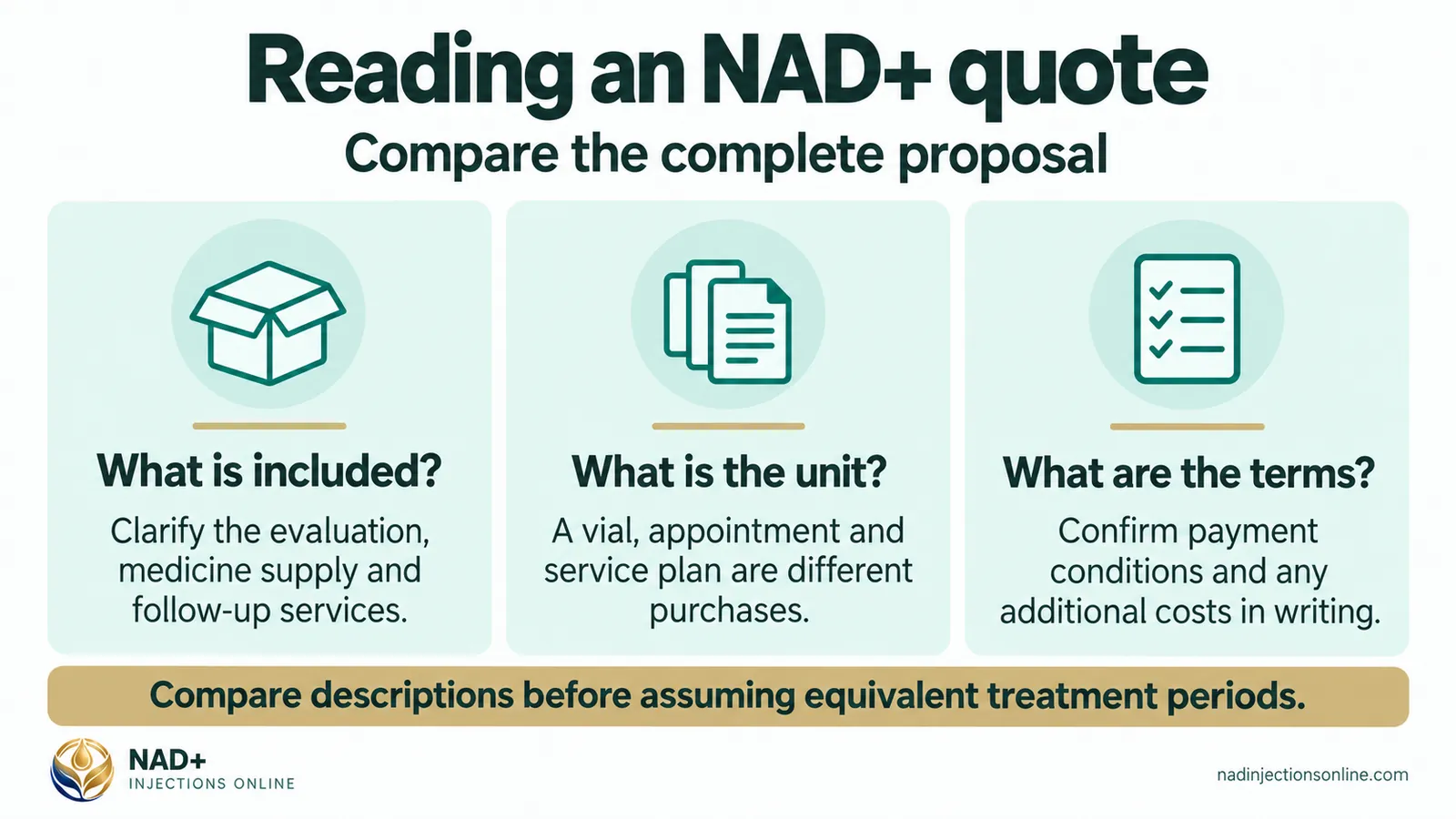
Compare descriptions before comparing figures. A local infusion appointment and a home prescription supply are different purchases. Ask what services, preparation and support each includes. Do not invent a dose or schedule to make them appear equivalent. A comparison can remain useful while acknowledging that the proposals do not describe the same thing.
Save the date and wording of the quote. When you return later, confirm the current terms instead of relying on an old screenshot. A general article can explain the questions to ask, while the current written proposal supplies the transaction details. Keeping those jobs separate avoids repeating a figure after the relevant offer has changed.
Ask what happens between receiving a quote and making a payment. Is the proposed supply still subject to a prescribing decision? When will the current total be confirmed? Which terms apply if the proposal changes? These are transaction questions for the service contact, rather than evidence that treatment will be appropriate. Save the response with the dated quote so you can distinguish the offer you actually received from a general description on an educational page.
Compounded drugs are not FDA-approved; FDA does not verify their safety, effectiveness or quality before marketing.
What should be confirmed before payment?
Ask when payment is collected, what happens if no prescription is recommended and how cancellation or refund terms apply. Ask whether anything repeats automatically and what a later repeat purchase involves. Do not infer continuing terms from an initial promotion. Request the actual conditions in writing if the explanation depends on several separate webpages.
Keep the prescribing decision separate from the payment discussion. A quotation is not a promise of medication, and payment acceptance does not establish clinical suitability. A wellness consultant can explain logistics and current terms, while the independent physician makes the clinical decision. Ask which person can answer each kind of question.
Keep a record of unresolved costs instead of assigning them a value yourself. If shipping, supplies, a later appointment or a changed preparation is not clearly addressed, ask whether it is included and under which conditions. The question does not presume an extra charge. It prevents a comparison from depending on an unstated assumption. You can then discuss affordability using the current proposal rather than a number copied from an unrelated infusion service or an outdated advertisement.
How do insurance and account payments differ?
Ask the insurer about coverage for the actual service and prescription. Ask any account administrator about its own expense and documentation rules. Those are separate questions from whether a merchant accepts a particular payment method. A receipt does not by itself promise reimbursement, and a checkout option does not determine account eligibility.
This guide does not establish the coverage terms of your plan or decide whether a particular claim can be submitted. A provider’s current cash-payment arrangements and a plan’s benefit decision should be checked separately. The insurance companion guide develops the documentation questions without asserting that all plans make the same determination.
What makes a quote useful for planning?
It identifies the quoted unit, preparation, included services and the conditions that could change the total. It also identifies who can answer a later billing question. If the proposal does not explain one of those items, mark it as unanswered rather than assuming the most favorable interpretation. Ask for the missing detail before building a budget around the offer.
Finally, compare promised health outcomes against the evidence instead of treating them as established financial value. A higher or lower price does not establish effectiveness. Ask the physician what supports the intended purpose of the proposed preparation, and ask the relevant service contact to explain the terms. These are different parts of an informed decision.
- Quoted unit: ask whether the proposal concerns supply, an encounter or another service.
- Included terms: confirm the relevant conditions instead of assuming each offer includes the same items.
- Unresolved item: ask for the missing detail before treating the proposal as a complete budget.
If a quote refers to follow-up, ask what that means in the current offer. Does it describe a scheduled encounter, access for routine questions or a review before a later prescription? These are questions to confirm, not services this article promises. Ask who provides the relevant support and how you would obtain it. A clear answer lets you compare the arrangement itself, rather than treating the same general word as proof that two providers include identical care.
What a physician weighs
Put the specific question from this guide into your own words when discussing nad injections cost. Explain what you want clarified, identify the actual preparation and bring the written information you have been given. Ask the physician to separate what the selected evidence supports from what remains a clinical judgment. If the answer depends on a product detail, ask how that detail will be confirmed with the pharmacist.
Compounded medications are prepared by a licensed pharmacy for an individual patient and are not FDA-approved. No approved label lists its uses or side effects, so the physician works from your history and clinical judgment, tells you what is known and what is uncertain, and sets how often you check in.
Any injectable can cause a reaction at the injection site or an allergic reaction, and NAD+ infusions are known for flushing and nausea when given quickly. Report anything unexpected to the physician the same day, and tell the physician about every medicine and supplement you take before anything is prescribed.
For severe allergic symptoms, including breathing difficulty or throat swelling, seek emergency care and call 911. This emergency advice takes priority over a routine same-day report.
Treatment requires a prescription. A licensed clinician evaluates you by telehealth and decides whether any medication is appropriate.
The current NAD+ product information explains this site’s prescribed pathway. For related questions, read does insurance cover nad injections and how nad injections are given.
NAD+ injection cost: common questions
Where can I find current NAD+ pricing?
Ask the current service contact for a written proposal with the included services, payment timing and applicable conditions.
Does a vial quote equal a month of treatment?
A quoted supply does not determine your prescribed schedule or establish a month of treatment. Ask the service to identify the quoted unit without creating your own dosing calculation.
Does a prescription establish insurance coverage?
Do not infer reimbursement from the existence of a prescription. Ask your plan about the actual proposed evaluation and medication, its terms and any required documentation.
Does FDA status answer every coverage question?
FDA describes compounded drugs as not FDA-approved; its compounding explanation is not a determination about your insurance policy. Ask the plan to address the specific expense.
Does accepting an HSA card establish eligibility?
Do not treat a checkout payment option as an eligibility determination. Ask the relevant administrator about its rules and the actual expense.
What should I ask about recurring charges?
Ask what repeats, when payment occurs, what is included and which cancellation or change conditions apply. Keep the written answer with the current proposal.
Where this guide comes from
The register citations and the public sources behind the text.
Sources (4)
- FDA: medicine benefits and risks (fda.gov)
- HHS: telehealth for patients (telehealth.hhs.gov)
- FDA: Compounding questions and answers (fda.gov)
- MedlinePlus: Anaphylaxis (medlineplus.gov)
Put the question to a physician
The guides explain; the physician decides. Start from home, with a wellness consultant explaining the steps and the cost first.
Availability depends on your state: you must be located in a state where an independent physician is licensed to treat you at the time of your consultation. For adults 18 and older. Contacting NAD Injections Online does not guarantee treatment and creates no obligation.