NAD+ and glutathione in 2026: separate products, separate claims
NAD+ and glutathione injections: what each one is
NAD+ and glutathione are separate molecules often marketed together: NAD+ is a coenzyme for energy metabolism and glutathione is an antioxidant. Evidence for combining them is limited, so ask the physician to assess each one on its own.
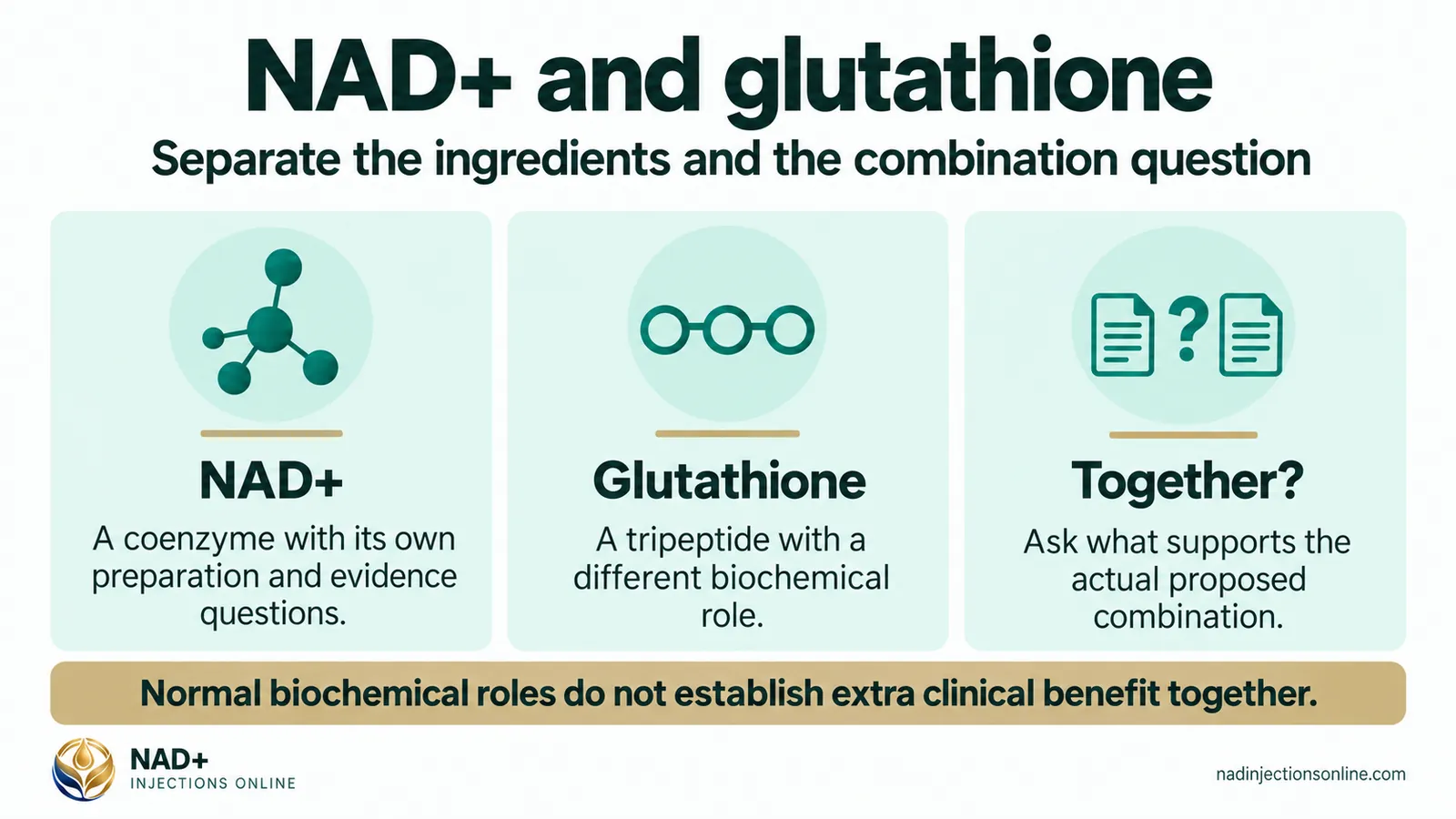
NAD and glutathione are different molecules with different biochemical roles. Nicotinamide adenine dinucleotide (NAD+) is a coenzyme, while glutathione is a tripeptide. Their endogenous roles do not establish extra clinical benefit from receiving them together, or determine the safety of a proposed combination.
If your question concerns prescribed NAD+ injections, explain whether you are asking about an existing product, a proposed second product or a combined preparation. This guide helps keep those situations distinct before an individual evaluation.
Which products are you considering?
Write down the complete names and ingredients rather than describing everything as an injection. Identify which product you currently use and which you are researching. That distinction keeps a clinician from assuming a combination you have not started.
If a website lists both names, ask whether it means separate products or ingredients in one preparation. Do not infer the contents from a package photograph or a broad treatment menu. Request actual product information for the question you want answered.
What if the recommendation is unclear?
Ask the person making it to identify the preparation and intended purpose. If the explanation moves between two separate medicines and one combined product, request clarification. Those are different proposals, even when the same ingredient names appear.
Keep the recommendation’s exact wording available for the consultation. A specific statement is easier to evaluate than a general impression that two products are meant to complement each other.
What is glutathione?
Glutathione is the cell’s main antioxidant, a tripeptide the body makes from three amino acids.1
The Forman review describes glutathione’s biochemical role and synthesis. That identity explanation is not a clinical test of a NAD-and-glutathione regimen. It should not be used to promise a result from adding a prescribed preparation.
Ask which part of a product claim comes from background biology and which comes from research on the actual intervention. A discussion can correctly describe an endogenous molecule while leaving the treatment question unresolved.
Is glutathione another name for NAD+?
No. A tripeptide and a dinucleotide coenzyme are different molecular identities. The references used here support that distinction without establishing interchangeability of products.
The relevant comparison is between the actual preparations and the question you want answered. It should not become an overall ranking of two broad biological roles.
What does NAD+ research establish?
NAD+ is a coenzyme found in every living cell, and its levels in many tissues decline with age.2
The review concerns NAD metabolism and research context. It is not a direct clinical experiment showing added benefit from a NAD-and-glutathione combination. Its biochemical explanation needs to remain separate from a proposed product claim.
The NAD+ benefits evidence guide explains how to read the difference between a mechanism and a clinical outcome. For a combination question, ask the additional question of whether the source tested the actual combined proposal.
Does shared biology establish a useful pairing?
The selected references do not establish extra clinical benefit from receiving NAD+ and glutathione together. Their accounts of endogenous roles do not replace evidence about a proposed treatment combination.
Ask for the result being claimed in plain language. Then ask what experiment measured that result with the actual preparations. The answer should not require you to assume that two background references describe a combined intervention.
What does together mean in practice?
Together can refer to an interest in two ingredients, separate products in a proposed regimen or several ingredients in one finished preparation. Clarify which situation applies before requesting advice. Otherwise, an answer to a general literature question may be mistaken for an instruction about your medicines.
Keep the product information organized so each preparation is identifiable. If the proposal changes during the discussion, ask which information still applies. A clear product description matters more than a broad category label.
Can separate references validate a blend?
The reviewed molecular references do not test the clinical effects of a particular NAD-and-glutathione blend. Putting separate sources beside each other does not establish that the combined preparation was studied.
Ask which evidence concerns the complete proposed product. If the response only addresses one ingredient at a time, request a separate explanation of the combination. A reasonable discussion should acknowledge that remaining question rather than imply it has already been answered.
What would make evidence relevant?
Look for the exact ingredients, preparation, route, study participants and measured endpoint. Compare those details with the claim that led you to the page. If they differ, ask what can still be concluded and what remains an inference.
A source about a biological mechanism can provide background. A source about another product can offer context. Neither should silently become a direct test of your proposed preparation. Keeping the scope visible is more useful than counting references.
What if a seller uses complementary wording?
Ask what that word means in the specific claim. It could describe a general story about different biological roles rather than a measured clinical result. Request the endpoint and the evidence instead of supplying your own interpretation.
You can leave the question open when product-specific support has not been supplied. That is different from declaring that every possible combination must be ineffective. A careful answer states which conclusion the reviewed sources do not establish.
Which safety questions need attention?
FDA advises reviewing medicines and supplements with a physician or pharmacist before adding another product. That general guidance does not establish a NAD-and-glutathione regimen as interaction-free. The actual products and other medicines belong in the evaluation.
FDA reports of severe chills, shaking, vomiting and fatigue after NAD+ injectable drugs prompted a reminder about ingredients suitable for sterile compounding. Some reports required medical treatment. The reports do not establish a reliable reaction rate or show that every preparation has the same risk.
What information should I prepare?
Bring complete labels, a list of your current medicines and the reason you are considering the proposed addition. Mention whether a recommendation concerns separate preparations or one combined product. Ask who can address any product-specific uncertainty.
The NAD+ side-effects guide provides fuller context for reported reactions. This combination guide cannot assess a reaction or replace an individual safety discussion.
What does a physician weigh?
Ask the clinician to explain the purpose of considering each product separately. Then ask what supports the combined proposal and which questions remain unresolved. A consultation should connect the evidence to your actual reason for asking rather than rely on a general biochemical theme.
Compounded medications are prepared by a licensed pharmacy for an individual patient and are not FDA-approved. No approved label lists its uses or side effects, so the physician works from your history and clinical judgment, tells you what is known and what is uncertain, and sets how often you check in.
Any injectable can cause a reaction at the injection site or an allergic reaction, and NAD+ infusions are known for flushing and nausea when given quickly. Report anything unexpected to the physician the same day, and tell the physician about every medicine and supplement you take before anything is prescribed.
For severe allergic symptoms such as breathing difficulty or throat swelling, seek emergency care and call 911. Emergency care takes priority over a routine same-day report.
The infusion reference above is not a measured reaction rate for a NAD-and-glutathione combination.
Treatment requires a prescription. A licensed clinician evaluates you by telehealth and decides whether any medication is appropriate. Booking does not guarantee a prescription.
NAD and glutathione: common questions
Are the two molecules identical?
No. Glutathione is a tripeptide and NAD+ is a dinucleotide coenzyme.
Does normal biology establish added benefit?
The selected biochemical references do not establish additional clinical benefit from receiving the two together.
Is a combined vial the same question?
Identify whether you mean separate products or one combined preparation. Ask for information about the actual proposal.
Are interactions ruled out by these sources?
General medicine-safety guidance does not establish a specific combination as interaction-free.
Does the FDA alert give an incidence?
The reported events do not provide a reliable rate for every NAD+ preparation.
What should the consultation address first?
Explain which products you mean and why you are considering them. Ask for the rationale for each before discussing the combination.
Where this guide comes from
The register citations and the public sources behind the text.
Sources (10)
- Forman HJ, Zhang H, Rinna A. Glutathione: overview of its protective roles, measurement, and biosynthesis. Mol Aspects Med. 2009;30(1-2):1-12.
- Covarrubias AJ, Perrone R, Grozio A, Verdin E. NAD(+) metabolism and its roles in cellular processes during ageing. Nat Rev Mol Cell Biol. 2021;22(2):119-141.
- Forman HJ, Zhang H, Rinna A. Glutathione: overview of its protective roles, measurement, and biosynthesis. Mol Aspects Med. 2009;30(1-2):1-12. (pmc.ncbi.nlm.nih.gov)
- Covarrubias AJ, Perrone R, Grozio A, Verdin E. NAD(+) metabolism and its roles in cellular processes during ageing. Nat Rev Mol Cell Biol. 2021;22(2):119-141. (pmc.ncbi.nlm.nih.gov)
- FDA: Drug interactions (fda.gov)
- FDA: ingredients suitable for sterile compounding (fda.gov)
- FDA: Compounding questions and answers (fda.gov)
- Grant R, Berg J, Mestayer R, et al. A Pilot Study Investigating Changes in the Human Plasma and Urine NAD+ Metabolome During a 6 Hour Intravenous Infusion of NAD. Front Aging Neurosci. 2019;11:257. (frontiersin.org)
- FDA: buying medicine online (fda.gov)
- MedlinePlus: Anaphylaxis (medlineplus.gov)
Put the question to a physician
The guides explain; the physician decides. Start from home, with a wellness consultant explaining the steps and the cost first.
Currently available to adults physically located in Florida at the time of their consultation. For adults 18 and older. Contacting NAD Injections Online does not guarantee treatment and creates no obligation.