Liposomal NAD+ in 2026: what the research says
Liposomal NAD+ explained: ingredient, absorption and evidence
Liposomal NAD+ is NAD+ wrapped in tiny fat-based spheres meant to help it survive digestion. Lab studies show liposomes can carry NAD+ into cells, but human data on oral liposomal NAD+ raising blood levels is limited, so treat absorption claims with care.

Liposomal NAD+ describes NAD+ enclosed in liposomes made from lipid bilayers. Nicotinamide adenine dinucleotide (NAD+) was tested in a laboratory liposomal preparation in cultured human cells and skin explants, rather than in people taking a commercial oral product. That study cannot establish an oral supplement’s clinical results or the effects of a prescribed injection.
If you are comparing a product with prescribed NAD+ injections, bring its complete ingredient information. This guide helps you identify which questions concern the molecule, which concern the formulation and which concern the evidence.
What ingredient is actually listed?
Start with the ingredient panel, even if the title prominently says NAD. Write down the complete name rather than relying on the abbreviation. If the product lists multiple ingredients, keep them all in the question you take to the clinician or pharmacist.
Ask whether the seller is naming the supplied ingredient or describing a pathway involving NAD. Those are different kinds of information. A product page can discuss the body’s use of a molecule without containing that molecule itself.
How do precursors differ?
NMN and NR are distinct NAD-related precursors, while NAD+ is the coenzyme itself. Their relationship in NAD metabolism does not make every preparation interchangeable. The source used for a product claim should identify the molecule actually studied.
The NMN-versus-NAD guide addresses that naming distinction in more detail. For a liposomal product, the first practical step remains the same: identify the full ingredient before evaluating a delivery description.
If a website uses different names in different places, ask which one applies to the product being supplied. Preserve the wording that confused you so the answer can address a specific discrepancy.
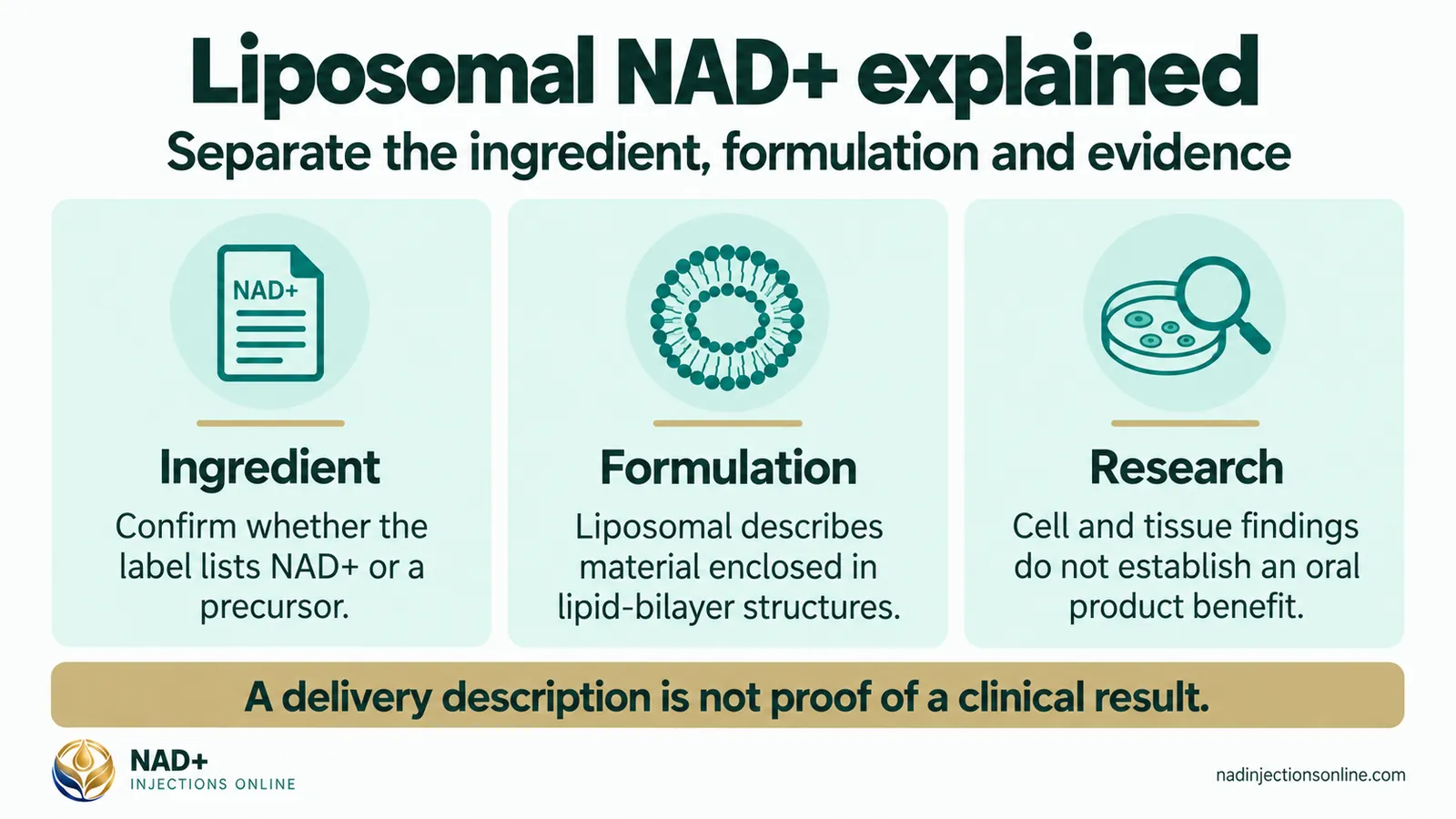
What does liposomal add to the name?
Liposomal describes the experimental formulation in the reviewed laboratory study. It does not change the need to identify the underlying ingredient and the route used. The study compared a particular liposomal NAD+ preparation with NAD+ alone in its experimental setting.
Ask what formulation the product uses and what evidence concerns that formulation. A general statement about liposomal technology should not be assumed to validate every product using the word. The connection between the actual label and the cited experiment should be made explicit.
Does a delivery description prove benefit?
It does not answer the clinical question by itself. Ask what result was measured and whether it is the result you mean. A comparison about a formulation can leave a question about a noticeable clinical effect unanswered.
Keep these distinctions visible in your notes:
- Ingredient: the specific molecule listed.
- Formulation: how the preparation is described.
- Route: how the product is intended to be administered.
- Research: what preparation the source actually tested.
- Claim: what result the page says you should expect.
These labels are a way to organize questions. They are not a certificate of product quality or suitability.
What did the laboratory work examine?
A laboratory study compared liposomal NAD+ with NAD+ alone in cultured human cells and skin explants, rather than testing an oral supplement or injection in patients.1
The reviewed experiment included cultured vascular endothelial cells, epidermal keratinocytes and skin outside the body. Those models are not people swallowing a supplement or receiving a prescribed injection. The setting must remain part of the explanation.
Look for the experimental model when you read a summary. The phrase human cells can sound like a human clinical trial if the surrounding description leaves out the laboratory setting. Ask whether people were participants or whether the work used cells of human origin.
Can I apply the findings to my product?
The study does not establish human oral absorption of a commercial product, clinical effects of a home injection or performance of a passive patch. Its formulation and experimental application differ from those preparations.
Ask the seller or clinician to explain the evidence connection for the actual product. An answer can acknowledge an interesting laboratory finding while saying that a patient-facing question remains open. That is a more useful explanation than treating the product name as the missing connection.
The guide to NAD+ research and benefits explains broader evidence differences. Here, the narrow point is that an experimental liposomal preparation is not automatically the commercial preparation you are considering.
Do oral studies answer the question?
In a study of healthy middle-aged and older adults, oral supplementation with an NAD+ precursor (nicotinamide riboside) raised blood NAD+ levels and was well tolerated.2
The Martens trial used oral nicotinamide riboside, a precursor, rather than an oral liposomal NAD+ product. Its blood measurements and tolerability finding belong to that preparation. They cannot establish the result of every product with NAD in its title.
The oral precursor trial and the liposomal laboratory work are separate experiments. Putting the references beside each other does not create a human trial of an oral liposomal NAD+ preparation.
What if a page combines several references?
Ask which reference supports each specific claim. One source may explain a molecule and another may describe a different delivery system. If no source tests the complete preparation and result being advertised, that missing evidence should remain clear.
You can make the question concrete by naming the claim and the product. Ask whether the source used the same ingredient and administration route. If the answer concerns a different preparation, request a plain explanation of what can and cannot be concluded.
Do not assume that a longer reference list is automatically a closer evidence match. Relevance depends on what the studies actually tested, not just how many titles appear at the bottom of a page.
How can I compare an injection?
Compare the evidence questions rather than assuming one route wins. Identify the product on each side, the intended purpose and the source being used to support it. If the preparations differ, ask the clinician how that difference limits the comparison.
An uncertain claim about an oral product does not itself establish a reason to receive a prescription. Explain your interest in your own words and ask whether the proposed preparation is relevant to that concern. A format preference and an outcome expectation should be discussed separately.
Which information should I bring?
Bring the complete label, the product page that prompted your question and a list of what you already take. Explain whether you have used the product or are only considering it. Those details help avoid a conversation based on an assumed regimen.
Ask for clarification if the explanation changes between NAD+, NMN, NR and a blend. You should know which ingredient the answer concerns at each point. The goal is a product-specific discussion, rather than a broad promise about the entire NAD-related category.
What does a physician weigh?
Ask what the clinician considers known about the preparation, what remains uncertain and why it is being discussed in your evaluation. A clear explanation can remain useful even when the evidence does not provide a simple product ranking.
Compounded medications are prepared by a licensed pharmacy for an individual patient and are not FDA-approved. No approved label lists its uses or side effects, so the physician works from your history and clinical judgment, tells you what is known and what is uncertain, and sets how often you check in.
Any injectable can cause a reaction at the injection site or an allergic reaction, and NAD+ infusions are known for flushing and nausea when given quickly. Report anything unexpected to the physician the same day, and tell the physician about every medicine and supplement you take before anything is prescribed.
For severe allergic symptoms such as breathing difficulty or throat swelling, seek emergency care and call 911. Emergency care takes priority over a routine same-day report.
The infusion reference in that wording does not establish a reaction rate for an oral liposomal product or a home injection.
Treatment requires a prescription. A licensed clinician evaluates you by telehealth and decides whether any medication is appropriate. Booking does not guarantee a prescription.
Liposomal NAD+: common questions
Does liposomal identify the ingredient?
Read the complete ingredient name. The formulation word alone is not a full product description.
Is every liposomal NAD+ product NMN?
NMN and NAD+ are distinct molecules. Check which one the actual product lists.
Did the reviewed liposomal paper treat people?
It studied cells and skin explants, rather than testing a commercial supplement or injection in patients.
Does oral NR evidence apply automatically?
No. The selected trial studied oral NR, not every NAD-labelled formulation.
Should I choose an injection instead?
Ask whether a prescribed preparation is appropriate for your reason for considering it. Uncertainty about one product does not establish superiority of another.
What is the best question for the seller?
Ask which study tested the exact ingredient, formulation, route and result described in the claim.
Where this guide comes from
The register citations and the public sources behind the text.
Sources (10)
- Ministrini S, Liberale L, Erle HE, et al. A Liposomal Formulation Enhances the Anti-Senescence Properties of Nicotinamide Adenine-Dinucleotide (NAD(+)) in Endothelial Cells and Keratinocytes. Curr Issues Mol Biol. 2025;47(9).
- Martens CR, Denman BA, Mazzo MR, et al. Chronic nicotinamide riboside supplementation is well-tolerated and elevates NAD(+) in healthy middle-aged and older adults. Nat Commun. 2018;9(1):1286.
- Ministrini S, Liberale L, Erle HE, et al. A Liposomal Formulation Enhances the Anti-Senescence Properties of Nicotinamide Adenine-Dinucleotide (NAD(+)) in Endothelial Cells and Keratinocytes. Curr Issues Mol Biol. 2025;47(9). (pubmed.ncbi.nlm.nih.gov)
- Covarrubias AJ, Perrone R, Grozio A, Verdin E. NAD(+) metabolism and its roles in cellular processes during ageing. Nat Rev Mol Cell Biol. 2021;22(2):119-141. (pmc.ncbi.nlm.nih.gov)
- Martens CR, Denman BA, Mazzo MR, et al. Chronic nicotinamide riboside supplementation is well-tolerated and elevates NAD(+) in healthy middle-aged and older adults. Nat Commun. 2018;9(1):1286. (pubmed.ncbi.nlm.nih.gov)
- FDA: Compounding questions and answers (fda.gov)
- Grant R, Berg J, Mestayer R, et al. A Pilot Study Investigating Changes in the Human Plasma and Urine NAD+ Metabolome During a 6 Hour Intravenous Infusion of NAD. Front Aging Neurosci. 2019;11:257. (frontiersin.org)
- FDA: Drug interactions (fda.gov)
- FDA: buying medicine online (fda.gov)
- MedlinePlus: Anaphylaxis (medlineplus.gov)
Put the question to a physician
The guides explain; the physician decides. Start from home, with a wellness consultant explaining the steps and the cost first.
Availability depends on your state: you must be located in a state where an independent physician is licensed to treat you at the time of your consultation. For adults 18 and older. Contacting NAD Injections Online does not guarantee treatment and creates no obligation.