NAD+ injections for women in 2026
NAD+ for women: product claims and prescribing questions
NAD+ injections for women use the same prescribed product as for men; there is no female-specific formula. Claims about skin, energy or menopause are not proven, and pregnancy or breastfeeding rules it out, so a physician reviews your history first.

NAD for women is a product category description, not evidence that a particular injection addresses a particular concern. Nicotinamide adenine dinucleotide (NAD+) differs from the oral NMN used in a selected women’s trial. Before considering a prescription, identify the proposed preparation and ask what its evidence actually measures.
- Study population: postmenopausal women with prediabetes in the selected NMN trial.
- Tested product: oral NMN, rather than a home NAD+ injection.
- Measured question: metabolic outcomes, rather than a general women’s benefits package.
- Prescription discussion: the actual ingredient, your history and the reason for considering it.
Read the product name first
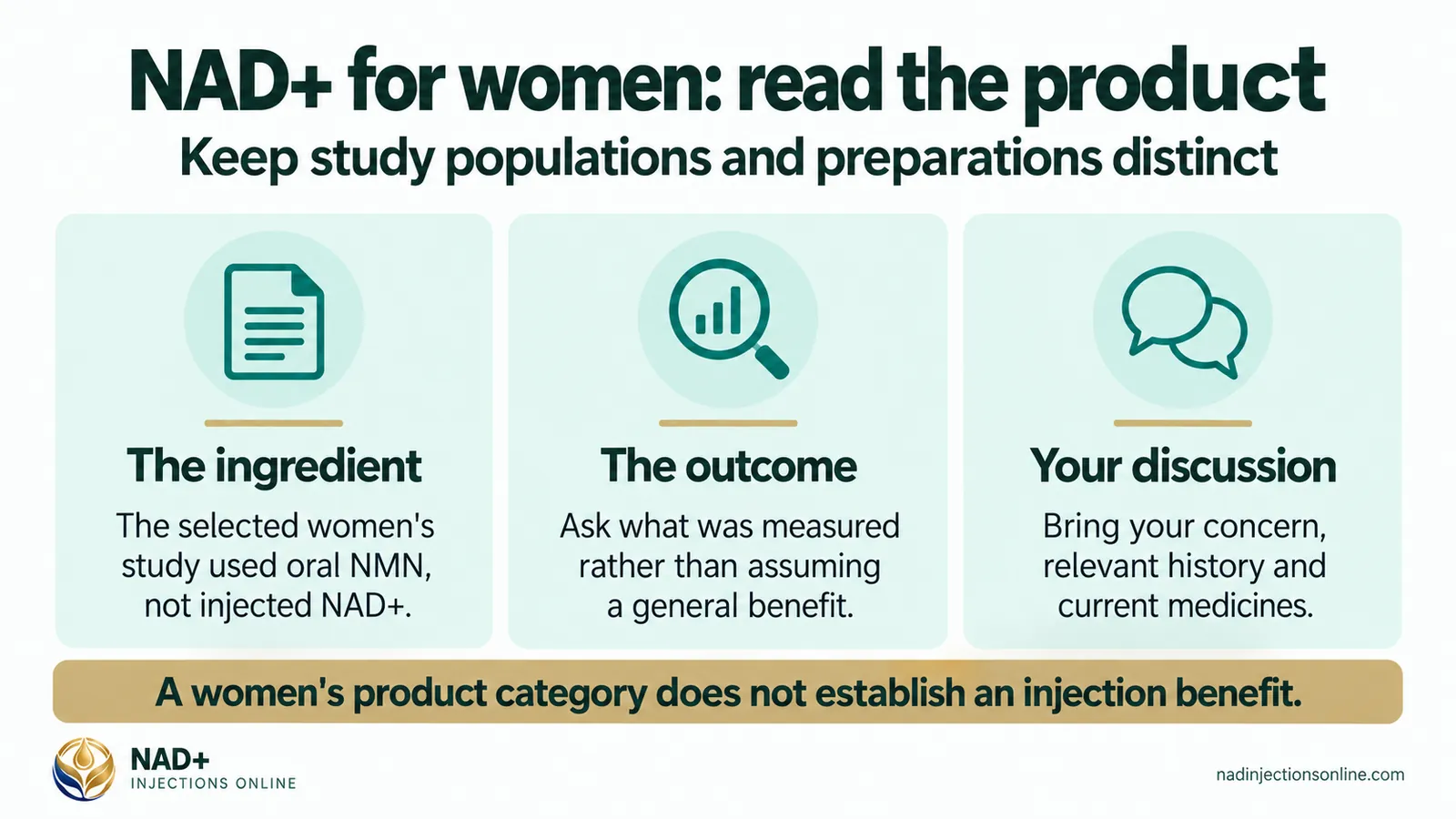
Identify the ingredient and route before deciding whether a study describes the product in front of you. The selected women’s trial used oral NMN. Another selected human trial used oral NR. Neither preparation should be relabeled as a dispensed NAD+ injection.
Ask for the complete proposed product name rather than a category such as women’s wellness. If several ingredients are listed, write them down separately. A study of one ingredient by one route does not explain a different preparation simply because both descriptions mention NAD.
The product name can be recorded alongside the question you want answered. This makes a practical comparison possible: does the reference concern that ingredient, that route and the same intended outcome? If one of those elements differs, ask the clinician to explain the boundary.
Use the prescribed NAD+ overview for the wider prescribing context. Keep a product’s identity separate from a claim that it produces a benefit for women as a group.
Understand the women’s study
The selected Yoshino study evaluated oral NMN in postmenopausal women with prediabetes. Its focus included muscle insulin sensitivity. This is useful population-specific research information, but it is not a home NAD+ injection study.
Being postmenopausal was a participant characteristic, not proof that the intervention treats all concerns a postmenopausal person might raise. The endpoint matters as much as the population. Ask for the full study description when a claim says only that a product was tested in women.
A careful summary keeps a metabolic measurement separate from a symptom claim. It also avoids declaring that every related question is settled in the opposite direction. This guide draws a boundary around the selected evidence rather than claiming to summarize every possible publication.
Before connecting the paper to a product decision, ask what part of it is relevant. The clinician may explain its role as background evidence and identify a remaining uncertainty. That is different from presenting the study as a direct trial of the prescribed preparation.
Separate symptoms from a product category
Begin the conversation with the concern that led you to search, then ask what assessment it needs. FDA recommends understanding why a medicine is being considered and what benefits and risks are expected. A broad product category does not supply that explanation.
Describe the timing, context and existing evaluation of the concern in your own words. If a hormone treatment is part of the discussion, identify it separately. The selected oral NMN study does not establish NAD+ injections as a treatment for menopause symptoms.
Ask how the proposed outcome would be assessed. A laboratory measurement and an experience in daily life answer different questions; neither should silently stand in for the other. Your question is easier to address when the hoped-for outcome is stated plainly.
Do not borrow another person’s reported experience as a response schedule. Ask what uncertainty means for the proposed decision and when to contact the prescriber with questions. The duration guide keeps body handling, observation periods and noticeable effects separate.
Bring the full medicine picture
Provide all prescription medicines, over-the-counter products and supplements before adding another preparation. FDA’s interaction guidance supports a review of the complete list. A general guide cannot determine whether an individual’s combination is suitable.
Include product labels when possible so the professional can see actual ingredients rather than abbreviated category names. Explain whether products are taken separately or are described as a combined preparation. Do not assume a women’s product label establishes compatibility with an existing regimen.
Pregnancy, plans for pregnancy and breastfeeding belong in this discussion before a treatment decision. FDA advises discussing medicines and supplements with a health professional in those circumstances. A study in nonpregnant postmenopausal participants cannot answer pregnancy or lactation questions.
Ask who should coordinate any unresolved question with existing care. The pregnancy and breastfeeding guide explains the limits of the selected evidence. Do not use a product’s natural presence in the body as a substitute for that assessment.
Keep preparation safety in view
Compounded medications are prepared by a licensed pharmacy for an individual patient and are not FDA-approved. No approved label lists its uses or side effects, so the physician works from your history and clinical judgment, tells you what is known and what is uncertain, and sets how often you check in.
Any injectable can cause a reaction at the injection site or an allergic reaction, and NAD+ infusions are known for flushing and nausea when given quickly. Report anything unexpected to the physician the same day, and tell the physician about every medicine and supplement you take before anything is prescribed.
Treatment requires a prescription. A licensed clinician evaluates you by telehealth and decides whether any medication is appropriate. Booking does not guarantee a prescription.
FDA reports of NAD injectable drugs include severe chills, shaking, vomiting and fatigue, with some patients needing medical treatment. Its reminder to compounders concerns unsuitable ingredients and possible excessive endotoxins. Those reports do not provide a women’s reaction rate or establish the cause of every event.
Ask how to contact the pharmacy about the supplied preparation and how to contact the prescriber about unexpected effects. Keep the label and dispensing information available for that conversation. Product preparation and an advertised benefit require different evidence.
Call 911 for breathing difficulty, throat swelling or other severe allergic symptoms. A nonemergency question should go to the responsible professional with the actual product information. A benefit claim should not be used to reinterpret an unexpected effect as a desirable response.
When a product is described as supported by women’s research, ask whether the reference matches both the ingredient and the intended result. The selected study used oral NMN and a metabolic endpoint in postmenopausal women with prediabetes. A shared audience description does not make those details match an injected preparation for another concern. Bring the full claim, rather than only the product category, to the prescribing discussion.
Ask for a clear evidence explanation
An explanation should identify whether it rests on physiology, a blood marker or a clinical outcome. In a study of healthy middle-aged and older adults, oral supplementation with an NAD+ precursor (nicotinamide riboside) raised blood NAD+ levels and was well tolerated. That oral result does not identify what an individual will notice from injected NAD+.
Ask the clinician to name the question the selected source actually answers. If the source is indirect, ask why it is being considered relevant and what remains uncertain. This helps distinguish a reasoned prescribing discussion from a broad audience-based claim.
Keep the practical questions focused on purpose, product identity, existing medicines and follow-up. FDA’s medicine-use guidance supports discussing expected effects and risks before a decision. An article can help organize those questions while leaving the individual assessment to the treating professional.
What a physician weighs
Bring a specific concern rather than assuming that a women’s product category defines the appropriate treatment. Ask the physician to explain the proposed ingredient and route, the applicable study outcome, the remaining uncertainty and the information needed from your existing care.
NAD for women: common questions
Is oral NMN the same preparation as injected NAD+?
No. The selected women’s trial tested oral NMN, while this guide’s prescribing questions concern an NAD+ injection. The study should retain its original ingredient and route.
Were the selected participants pregnant?
The selected NMN study involved postmenopausal women with prediabetes. It does not resolve pregnancy or breastfeeding safety questions for a proposed NAD+ preparation.
Does a women’s label establish a benefit?
An audience description does not identify a measured outcome. Ask which study supports the specific preparation and concern being discussed.
Can I rely on a blood marker alone?
The selected oral NR study reported a rise in blood NAD+ levels. That biomarker finding does not establish a noticeable benefit from a different injected preparation.
Should I disclose supplements too?
Yes. FDA advises reviewing prescription medicines, nonprescription products and supplements when considering interactions. Bring actual ingredient names.
Where do I raise a new reaction?
Report unexpected effects to the prescriber as directed. Severe allergic symptoms, including difficulty breathing or throat swelling, require emergency care; call 911.
A useful NAD discussion starts with the reason for considering the product and a clear explanation of how the evidence fits that reason.
Where this guide comes from
The register citations and the public sources behind the text.
Sources (9)
- Covarrubias AJ, Perrone R, Grozio A, Verdin E. NAD(+) metabolism and its roles in cellular processes during ageing. Nat Rev Mol Cell Biol. 2021;22(2):119-141. (pmc.ncbi.nlm.nih.gov)
- Yoshino M, Yoshino J, Kayser BD, et al. Nicotinamide mononucleotide increases muscle insulin sensitivity in prediabetic women. Science. 2021;372(6547):1224-1229. (pubmed.ncbi.nlm.nih.gov)
- Martens CR, Denman BA, Mazzo MR, et al. Chronic nicotinamide riboside supplementation is well-tolerated and elevates NAD(+) in healthy middle-aged and older adults. Nat Commun. 2018;9(1):1286. (pubmed.ncbi.nlm.nih.gov)
- FDA: Medicine and Pregnancy (fda.gov)
- FDA: Drug interactions (fda.gov)
- FDA: medicine benefits and risks (fda.gov)
- FDA: Compounding questions and answers (fda.gov)
- FDA: ingredients suitable for sterile compounding (fda.gov)
- MedlinePlus: Anaphylaxis (medlineplus.gov)
Put the question to a physician
The guides explain; the physician decides. Start from home, with a wellness consultant explaining the steps and the cost first.
Currently available to adults physically located in Florida at the time of their consultation. For adults 18 and older. Contacting NAD Injections Online does not guarantee treatment and creates no obligation.