How long do NAD+ injections last? 2026 guide
How long NAD+ injections take to work and how long effects last
How long NAD+ injections last is not well established. Studies show blood NAD+ levels rise within hours of a dose and fall back over the following days, but how that feels varies, so the physician sets your schedule and reviews it at check-ins.
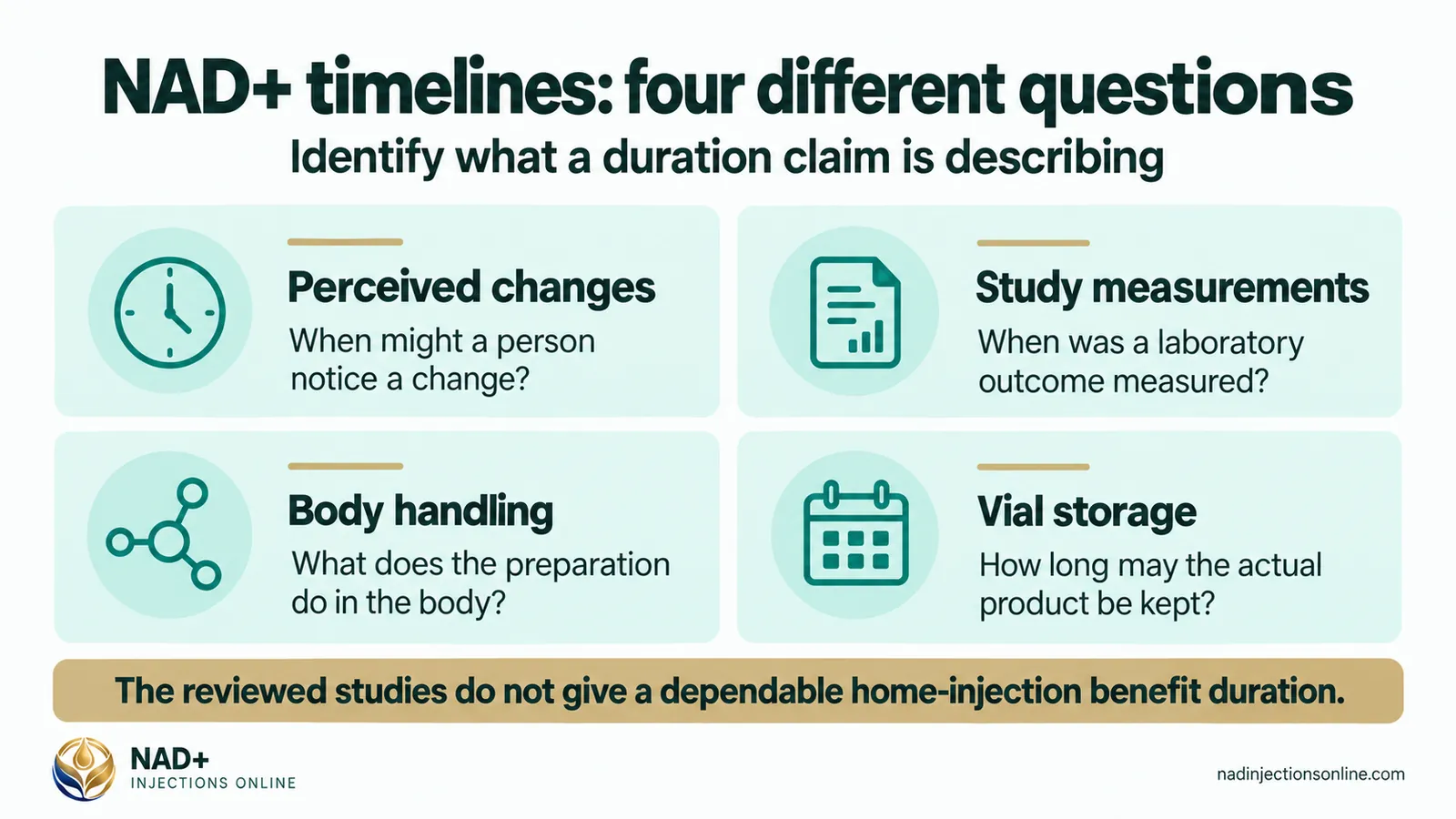
How long do NAD injections last? The studies reviewed here do not supply a dependable duration of symptom benefits for a home NAD+ prescription. Nicotinamide adenine dinucleotide (NAD+) research also measures things other than how a person feels. Ask whether a claim concerns a perceived change, a laboratory measurement, body handling or vial storage.
- A perceived effect: ask which symptom or daily activity is being discussed.
- A laboratory result: identify the compound, specimen and collection time.
- A prescription schedule: follow the directions supplied for your own product.
- A storage date: use the pharmacy label, independently of any benefit claim.
Which timeline are you asking about?
Name the question before looking for a number. You may be asking how soon something could be noticed, how long a change could persist, how the body handles the ingredient or how long a vial can be kept. One answer cannot address all four without evidence for each.
That distinction is useful when a page uses ‘lasts’ repeatedly but changes its meaning. It may begin with a person’s expectations and end with a blood-sampling interval. Read the sentence before and after the timing claim to see whether the endpoint has stayed the same.
If your concern is fatigue, describe fatigue rather than simply saying you want more NAD. If your concern is storage, describe the product and its label instead. A specific question gives the physician or pharmacist something concrete to address without guessing which internet claim you have in mind.
The NAD+ prescription overview explains how the evaluation and dispensed preparation fit together. This guide focuses on interpreting duration claims; it does not provide an instruction to use a medicine for a certain period or to expect a response by a deadline.
What does the infusion paper actually say?
The Grant paper describes a small IV metabolite pilot. Its researchers observed NAD+ and related compounds in blood and urine around a continuing infusion. That is relevant to the scientific question they asked, but it is different from measuring how long a home injection relieves a symptom.
A small pilot study measured how a six-hour intravenous NAD+ infusion changed NAD+ and related metabolites in blood and urine. Keep the word intravenous attached to that finding. Removing it makes the description sound as though every injectable route was studied when the cited preparation used a particular route.
Researchers also watched for adverse events. That observation should not be erased, but it does not turn the paper into proof of a predictable benefit. The useful interpretation is that it provides limited, route-specific information and leaves your symptom-duration question unanswered by this particular study.
If someone quotes the paper as a duration guide, ask them to show the endpoint they are referring to. Was it an observation in a sample or a measured patient benefit? An answer should connect the claim to the actual observation rather than only to the paper’s title.
Why do capsules appear in injection searches?
Oral-precursor research is often discussed under the broader NAD heading. Nicotinamide riboside is a precursor, rather than the finished NAD+ molecule in an injectable preparation. Its human study therefore needs to remain identified as oral NR research whenever it is used to explain the evidence.
In a study of healthy middle-aged and older adults, oral supplementation with an NAD+ precursor (nicotinamide riboside) raised blood NAD+ levels and was well tolerated. That statement identifies a biomarker and tolerability within the study. It does not tell a person how long a home NAD+ injection will produce a noticeable effect.
A longer observation period in a capsule experiment is not an instruction to continue injections for that same period. Nor can a supplement’s suggested use establish how a physician should prescribe a different formulation. Ask which ingredient was actually tested before using a study to support a decision.
The comparison of injections and supplements discusses those product categories more fully. For a duration question, the main point is to retain the molecule, route and outcome instead of collecting unrelated timelines under one label.
Can ‘in your system’ explain duration?
Not by itself. A statement about a measured compound in blood or urine does not establish how long a person experiences a clinical effect. The selected IV pilot cannot provide one clearance or benefit-duration rule for every preparation that uses NAD-related language.
Ask what ‘in your system’ means in the explanation. Is the author referring to the administered molecule, a breakdown product, an observation in a specimen or a proposed downstream effect? If the source does not match the statement, the number is not a useful answer to your personal question.
Do not use a claimed short duration as a reason to take the medicine more often. If the directions are unclear, ask the prescriber or pharmacist to explain them. Changing use to match an online estimate creates a prescribing decision without resolving the evidence behind the estimate.
Storage is a different matter again. A medicine sitting in its container is not a clinical effect in the body. The storage guide directs that question back to the actual label and dispensing pharmacy.
How can I prepare for a check-in?
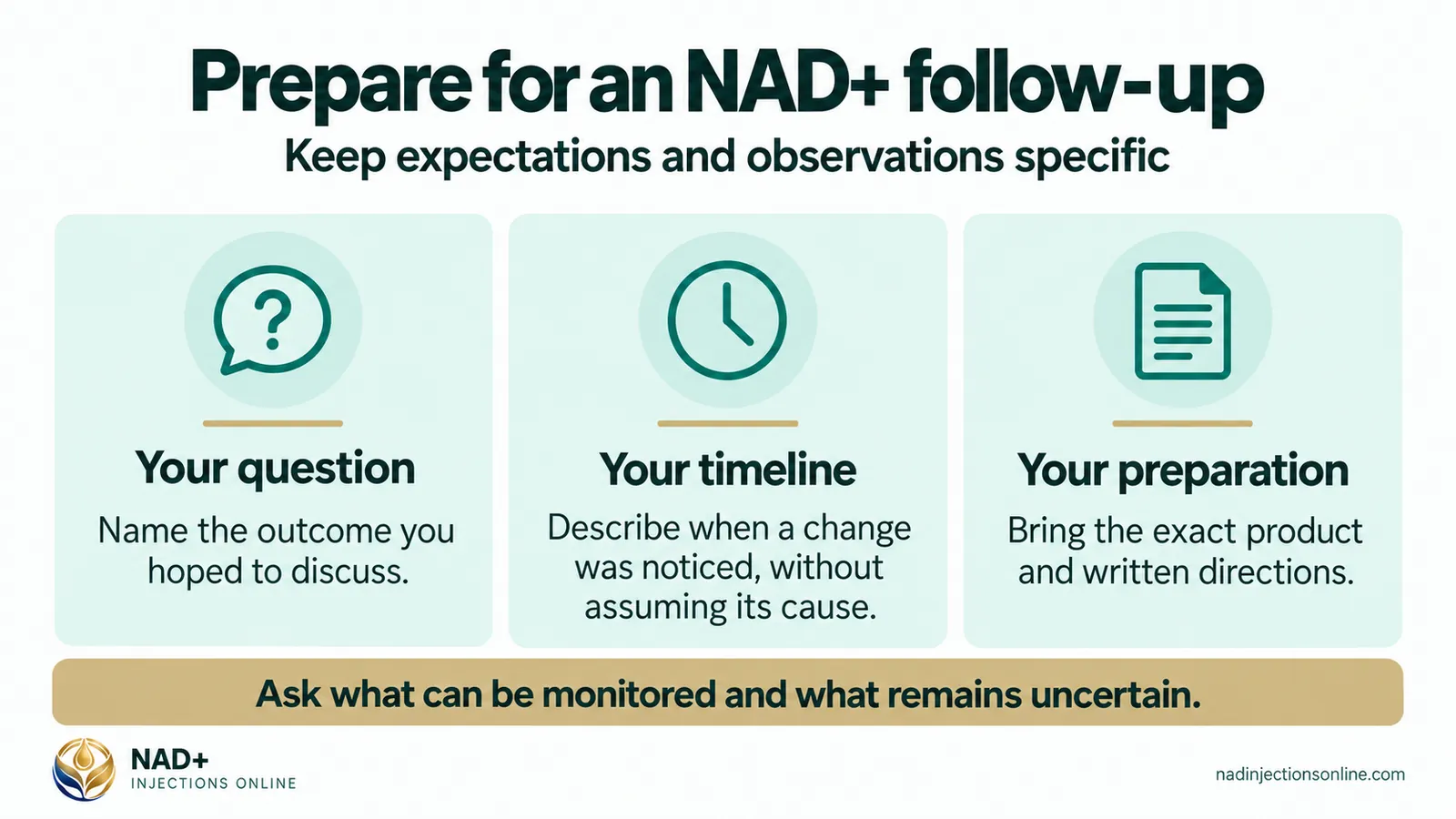
Prepare a description of what prompted the prescription discussion and what has changed since then. FDA recommends asking what effects to expect, what monitoring may be needed and when to report back. Those are questions for the prescriber, especially when a general article cannot establish a benefit timeline.
If you keep notes, record observations in ordinary language. Say what you noticed and when, rather than labeling it as a response to NAD. Include relevant changes in other products or routines so the professional can ask follow-up questions about the whole situation.
Ask how uncertainty affects the next decision. What information would prompt a review, what should be reported promptly and who should receive questions about the medicine? This creates a clearer conversation than trying to determine whether you have crossed a promised number of days.
The absence of a noticeable change should not lead to a self-directed increase or new schedule. Request clarification of the existing plan and the reason for any proposed change. A written direction for your actual prescription is more useful than a general claim about how long everyone should use NAD.
When a timeline is quoted, ask the person explaining it to finish the sentence: time until what, measured how, with which preparation? A metabolite measurement from the selected intravenous pilot and a blood marker from the oral NR trial answer different questions. Neither should be used without explanation as a deadline for a personal symptom change. Keep any follow-up appointment separate from a promise about what will happen before it.
What if I feel worse after use?
Treat an unexpected change as something to report, rather than evidence that the product is working. FDA’s sterile-compounding reminder includes reports of severe chills, shaking, vomiting and fatigue following NAD injectable drugs. Some reports required medical treatment; the agency highlights possible endotoxin-related concerns.
The reports do not provide a frequency or a standard recovery period for your prescription. Explain your symptoms and the product used to the treating professional. For severe allergic symptoms such as breathing difficulty or throat swelling, call 911 rather than waiting for a routine reply.
Compounded medications are prepared by a licensed pharmacy for an individual patient and are not FDA-approved. No approved label lists its uses or side effects, so the physician works from your history and clinical judgment, tells you what is known and what is uncertain, and sets how often you check in.
Any injectable can cause a reaction at the injection site or an allergic reaction, and NAD+ infusions are known for flushing and nausea when given quickly. Report anything unexpected to the physician the same day, and tell the physician about every medicine and supplement you take before anything is prescribed.
Treatment requires a prescription. A licensed clinician evaluates you by telehealth and decides whether any medication is appropriate. Booking does not guarantee a prescription.
What a physician weighs
Bring the exact timeline claim you have read and the name of your preparation. Ask which outcome the claim measures, whether the cited route matches yours, and how the prescriber wants unexpected changes reported. Those questions can guide a decision without assuming a predictable benefit.
How long do NAD injections last: common questions
Does ‘lasts’ mean the same as shelf life?
No. A vial’s handling date and a person’s perceived change concern different questions.
Can I use an oral NR timeline?
It does not establish a duration for injected NAD+. The ingredient and route differ.
Did Grant study home injections?
The reviewed pilot used an IV infusion and measured blood and urine metabolites.
Does an early reaction show benefit?
An unexpected reaction should be assessed as a safety question. It does not establish that the intended benefit has begun.
Should I copy a cycling schedule?
Use your own prescription directions and ask the prescriber about changes rather than copying a general schedule.
Who answers a storage-duration question?
The dispensing pharmacist can clarify the preparation’s label and handling instructions.
A precise duration claim needs a matching product and a defined outcome. If either is missing, ask for clarification before treating the claim as a plan for your own prescription.
Where this guide comes from
The register citations and the public sources behind the text.
Sources (6)
- Grant R, Berg J, Mestayer R, et al. A Pilot Study Investigating Changes in the Human Plasma and Urine NAD+ Metabolome During a 6 Hour Intravenous Infusion of NAD. Front Aging Neurosci. 2019;11:257. (frontiersin.org)
- Martens CR, Denman BA, Mazzo MR, et al. Chronic nicotinamide riboside supplementation is well-tolerated and elevates NAD(+) in healthy middle-aged and older adults. Nat Commun. 2018;9(1):1286. (pubmed.ncbi.nlm.nih.gov)
- FDA: medicine benefits and risks (fda.gov)
- FDA: Compounding questions and answers (fda.gov)
- FDA: ingredients suitable for sterile compounding (fda.gov)
- MedlinePlus: Anaphylaxis (medlineplus.gov)
Put the question to a physician
The guides explain; the physician decides. Start from home, with a wellness consultant explaining the steps and the cost first.
Currently available to adults physically located in Florida at the time of their consultation. For adults 18 and older. Contacting NAD Injections Online does not guarantee treatment and creates no obligation.