Does NAD+ need to be refrigerated? 2026 storage guide
NAD+ storage: refrigeration, light and your pharmacy label
Most NAD+ injection vials need to be refrigerated at about 36 to 46°F (2 to 8°C) and kept away from light, but your pharmacy label is the final word. Check it as soon as the package arrives and ask the pharmacy if anything is unclear.

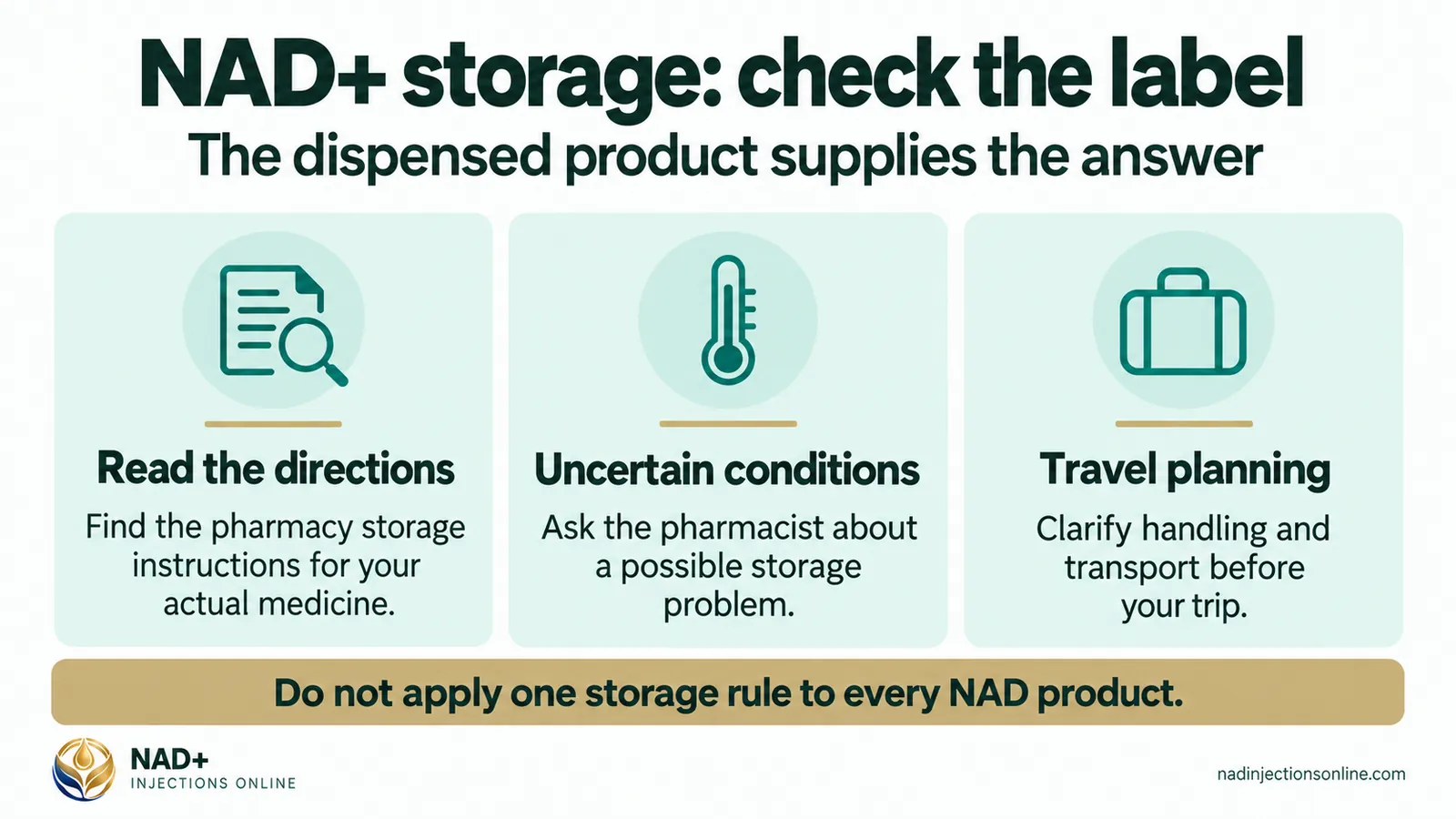
Does NAD need to be refrigerated? Your dispensed product’s pharmacy label supplies the answer, rather than a rule that applies to every NAD item. Nicotinamide adenine dinucleotide (NAD+) can appear in different preparations. If the storage wording is unclear or the medicine has been exposed to uncertain conditions, contact the dispensing pharmacist.
- Your prescription: use its own storage instructions and labeled date.
- Another product’s website: a different formulation may have different directions.
- A chemistry experiment: laboratory conditions do not establish a patient’s vial instructions.
- An interrupted journey: ask the pharmacy about the exposure rather than guessing.
Where do I find the answer?
Find the storage wording on the pharmacy label and in the written information that accompanies the medicine. FDA advises reading those instructions because storage requirements differ among medicines. If the documents appear to disagree, ask the dispensing pharmacy which instruction applies before making your own changes.
Keep the outer packaging and the vial information available while asking. Tell the pharmacist the exact ingredient and presentation on the label, rather than saying only that you have NAD. Request an answer that identifies your preparation, including what to do if the usual storage arrangement becomes unavailable.
The prescribed NAD+ overview explains the pharmacy’s role in supplying a patient-specific preparation. For storage questions, the dispenser is a more relevant contact than the author of a supplement review or the seller of a different item.
Does powder mean the same handling?
Do not transfer handling instructions between a powder and a prepared solution. Identify what you actually received and ask the pharmacy to explain the directions for that presentation. If a product requires preparation, this guide cannot provide replacement instructions or authorize adding anything to it.
The published stability experiment reviewed here used laboratory NAD+ and NADH solutions in specified buffers. It did not test every medicine prepared for patients. Its findings therefore cannot tell you when your own vial needs refrigeration or whether a particular storage mistake can be accepted.
That distinction matters when a search result combines advice about capsules, powders, sprays and injectable solutions under one heading. Similar ingredient names do not make the handling instructions interchangeable. Read the explanation of reconstitution for the terminology, then return to your pharmacy’s directions.
What if I left it out?
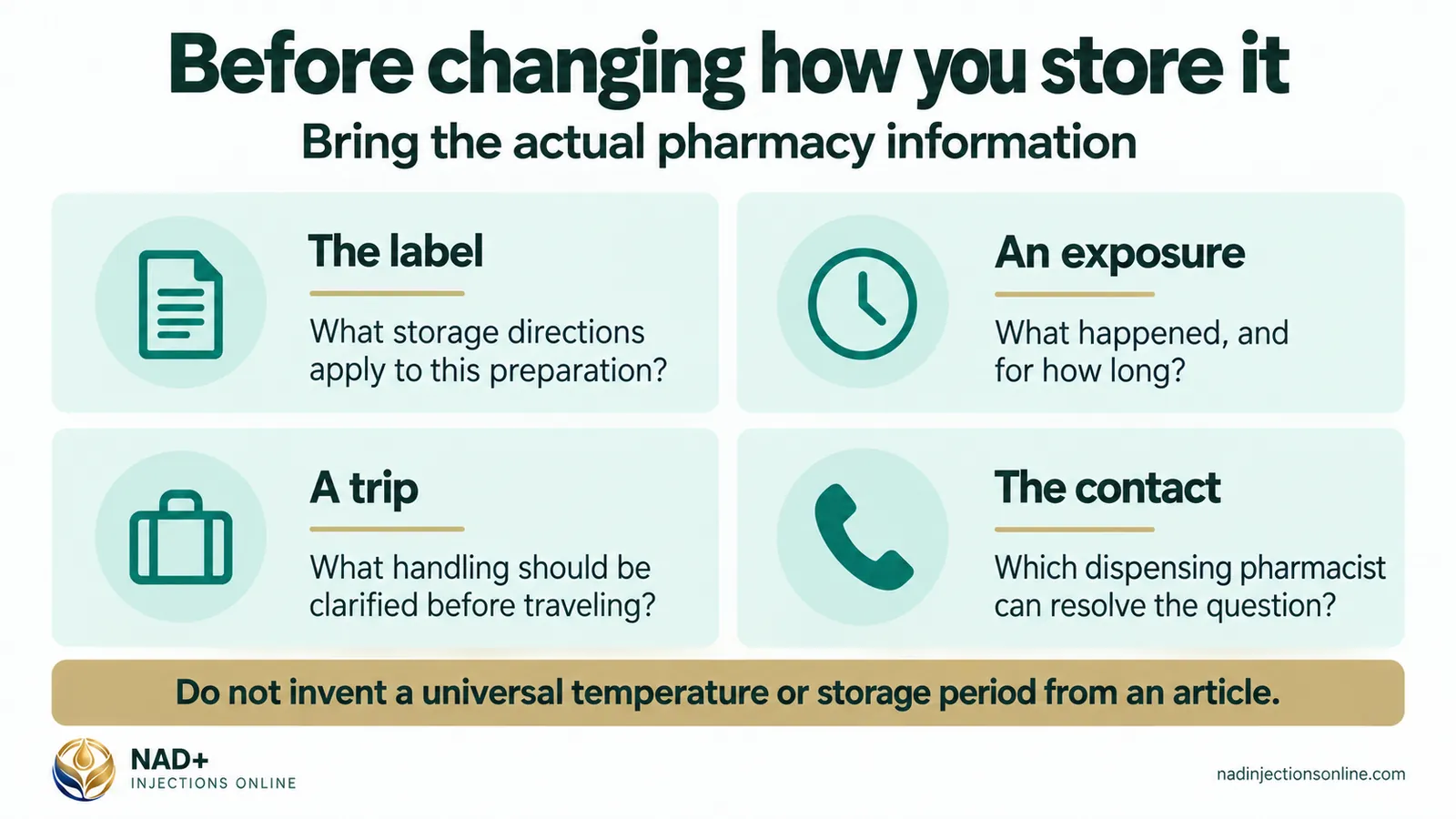
Contact the pharmacy with a factual description of the exposure. FDA recommends checking a medicine’s storage information or seeking professional advice when the recommended temperature has not been maintained. No general time allowance in this guide can establish that a specific vial is still suitable.
Explain where it was, what you know about the conditions and whether you recorded any temperature information. Say explicitly when a detail is unknown. If you were away from home, include the travel sequence rather than summarizing it as a short trip.
Ask how to keep the medicine while waiting for an answer and whether the pharmacist needs photographs of the packaging or label. Cooling the vial again does not provide an assessment of what happened earlier. Keep the response with your prescription information so the next step is clear.
What should I ask before traveling?
Ask how to follow the labeled conditions throughout the journey, including delays and the time before you reach your destination. A travel plan should identify the actual product and its instructions. Avoid using another person’s packing arrangement as proof that yours will be acceptable.
Consider what would happen if the planned storage fails. Write down the pharmacy contact information, how you will describe an exposure and where to obtain advice if a connection or delivery is delayed. These questions are more useful than selecting a generic online shelf-life estimate.
Keep storage life separate from symptom expectations. The guide to NAD duration explains the difference between how a medicine is handled, what a study measured and how long someone expects to notice an effect.
What safety information stays relevant?
Compounded medications are prepared by a licensed pharmacy for an individual patient and are not FDA-approved. No approved label lists its uses or side effects, so the physician works from your history and clinical judgment, tells you what is known and what is uncertain, and sets how often you check in.
Any injectable can cause a reaction at the injection site or an allergic reaction, and NAD+ infusions are known for flushing and nausea when given quickly. Report anything unexpected to the physician the same day, and tell the physician about every medicine and supplement you take before anything is prescribed.
Breathing difficulty or throat swelling can indicate a severe allergic reaction; call 911 rather than waiting for a routine reply.
Treatment requires a prescription. A licensed clinician evaluates you by telehealth and decides whether any medication is appropriate. Booking does not guarantee a prescription.
Storage advice does not establish that a preparation is effective for your reason for considering it. Ask the physician about that reason separately, and ask the pharmacist about the dispensed product. A clear division between those questions makes it easier to get an answer that actually applies.
What a physician weighs
Bring the complete label, your storage arrangement and any travel plans to the discussion. If an exposure has already occurred, describe what you know without trying to turn a laboratory finding into permission to use the vial.
Does NAD need to be refrigerated: common questions
Should I refrigerate every NAD+ product?
Use the instructions for the product in hand. A rule for a capsule, powder or another pharmacy’s vial may not apply.
Is the labeled date a benefit timeline?
No. Product dating is a handling question; the duration of a perceived effect is a separate clinical question.
Can I freeze it for a trip?
Ask the dispensing pharmacist whether the proposed arrangement follows your product’s instructions. This guide does not authorize freezing.
What if the label is missing?
Contact the dispensing pharmacy for the correct written information before relying on a storage assumption.
Does clear liquid establish usable quality?
An unchanged appearance cannot resolve a temperature-exposure question. Discuss the history with the pharmacist.
Can a laboratory paper extend the date?
The reviewed buffer study cannot establish a new date for a patient vial.
A useful storage answer identifies your actual preparation. Keep its instructions available and resolve unclear handling with the pharmacy that dispensed it.
Where this guide comes from
The register citations and the public sources behind the text.
Sources (6)
- FDA: expired medicines and storage (fda.gov)
- FDA: temperature-sensitive medicines (fda.gov)
- Wolfe KD, Alahuhta M, Himmel ME, Bomble YJ, Jennings GK, Cliffel DE. Long-Term Stability of Nicotinamide Cofactors in Common Aqueous Buffers: Implications for Cell-Free Biocatalysis. Molecules. 2024;29(22). (pubmed.ncbi.nlm.nih.gov)
- FDA: Compounding questions and answers (fda.gov)
- FDA: medicine benefits and risks (fda.gov)
- MedlinePlus: Anaphylaxis (medlineplus.gov)
Put the question to a physician
The guides explain; the physician decides. Start from home, with a wellness consultant explaining the steps and the cost first.
Currently available to adults physically located in Florida at the time of their consultation. For adults 18 and older. Contacting NAD Injections Online does not guarantee treatment and creates no obligation.