NAD+ reconstitution in 2026: what your vial needs
NAD+ reconstitution explained: powder, liquid and pharmacy directions
NAD+ reconstitution only applies if your pharmacy ships powder that must be mixed before use; many NAD+ injections arrive as a ready-to-use liquid. Follow the pharmacy label and the physician’s directions exactly, and never mix a vial without them.
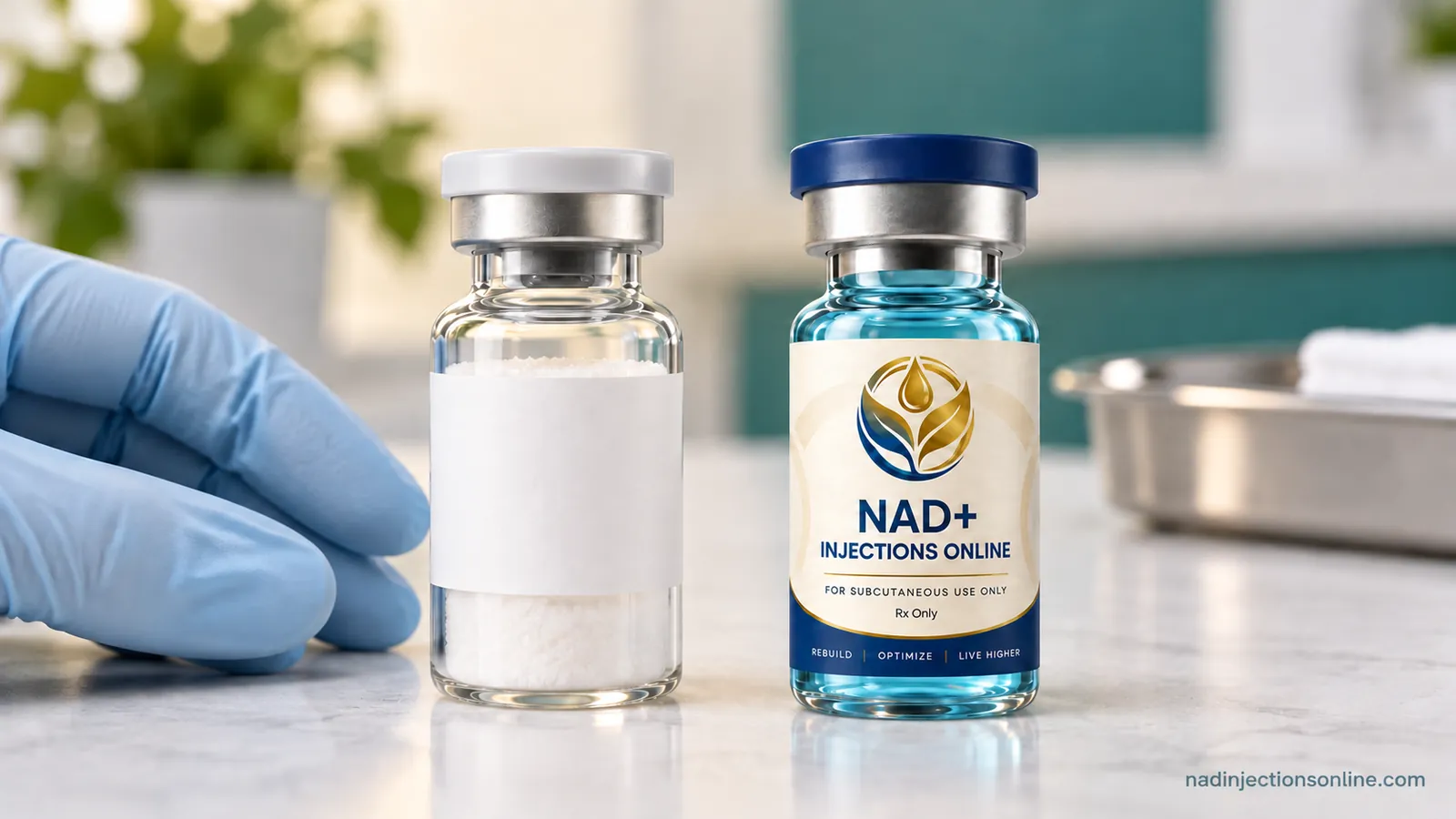
NAD+ reconstitution means preparing a liquid medicine from a powder; it does not describe every product presentation. A vial already supplied as a solution is different. Ask the dispensing pharmacist which instructions apply to the actual preparation rather than adapting a general recipe.
This guide explains terminology and the information to clarify about nicotinamide adenine dinucleotide (NAD+). It provides no mixing steps, quantities, conversions or dose directions. For the prescribed pathway, see the NAD+ injection information.
Which presentation do you have?
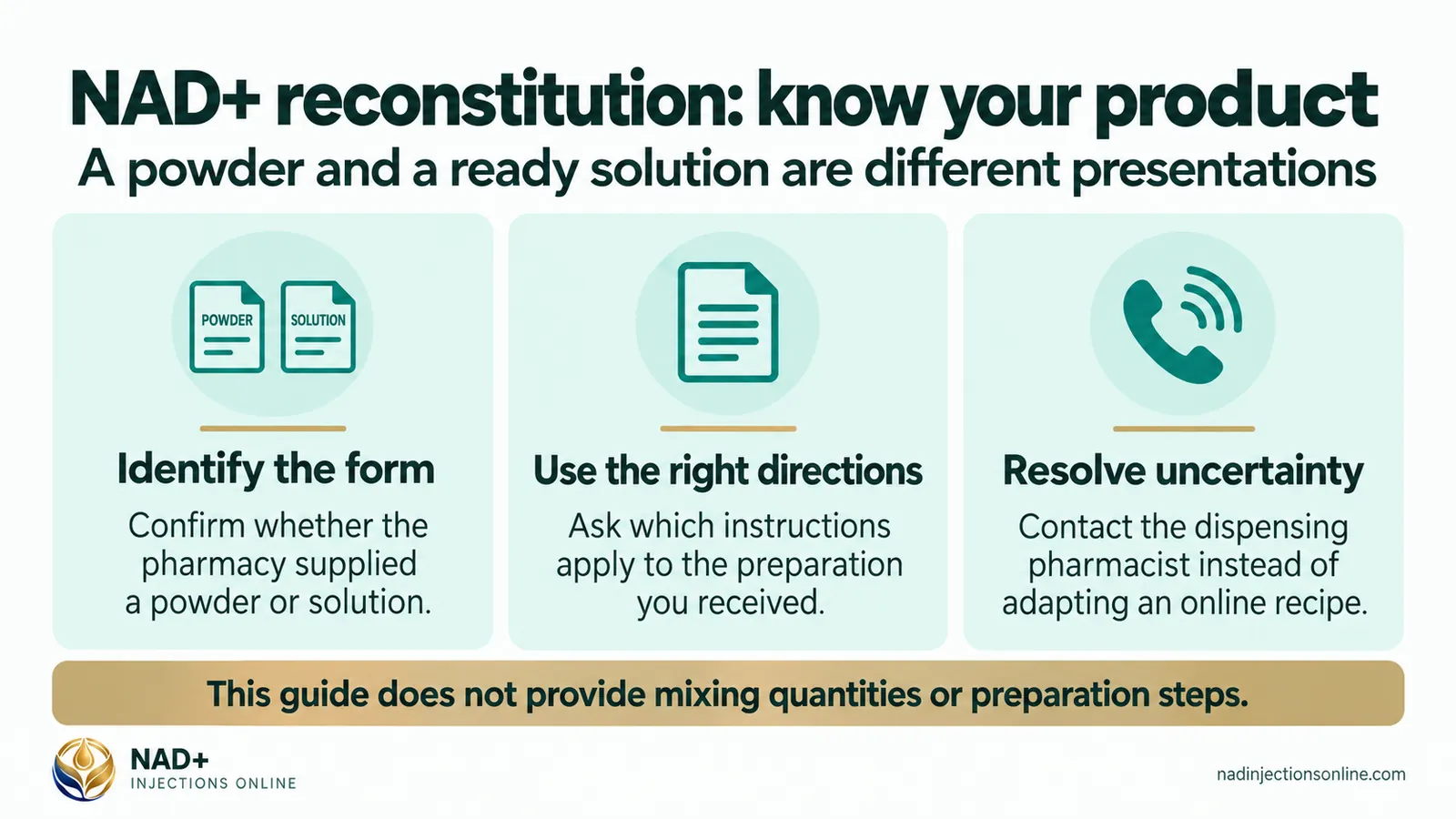
Start with the actual product information. Do not infer the presentation from a photograph on a different website or from the broad wording of an article. If it is unclear whether you have a powder or a prepared solution, ask the pharmacist to identify it.
Reconstitution describes preparing a liquid medicine from a powder, while a product already supplied as a solution is a different presentation. That definition does not establish that any particular vial requires the same preparation as another.
What should the pharmacy clarify?
Ask which product was dispensed and which information belongs to it. If a separate instruction sheet was supplied, ask how it relates to the label. The goal is a coherent explanation for your actual preparation, rather than a collection of general instructions.
Save the wording that created the uncertainty so the person answering can address it directly. A specific question about the supplied presentation is more useful than asking for a universal NAD recipe.
Why is a generic recipe insufficient?
An online recipe may assume a different presentation or set of product details. A shared ingredient name does not identify all those assumptions. Ask which preparation the instructions were written for before treating them as relevant to your product.
FDA’s general medicine-use advice is to follow the label and the instructions of the physician or pharmacist. It does not provide a universal NAD+ preparation protocol. The actual product information remains the reference for the individual medicine.
Can another vial’s instructions fill the gap?
Take the gap to the dispensing pharmacist instead of assuming a similar name means the same preparation. Explain which direction is missing or unclear. A useful answer should identify your product and address that uncertainty.
You can organize the question using these headings:
- Product identity: the complete supplied name.
- Presentation: powder or prepared solution.
- Documents: the label and accompanying information.
- Uncertainty: the exact wording that needs clarification.
- Contact: the dispensing pharmacist who can explain it.
These headings are for communication. They are not a preparation method or a way to certify the product independently.
What can a calculator not tell you?
A calculator cannot identify the product merely from the assumptions entered into it. If the actual presentation or instructions are uncertain, arithmetic does not supply the missing information. Ask the pharmacist about the preparation rather than using a result to decide what the vial must contain.
The dose-and-frequency guide addresses the separate prescribing question. Understanding the word reconstitution does not establish your dose, schedule or the directions for a particular preparation.
What if the label and a website disagree?
Show the discrepancy to the pharmacist. Identify the actual label and the specific website wording instead of trying to reconcile them by analogy. A general page may be discussing another presentation entirely.
If the uncertainty involves what you understood in the consultation, ask the clinician and pharmacist to clarify the prescription. Keep the final clarification with the product information so you do not have to reconstruct it from memory later.
This guide does not offer a calculation or an alternative instruction set. Its purpose is to help you identify the right question and the appropriate professional source of an answer.
What does ingredient suitability mean?
FDA warned about food-grade NAD ingredients used for IV products and possible excessive endotoxins. The agency received reports of severe chills, shaking, vomiting and fatigue after NAD+ injectable drugs, sometimes requiring medical treatment. This is an ingredient-suitability and contamination concern.
Those reports do not establish a reliable reaction rate or prove that the NAD molecule caused every event. They also do not establish that a particular pharmacy is implicated or exempt. The warning needs to retain that scope.
Does a purity statement resolve that concern?
Ask about the actual dispensing pathway and product information rather than treating a general purity claim as a complete answer. A product photograph or ingredient description cannot resolve every question about the supplied preparation.
The word solution should not be treated as a quality certification. If you have a concern about the actual product, ask the dispensing pharmacist. A public terminology explanation cannot verify a vial by its appearance.
The NAD+ side-effects guide gives fuller context for reported reactions. Preparation questions should not be reduced to arithmetic when the underlying concern involves the actual medicine.
How do I identify the pharmacy?
FDA advises checking an online pharmacy’s state license, prescription requirement and access to a licensed pharmacist. These are safeguards for the dispensing pathway. They do not establish NAD+ effectiveness or FDA approval of a compounded preparation.
Ask who dispenses the product and how to contact a pharmacist about its label. A general sales contact and a medicine-specific professional question are not necessarily the same conversation. Request the appropriate contact rather than assuming every representative can clarify preparation directions.
What information should I keep?
Keep the actual product label, accompanying instructions and any clarification you receive. Note which preparation the answer concerns. That helps avoid carrying information from a previous product or another website into the current question.
If the name on a page and the supplied information differ, ask the pharmacy to explain the discrepancy. Preserve the exact wording so the answer can address the specific issue.
A clear record is useful even when the answer is simply that a general article concerned a different presentation. It prevents the same uncertainty from recurring when you later compare product descriptions.
What does a physician weigh?
Explain whether your concern is product identity, unclear instructions or a recommendation found online. Ask the clinician and pharmacist to separate the prescription decision from the preparation-information question. Both should concern the actual product rather than an assumed recipe.
Compounded medications are prepared by a licensed pharmacy for an individual patient and are not FDA-approved. No approved label lists its uses or side effects, so the physician works from your history and clinical judgment, tells you what is known and what is uncertain, and sets how often you check in.
Any injectable can cause a reaction at the injection site or an allergic reaction, and NAD+ infusions are known for flushing and nausea when given quickly. Report anything unexpected to the physician the same day, and tell the physician about every medicine and supplement you take before anything is prescribed.
For severe allergic symptoms such as breathing difficulty or throat swelling, seek emergency care and call 911. Emergency care takes priority over a routine same-day report.
The infusion reference in that safety wording does not provide a reaction rate for every home-injection preparation.
Treatment requires a prescription. A licensed clinician evaluates you by telehealth and decides whether any medication is appropriate. Booking does not guarantee a prescription.
Before requesting a clarification, list the documents you have and identify which one leaves a question unanswered. A website article, a label and a separate instruction sheet may concern different presentations. Ask the pharmacist which information applies to the actual dispensed product. Keep that answer together with the product record rather than retaining a set of unrelated recipes that happen to use the same ingredient name.
NAD+ reconstitution: common questions
Is reconstitution the same as dosing?
It describes preparing a liquid medicine from a powder. It does not set the dose or frequency of an individual prescription.
Does every vial require the same preparation?
A powder and a supplied solution are different presentations. Ask which directions apply to the actual product.
Can a calculator identify the presentation?
It cannot replace the product information. Ask the pharmacist to identify what was dispensed.
Does purity wording certify injectable suitability?
FDA’s ingredient warning raises suitability and contamination concerns that a generic purity claim does not resolve.
Does a licensed pharmacy prove effectiveness?
Pharmacy safeguards do not establish clinical effectiveness or approval of the compounded preparation.
Who should explain unclear directions?
Ask the physician or dispensing pharmacist to clarify the instructions for the actual medicine.
Where this guide comes from
The register citations and the public sources behind the text.
Sources (8)
- FDA: medicine benefits and risks (fda.gov)
- FDA: ingredients suitable for sterile compounding (fda.gov)
- FDA: buying medicine online (fda.gov)
- FDA: Compounding questions and answers (fda.gov)
- Grant R, Berg J, Mestayer R, et al. A Pilot Study Investigating Changes in the Human Plasma and Urine NAD+ Metabolome During a 6 Hour Intravenous Infusion of NAD. Front Aging Neurosci. 2019;11:257. (frontiersin.org)
- FDA: Drug interactions (fda.gov)
- MedlinePlus: Anaphylaxis (medlineplus.gov)
- NLM: RxNorm Overview, powder and liquid dose-form terminology (nlm.nih.gov)
Put the question to a physician
The guides explain; the physician decides. Start from home, with a wellness consultant explaining the steps and the cost first.
Currently available to adults physically located in Florida at the time of their consultation. For adults 18 and older. Contacting NAD Injections Online does not guarantee treatment and creates no obligation.