NMN vs NAD+ in 2026: which is which
NMN vs NAD+: precursor, coenzyme and products compared
NMN vs NAD+ is a precursor versus the finished coenzyme: NMN (nicotinamide mononucleotide) is a building block the body converts into NAD+, while NAD+ is the active coenzyme itself. NMN is sold as an oral supplement; NAD+ injections need a physician and a pharmacy.
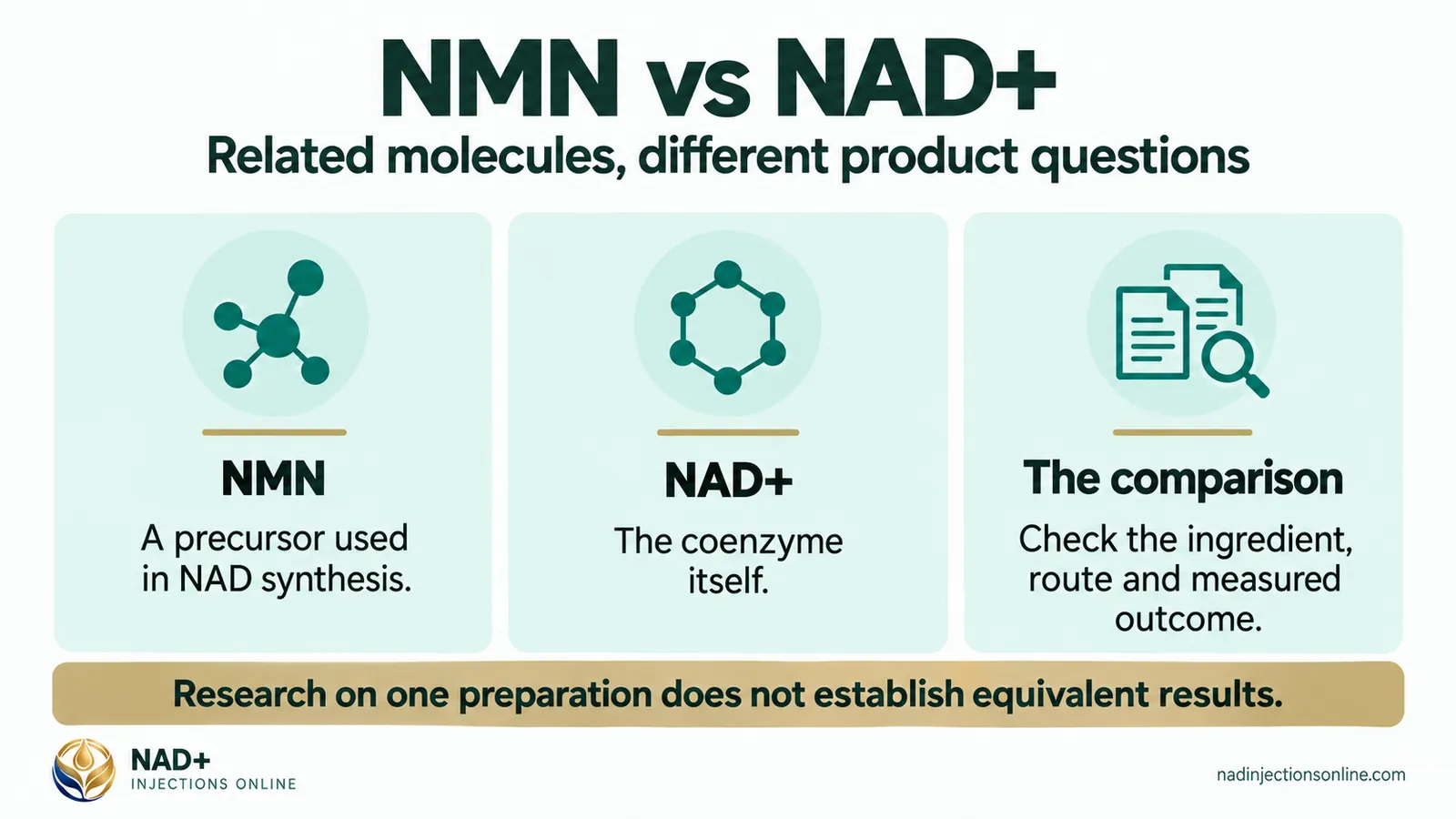
NMN vs NAD is a comparison of related but distinct molecules. Nicotinamide mononucleotide is a precursor used in NAD synthesis; nicotinamide adenine dinucleotide (NAD+) is the coenzyme itself. A product containing one is not automatically equivalent to a product containing the other.
If your question concerns prescribed NAD+ injections, identify the ingredient in the product you already have or are considering. This guide focuses on information to bring to the clinician, rather than choosing a supplement or prescription for you.
Which ingredient do I actually have?
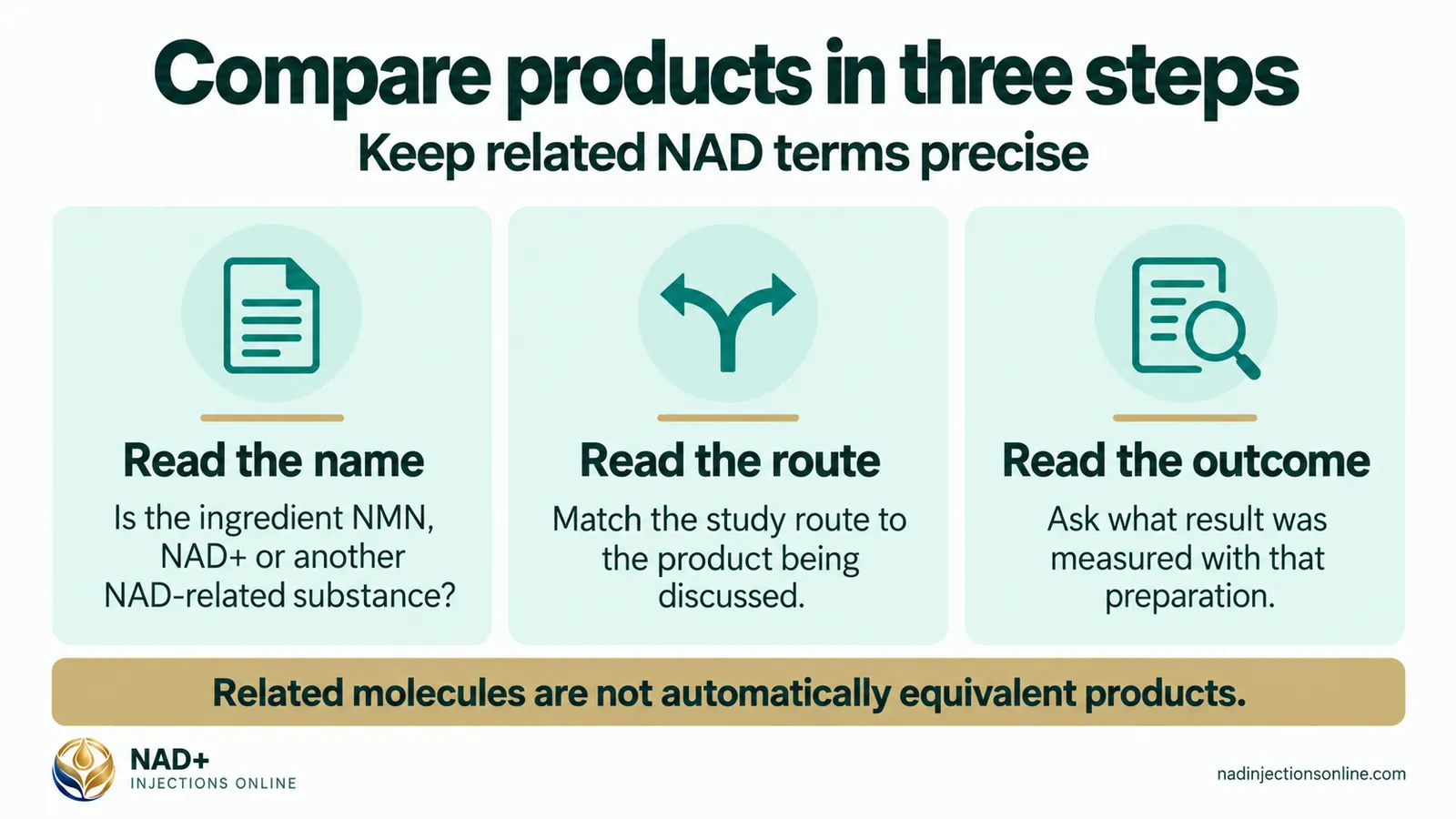
Use the complete ingredient panel as your starting point. A product title can emphasize NAD while leaving the specific ingredient to smaller print. Write down the full name and the presentation so you do not have to rely on memory during the consultation.
If a page uses several names, ask which one is actually in the product. Do not assume that a discussion of the body’s NAD pathway means the product contains NAD+ itself. A pathway description and an ingredient statement serve different purposes.
Why does the full name matter?
NMN is nicotinamide mononucleotide, while NAD is nicotinamide adenine dinucleotide. The precursor relationship connects them biologically without making them the same molecule. That distinction remains important when a source describes a particular preparation.
You can prepare a simple record with the product name, complete ingredient information and the claim you want explained. If several ingredients appear together, ask which component the cited research concerns. An answer about one ingredient should not silently become an answer about the whole product.
Keep unclear wording in your question. For example, ask whether a page is naming the supplied ingredient or describing what the body may make from it. The goal is a precise answer that you can carry into the rest of the discussion.
What does precursor mean here?
A precursor is used in the synthesis of another molecule. In this comparison, NMN participates in NAD synthesis. The term describes a biochemical relationship; it does not establish an equivalent clinical effect from every NMN and NAD+ preparation.
NIH’s niacin reference explains that the body converts absorbed niacin into NAD, which participates in metabolic reactions. That nutritional context does not establish the effect of a prescribed NAD+ injection. It also does not supply an injection recommendation from a dietary explanation.
Does the relationship identify a better choice?
The NAD metabolism review does not turn the precursor relationship into a general comparison of product effectiveness. Molecular identity and treatment outcomes are different questions. A preparation-specific clinical claim requires evidence beyond identifying its place in a pathway.
State what you mean by better when asking the clinician. Are you asking about the evidence for a particular concern, the available route or a product you are already taking? Those questions can lead to different explanations, and a broad ranking may answer none of them well.
Avoid letting a simplified pathway picture settle your individual decision. It may help explain terminology while leaving the clinically relevant question open. Ask the person explaining it to say where the background biology ends and the evidence for the proposed product begins.
What did the NMN research study?
A randomized trial in postmenopausal women with prediabetes studied oral NMN and muscle insulin sensitivity, not NAD+ injections or menopause symptom treatment.1
The selected research involved oral NMN in postmenopausal women with prediabetes. It did not test NAD+ injections, and its metabolic endpoint was not a measurement of menopause symptom relief. Those details limit how the study can be used in a product comparison.
When reading a research summary, look for four items: the ingredient, route, participants and measured result. Compare them with the actual question you brought to the page. If the summary describes a different preparation, ask for the missing connection rather than assuming it applies.
Can the finding answer my injection question?
A study of an oral precursor cannot establish the clinical effect of injected NAD+. The molecule and the route differ, so the experiment does not provide a direct test of that prescription. It remains evidence about the intervention the researchers actually studied.
Ask which source supports the specific statement being made about the proposed preparation. An explanation can acknowledge a useful finding while also describing its limits. You should be able to tell whether the clinician is discussing measured results, biological reasoning or an unresolved question.
The NAD+ evidence guide explains this distinction across more research. Here, keep the focus on the exact NMN-versus-NAD comparison and the reason the difference matters for your question.
What about liposomal or blended products?
First identify the molecule, then the formulation. Liposomal wording does not remove the need to ask whether the product contains NAD+, NMN, NR or another ingredient. If the page highlights a delivery description before naming the ingredient, request a complete explanation.
A blend adds another question: was the cited research about the complete combination or only one component? Keep those possibilities distinct. A set of references for separate ingredients should not be interpreted as an experiment on the combined product unless that is what the source actually describes.
What should I bring from the label?
Bring enough information for the clinician or pharmacist to identify the product without guessing:
- The full ingredient names.
- The presentation and intended route.
- The complete product label.
- The reason you started considering it.
- The specific research claim you want explained.
The liposomal NAD+ guide covers the formulation question in more detail. You do not need to settle it before the consultation, but you should flag it if the wording is part of your uncertainty.
If two pages describe the same product differently, show both descriptions. Ask which information applies to the actual preparation. Do not treat a difference in marketing language as proof that ingredients can be substituted.
Can I take NMN with NAD+?
FDA recommends reviewing medicines and supplements with a physician or pharmacist when adding another product. That general advice applies to organizing the product discussion. It does not establish the safety or effectiveness of a particular NMN-and-NAD+ combination.
Explain what you already take and what you are considering adding. Be specific about which product is current and which is only being researched. That helps the clinician answer the real question without assuming a regimen you have not started.
Does combining them establish more benefit?
The fact that the molecules are connected through NAD synthesis does not establish additional clinical benefit from combining their products. The metabolic relationship is not evidence that a particular combination improves a person’s desired outcome.
Ask why each ingredient would be included and what evidence supports that reason. If the explanation only says the names are related, request the clinical reasoning separately. It is reasonable to leave a combination question unanswered until the actual products and purpose are clear.
This guide does not supply a shared schedule, a substitution rule or a conversion between products. Those details belong to an individual prescription discussion when a clinician considers one appropriate.
What does a physician weigh?
A useful evaluation connects your reason for asking with the actual preparation under consideration. Describe the concern in your own words rather than adopting a product page’s terminology. Ask what the clinician considers known, uncertain and relevant to your situation.
Compounded medications are prepared by a licensed pharmacy for an individual patient and are not FDA-approved. No approved label lists its uses or side effects, so the physician works from your history and clinical judgment, tells you what is known and what is uncertain, and sets how often you check in.
Any injectable can cause a reaction at the injection site or an allergic reaction, and NAD+ infusions are known for flushing and nausea when given quickly. Report anything unexpected to the physician the same day, and tell the physician about every medicine and supplement you take before anything is prescribed.
For severe allergic symptoms such as breathing difficulty or throat swelling, seek emergency care and call 911. Emergency care takes priority over a routine same-day report.
The infusion wording concerns an intravenous route and is not a measured reaction rate for a precursor product or a home injection.
Treatment requires a prescription. A licensed clinician evaluates you by telehealth and decides whether any medication is appropriate. Booking does not guarantee a prescription.
NMN vs NAD: common questions
Is NMN the coenzyme itself?
No. NMN is a precursor used in NAD synthesis; NAD+ is the coenzyme named in this comparison.
Does oral NMN research test NAD+ injections?
No. The selected NMN trial used an oral preparation and a specific metabolic endpoint.
Is NR another name for NMN?
NR and NMN are distinct NAD-related precursor names. Identify the complete ingredient rather than using the abbreviations interchangeably.
Does a NAD product title identify everything?
Read the full ingredient information and ask for clarification when the title and ingredient panel leave different impressions.
Should I combine products on my own?
Ask a physician or pharmacist to review the actual medicines and supplements before adding another product.
What if I only want the scientific difference?
The central distinction is that NMN is a precursor and NAD+ is the coenzyme. That identity answer does not decide a treatment choice.
Where this guide comes from
The register citations and the public sources behind the text.
Sources (9)
- Yoshino M, Yoshino J, Kayser BD, et al. Nicotinamide mononucleotide increases muscle insulin sensitivity in prediabetic women. Science. 2021;372(6547):1224-1229.
- Covarrubias AJ, Perrone R, Grozio A, Verdin E. NAD(+) metabolism and its roles in cellular processes during ageing. Nat Rev Mol Cell Biol. 2021;22(2):119-141. (pmc.ncbi.nlm.nih.gov)
- NIH ODS: Niacin (ods.od.nih.gov)
- Yoshino M, Yoshino J, Kayser BD, et al. Nicotinamide mononucleotide increases muscle insulin sensitivity in prediabetic women. Science. 2021;372(6547):1224-1229. (pubmed.ncbi.nlm.nih.gov)
- FDA: Drug interactions (fda.gov)
- FDA: Compounding questions and answers (fda.gov)
- Grant R, Berg J, Mestayer R, et al. A Pilot Study Investigating Changes in the Human Plasma and Urine NAD+ Metabolome During a 6 Hour Intravenous Infusion of NAD. Front Aging Neurosci. 2019;11:257. (frontiersin.org)
- FDA: buying medicine online (fda.gov)
- MedlinePlus: Anaphylaxis (medlineplus.gov)
Put the question to a physician
The guides explain; the physician decides. Start from home, with a wellness consultant explaining the steps and the cost first.
Availability depends on your state: you must be located in a state where an independent physician is licensed to treat you at the time of your consultation. For adults 18 and older. Contacting NAD Injections Online does not guarantee treatment and creates no obligation.