NAD+ injections vs supplements in 2026
NAD+ injections or oral supplements: comparing the products
NAD+ injections vs supplements is a comparison of route and product: injections deliver prescribed NAD+ directly, while oral supplements usually contain precursors such as NR or NMN that the body converts. Precursors have more human studies; injections skip digestion but have less published data.
NAD+ injections versus supplements should be compared by the actual ingredient, route and research endpoint. Nicotinamide adenine dinucleotide (NAD+) and oral precursors are different interventions. The selected references do not establish one universally superior form or a benefit from combining them. This guide helps you prepare a product-specific discussion with the physician and pharmacist.
Is the ingredient NAD+ or a precursor?
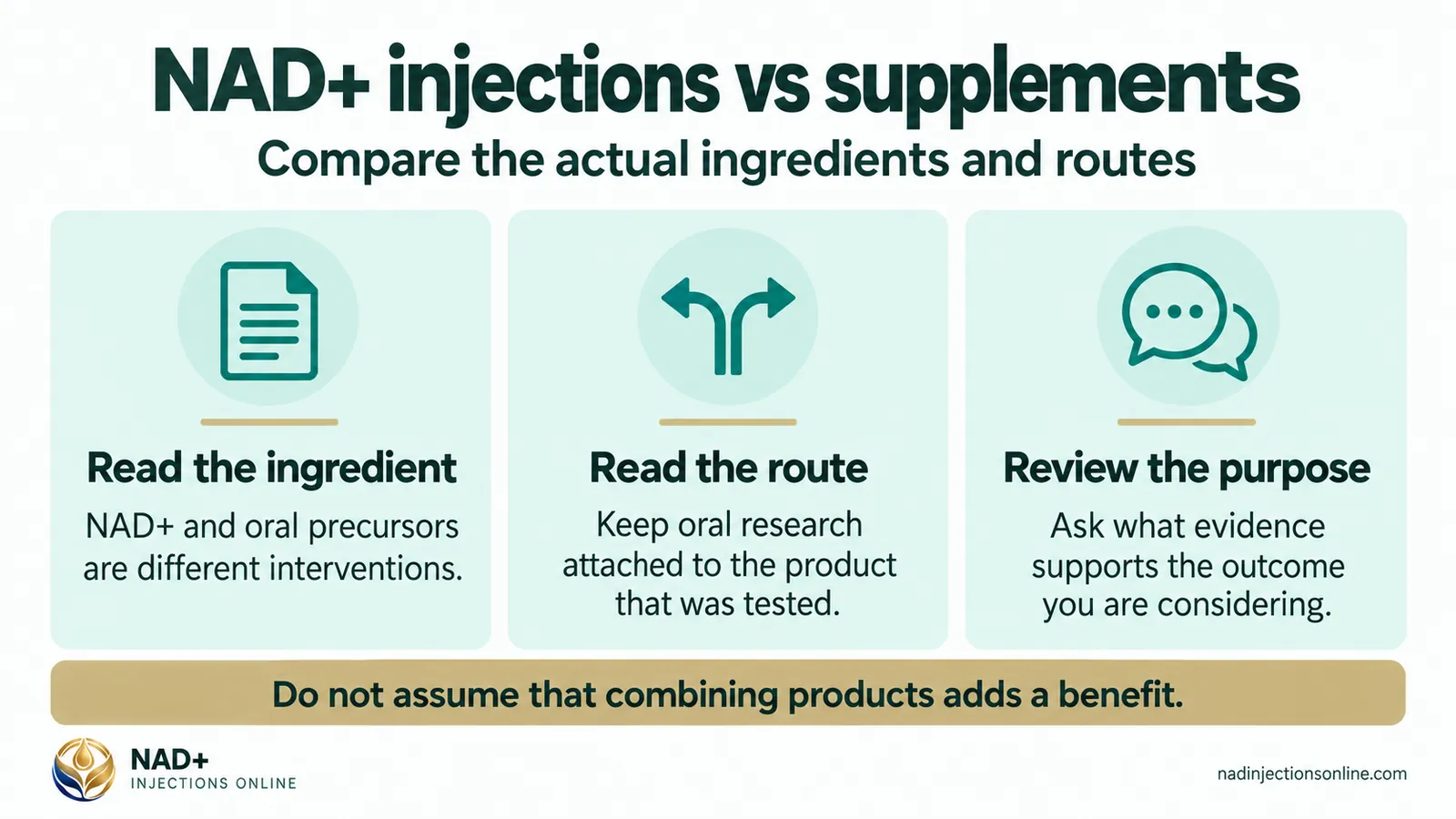
Read the actual ingredient label before grouping products together. An NAD+ preparation and an oral precursor are different interventions. The selected nicotinamide-riboside study concerns oral NR, not a home injection containing NAD+ itself. A shopping category can use related terms while the research references remain about distinct molecules and routes.
Ask whether a product has one ingredient or several. A reference about an individual ingredient is not automatically a trial of the full combination. Keep the actual preparation attached to the claimed result when asking the physician or pharmacist for guidance. The dedicated NMN comparison explains precursor identity in more detail.
First read the ingredient line rather than relying on the category word supplement. A page may discuss NAD+, a precursor or a mixture while using similar promotional language for each. Ask the pharmacist or physician to identify the actual product in the proposed comparison. Without that identity, a genuine study can be attached to the wrong intervention. Keeping the original ingredient and route in your notes makes it easier to spot the mismatch.
In a study of healthy middle-aged and older adults, oral supplementation with an NAD+ precursor (nicotinamide riboside) raised blood NAD+ levels and was well tolerated.1
What does the oral evidence tell me?
The selected oral-NR trial describes blood NAD+ changes and tolerability in healthy middle-aged and older adults. Those findings should remain identified as findings of that study. They do not establish an injection symptom benefit or predict your own experience with a different preparation. A genuine citation can still be a poor match for the claim placed beside it.
Ask which endpoint the reference measured. If your question concerns a symptom and the cited result concerns a blood measurement, the connection still needs support. The molecule’s normal biological role does not fill that gap. The conclusions here concern the selected sources, rather than every study of every supplement.
If the question is whether to use two products together, bring both labels and your current medicine and supplement list to the physician. A route comparison does not clear a combination, and a paper about one intervention does not supply directions for adding another. Ask which question the professional is answering: a product interaction, a proposed clinical purpose or a practical preference. The discussion should address your actual products rather than a broad assumption about all NAD-related supplements.
An intranasal NAD study used cultured human olfactory cells and mice with induced smell loss; it did not establish wellness benefits or comparative absorption in people.2
Do other delivery claims settle the choice?
The selected IV study, intranasal preclinical study and liposomal laboratory study address different questions. The nasal work used cells and mice, and the liposomal work used cells and skin explants. Those designs do not establish a universal human ranking of the commercial preparations a person might compare.
Do not read a laboratory delivery observation as an oral-product effectiveness result. Ask which preparation, route and population the actual paper concerns. If those details are missing from the article, request the source rather than filling in the most appealing interpretation. The dedicated liposomal guide explains the formulation question separately.
For oral-precursor research, retain the studied population and outcome when summarizing the finding. A blood measurement in the Martens study remains a blood measurement, not a forecast of how a different person will feel after an injection. Likewise, a laboratory experiment with liposomal NAD+ remains tied to that experimental setting. You can use the papers to prepare precise questions without asking them to decide a comparison they did not test.
A laboratory study compared liposomal NAD+ with NAD+ alone in cultured human cells and skin explants, rather than testing an oral supplement or injection in patients.3
Can I combine a supplement and prescription?
Bring the supplement label and your medicine list to the physician or pharmacist before adding another product. FDA advises reviewing medicines and supplements for possible interactions. That advice supports a product-specific discussion; it is not evidence that a particular combination is beneficial, interaction-free or needed.
Do not assume that two products belong together because both are described with NAD-related terms. Nor should this guide claim that every possible combination has already been ruled out. Identify the exact ingredients, proposed directions and reason for considering them, then ask the responsible professional to assess the actual regimen.
How can I make the comparison useful?
Write down the ingredient, route, evidence endpoint and questions that remain unanswered. Add the dispensing pathway and current terms if a prescription is proposed. This gives the discussion a clear structure without pretending unrelated studies can produce a single score. Practical preferences should stay recognizable as preferences rather than becoming claims of superior benefit.
Ask the physician what supports the proposed purpose for your circumstances and which limitations should be understood. Pharmacy credentials, a prescription and an attractive formulation name answer different questions. None by itself establishes a symptom outcome. A useful choice conversation keeps those categories visible instead of promising that one route is best for everyone.
- Ingredient: read the actual product identity rather than a broad supplement label.
- Route: keep the administration form attached to each research finding.
- Endpoint: distinguish a laboratory measurement from the clinical outcome being claimed.
What a physician weighs
Put the specific question from this guide into your own words when discussing nad injections vs supplements. Explain what you want clarified, identify the actual preparation and bring the written information you have been given. Ask the physician to separate what the selected evidence supports from what remains a clinical judgment. If the answer depends on a product detail, ask how that detail will be confirmed with the pharmacist.
Compounded medications are prepared by a licensed pharmacy for an individual patient and are not FDA-approved. No approved label lists its uses or side effects, so the physician works from your history and clinical judgment, tells you what is known and what is uncertain, and sets how often you check in.
Any injectable can cause a reaction at the injection site or an allergic reaction, and NAD+ infusions are known for flushing and nausea when given quickly. Report anything unexpected to the physician the same day, and tell the physician about every medicine and supplement you take before anything is prescribed.
For severe allergic symptoms, including breathing difficulty or throat swelling, seek emergency care and call 911. This emergency advice takes priority over a routine same-day report.
Treatment requires a prescription. A licensed clinician evaluates you by telehealth and decides whether any medication is appropriate.
The current NAD+ product information explains this site’s prescribed pathway. For related questions, read nmn vs nad and liposomal nad explained.
NAD+ injections vs supplements: common questions
Is one NAD+ form demonstrated best for everyone?
The oral-NR trial, intravenous pilot and laboratory studies discussed here do not establish one best form for every person and purpose.
Is oral NR the same as an NAD+ injection?
No. Martens studied oral nicotinamide riboside, a precursor, rather than an injected NAD+ preparation.
Does the nasal research establish human absorption?
No. The cited intranasal research used cultured human olfactory cells and a mouse model, rather than a comparative human absorption trial.
Does a liposomal laboratory study validate oral products?
No. The cited liposomal paper studied cultured human cells and skin explants, not clinical outcomes from oral liposomal products in adults.
Can I combine products because they share a pathway?
Do not use a shared pathway as permission to combine products. Give the physician the complete medicine and supplement list so the actual combination can be assessed.
What should I bring to the discussion?
Bring the actual product labels, intended purpose, other medicines and supplements, and the source behind the claim you want assessed.
Where this guide comes from
The register citations and the public sources behind the text.
Sources (11)
- Martens CR, Denman BA, Mazzo MR, et al. Chronic nicotinamide riboside supplementation is well-tolerated and elevates NAD(+) in healthy middle-aged and older adults. Nat Commun. 2018;9(1):1286.
- Yoo SH, Jang JY, Bae JS, et al. Therapeutic effect of intranasal nicotinamide adenine dinucleotide in the restoration of olfactory dysfunction. Exp Mol Med. 2026;58(7):2155-2167.
- Ministrini S, Liberale L, Erle HE, et al. A Liposomal Formulation Enhances the Anti-Senescence Properties of Nicotinamide Adenine-Dinucleotide (NAD(+)) in Endothelial Cells and Keratinocytes. Curr Issues Mol Biol. 2025;47(9).
- Martens CR, Denman BA, Mazzo MR, et al. Chronic nicotinamide riboside supplementation is well-tolerated and elevates NAD(+) in healthy middle-aged and older adults. Nat Commun. 2018;9(1):1286. (pubmed.ncbi.nlm.nih.gov)
- Covarrubias AJ, Perrone R, Grozio A, Verdin E. NAD(+) metabolism and its roles in cellular processes during ageing. Nat Rev Mol Cell Biol. 2021;22(2):119-141. (pmc.ncbi.nlm.nih.gov)
- Yoo SH, Jang JY, Bae JS, et al. Therapeutic effect of intranasal nicotinamide adenine dinucleotide in the restoration of olfactory dysfunction. Exp Mol Med. 2026;58(7):2155-2167. (pubmed.ncbi.nlm.nih.gov)
- Grant R, Berg J, Mestayer R, et al. A Pilot Study Investigating Changes in the Human Plasma and Urine NAD+ Metabolome During a 6 Hour Intravenous Infusion of NAD. Front Aging Neurosci. 2019;11:257. (frontiersin.org)
- Ministrini S, Liberale L, Erle HE, et al. A Liposomal Formulation Enhances the Anti-Senescence Properties of Nicotinamide Adenine-Dinucleotide (NAD(+)) in Endothelial Cells and Keratinocytes. Curr Issues Mol Biol. 2025;47(9). (pubmed.ncbi.nlm.nih.gov)
- FDA: medicine benefits and risks (fda.gov)
- MedlinePlus: Anaphylaxis (medlineplus.gov)
- FDA: Drug interactions (fda.gov)
Put the question to a physician
The guides explain; the physician decides. Start from home, with a wellness consultant explaining the steps and the cost first.
Availability depends on your state: you must be located in a state where an independent physician is licensed to treat you at the time of your consultation. For adults 18 and older. Contacting NAD Injections Online does not guarantee treatment and creates no obligation.