NAD+ injections for men in 2026
NAD+ for men: products, claims and evidence
NAD+ injections for men use the same prescribed product as for anyone else; there is no male-specific formula. Claims about energy, recovery or testosterone are not proven in human trials, so a physician reviews your history and goals before prescribing.

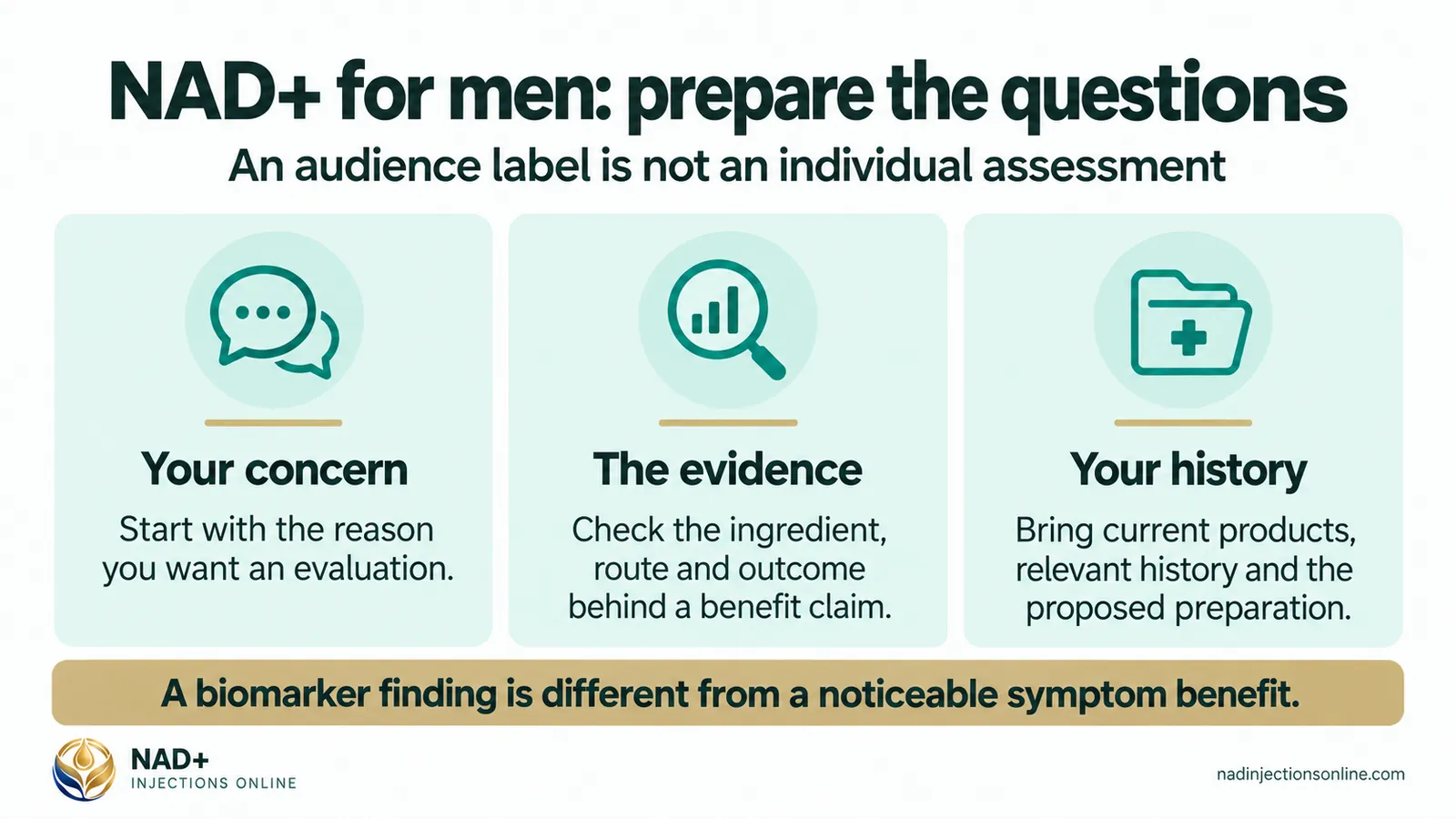
NAD benefits for men cannot be inferred simply from an article aimed at men. The reviewed studies do not establish broad symptom benefits from a home nicotinamide adenine dinucleotide (NAD+) injection. Identify the proposed preparation and your reason for asking, then discuss which evidence applies to that specific question.
- A product aimed at men: an audience description, not an individual assessment.
- An oral NR trial: research on a different ingredient and route.
- A measured biomarker: different from a noticeable symptom benefit.
- A prescription discussion: your concern, history, products and remaining uncertainty.
What question should I bring first?
Start with the concern that led you to consider NAD, rather than assuming that being a man creates a need for it. Describe what you want evaluated in concrete language. FDA encourages patients to understand a medicine’s purpose and ask what to expect and how it will be monitored.
If you have read a benefit list, bring the specific claim that interests you. Ask whether the cited evidence tested that outcome with the same ingredient and route. A clear question lets the clinician explain what is directly supported and what remains an inference.
Do not feel that you must fit your concern into the language of a product menu. An evaluation can address the concern before deciding whether any medicine is appropriate. That discussion is more informative than choosing a preparation because its audience label seems to match you.
The NAD+ prescription overview explains the relevant product pathway. This guide helps you prepare the evidence questions without presenting a special injection protocol for men.
What did researchers actually give the men?
The selected Dollerup trial used oral nicotinamide riboside, not injected NAD+. It enrolled men with obesity and investigated metabolic parameters. Those details should remain part of any description of its result.
The trial did not find improved insulin sensitivity with its studied oral NR intervention. That result does not establish a different benefit for NAD+ injections, and it cannot provide a regimen for the product you may be considering. A capsule study is still a capsule study when the search heading says NAD.
If an article describes the trial as evidence for men’s injections, ask where the product and route changed in the explanation. The answer should name that limitation rather than rely only on the presence of male participants. Participant sex does not make different interventions equivalent.
The null result should also remain specific. It concerns the study’s intervention and outcomes; it is not proof that every NAD-related question has been settled. Accurate discussion preserves boundaries without replacing one broad claim with another.
Why don’t biomarker results answer everything?
A biomarker describes what a study measured, not every experience someone hopes to change. The oral NR research reviewed here reported higher blood NAD+ levels and tolerability in healthy middle-aged and older adults. It does not establish symptom benefits from a home injection of the coenzyme.
The molecule’s normal role is a separate kind of evidence. A physiology review can explain what NAD does in cells without demonstrating that supplying more as a prescription produces a desired outcome. Keep the biological explanation and the treatment claim as separate sentences.
This helps when a product description moves from a correct definition to a broad benefit list. Ask which study supports each claimed outcome. One biomarker trial cannot supply missing evidence for all the benefits placed beside it.
If you want to compare product categories, the injections and supplements guide explains why precursor ingredients require their own descriptions. Do not use a shared acronym to treat the preparations as interchangeable.
What history and labels should I prepare?
Prepare a complete list of current medicines and supplements, with the names and routes shown on their labels. FDA recommends reviewing prescription and nonprescription products before adding another medicine. Include items purchased outside the pharmacy that handles your usual prescriptions.
Explain which NAD preparation has been proposed, who suggested it and whether you have used a related product before. Distinguish a past oral supplement from a previous injection or infusion. The clinician should not have to assume that the same letters mean the same exposure.
If another professional manages an existing prescription, ask how relevant information will be shared. A clear product list can prevent a discussion about one medicine from proceeding as though the other products were absent. Do not interpret a shared audience label as compatibility evidence.
Ask for written instructions and a contact route for questions if a medicine is prescribed. The practical value is clarity about your own preparation, rather than a general schedule assembled from other people’s experiences.
Where do hormone questions belong?
A specific hormone concern needs a specific discussion. The selected men’s NR trial does not establish a testosterone-treatment effect of NAD+ injections. Do not assume that a product aimed at men has been tested for that outcome.
Describe any result or concern directly and ask what evaluation is appropriate. If the goal is to understand an existing treatment, bring that treatment’s details. A coenzyme’s normal function is not a reason to alter a separate prescription on your own.
The hormone evidence guide explains the distinction between metabolic research and estrogen or testosterone claims. Keep this article’s broader question, whether the selected research applies to the proposed product, separate from that narrower hormone question.
Ask how the clinician would assess the original concern even if NAD were not prescribed. This is a useful editorial question because it prevents the medicine from becoming the entire explanation before the concern itself has been understood.
If a claim says a preparation was researched for men, ask it to name the actual ingredient, route and endpoint. The selected oral NR trial in men with obesity does not become a home NAD+ injection trial because its participants were male. Bring the full claim to the prescriber and ask which portion the study supports, including the reported result rather than only the fact that the study exists.
What safety limits should remain visible?
Compounded medications are prepared by a licensed pharmacy for an individual patient and are not FDA-approved. No approved label lists its uses or side effects, so the physician works from your history and clinical judgment, tells you what is known and what is uncertain, and sets how often you check in.
Any injectable can cause a reaction at the injection site or an allergic reaction, and NAD+ infusions are known for flushing and nausea when given quickly. Report anything unexpected to the physician the same day, and tell the physician about every medicine and supplement you take before anything is prescribed.
Treatment requires a prescription. A licensed clinician evaluates you by telehealth and decides whether any medication is appropriate. Booking does not guarantee a prescription.
FDA’s NAD sterile-compounding reminder describes reports of severe chills, shaking, vomiting and fatigue after injectable drugs, with some requiring medical treatment. It highlights unsuitable ingredients and possible excessive endotoxins. The reports do not provide a male-specific frequency or establish that every preparation produces the same reactions.
Ask the prescriber and pharmacist what to do with unexpected effects and product questions. For breathing difficulty or throat swelling, seek emergency care and call 911. An online benefit explanation should not delay an assessment of severe symptoms.
What a physician weighs
Bring the product label and the specific claim you want assessed. Ask what evidence matches your reason for considering the preparation, how existing medicines affect the discussion and what would be reviewed if a prescription were considered.
NAD+ injections for men: common questions
Is there a universal men’s NAD+ protocol here?
No. This guide explains evidence and preparation questions, not a dosing or scheduling plan.
Does the men’s study apply to every man?
The selected trial studied a defined population and intervention. Male enrollment alone does not establish broad applicability.
Was its ingredient NAD+?
It used NR, an oral precursor, rather than a prescribed NAD+ injection.
Can a blood result prove how I will feel?
The oral biomarker finding does not establish that injection outcome.
Should I bring past product information?
Tell the clinician about relevant prior use and keep the ingredient and route clear.
Does pharmacy supply establish benefits?
Pharmacy preparation does not replace evidence for the claimed clinical outcome.
A product’s audience is only the start of the question. Your evaluation should consider the actual preparation, the relevant history and the evidence for the outcome you have in mind.
Where this guide comes from
The register citations and the public sources behind the text.
Sources (8)
- Dollerup OL, Christensen B, Svart M, et al. A randomized placebo-controlled clinical trial of nicotinamide riboside in obese men: safety, insulin-sensitivity, and lipid-mobilizing effects. Am J Clin Nutr. 2018;108(2):343-353. (pubmed.ncbi.nlm.nih.gov)
- Martens CR, Denman BA, Mazzo MR, et al. Chronic nicotinamide riboside supplementation is well-tolerated and elevates NAD(+) in healthy middle-aged and older adults. Nat Commun. 2018;9(1):1286. (pubmed.ncbi.nlm.nih.gov)
- Covarrubias AJ, Perrone R, Grozio A, Verdin E. NAD(+) metabolism and its roles in cellular processes during ageing. Nat Rev Mol Cell Biol. 2021;22(2):119-141. (pmc.ncbi.nlm.nih.gov)
- FDA: Compounding questions and answers (fda.gov)
- FDA: Drug interactions (fda.gov)
- FDA: medicine benefits and risks (fda.gov)
- FDA: ingredients suitable for sterile compounding (fda.gov)
- MedlinePlus: Anaphylaxis (medlineplus.gov)
Put the question to a physician
The guides explain; the physician decides. Start from home, with a wellness consultant explaining the steps and the cost first.
Currently available to adults physically located in Florida at the time of their consultation. For adults 18 and older. Contacting NAD Injections Online does not guarantee treatment and creates no obligation.