Does NAD+ affect estrogen or testosterone? 2026 evidence
NAD+ and hormones: estrogen, testosterone and the limits
There is no good evidence that NAD+ injections raise or lower estrogen or testosterone in people. Animal studies suggest NAD+ affects cells involved in hormone production, but human data is lacking, so hormone questions belong with your physician and lab tests.

Does NAD+ increase estrogen? The reviewed evidence does not establish that effect for NAD+ injections, or a testosterone-treatment effect. Nicotinamide adenine dinucleotide (NAD+) is a coenzyme. Before treating a hormone claim as a reason to use it, identify the preparation, the measured outcome and whether the supporting study actually tested injections.
- Estrogen question: ask for a study measuring the claimed hormone outcome.
- Oral NMN research: selected postmenopausal participants and metabolic measurements.
- Oral NR research: selected men and metabolic measurements.
- Your prescription: discuss the actual hormone concern and existing products.
What exactly is the estrogen claim?
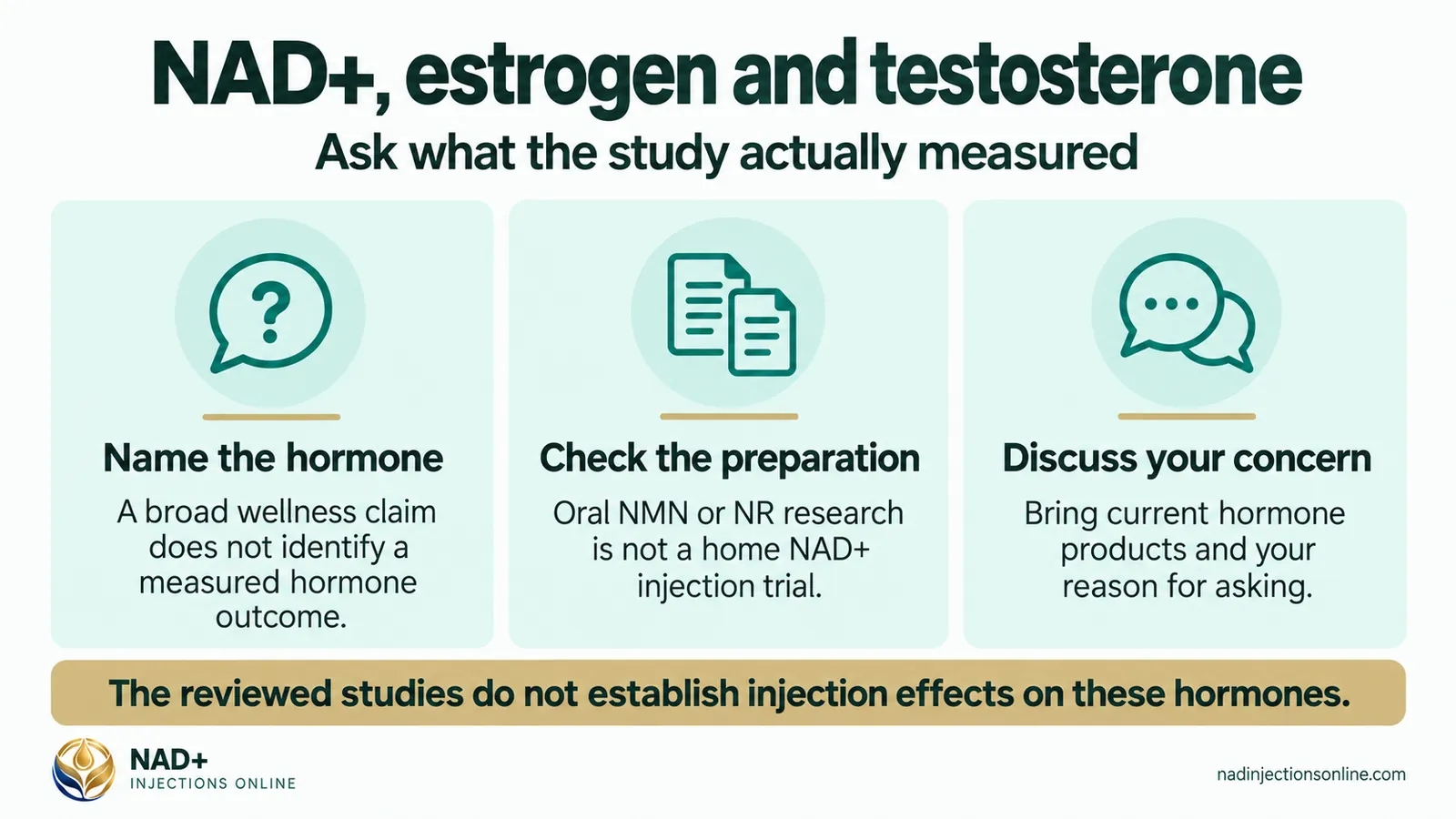
Identify the hormone and outcome before trying to interpret the claim. A statement that a product supports women does not tell you whether estrogen was measured or whether a symptom was assessed. Ask what change is being proposed and which source is meant to demonstrate it.
The NAD-related trial reviewed here involved oral NMN, a precursor, in postmenopausal women with prediabetes and overweight or obesity. Its metabolic focus does not establish an estrogen effect of prescribed NAD+ injections. The fact that participants were women cannot carry a conclusion the experiment did not test.
Keep ordinary biological explanations separate from intervention claims as well. Knowing that the body uses NAD in cellular processes does not establish that an injection changes a hormone level. A source should match the actual preparation and outcome before being used to support that statement.
The prescription overview provides context about NAD+ preparations. This page narrows the discussion to hormone assertions so you can ask a clear question rather than collect broad wellness claims.
What does the women’s study support?
It supports a description of research using oral NMN in a defined group, not a recommendation to treat menopause with an injection. The researchers examined muscle insulin sensitivity and related metabolic measurements. The selected participants and route are part of how that evidence should be described.
Calling it a study in postmenopausal women is accurate but incomplete. If a summary leaves out prediabetes, the oral precursor and the metabolic endpoint, a reader can easily assume a broader question was answered. Those omitted details determine how much the paper says about your reason for asking.
If you are looking for help interpreting estrogen or testosterone results, ask the professional about those results directly. Do not assume that a study with a matching age or sex tested your hormone concern. Similar participant characteristics do not make unrelated endpoints equivalent.
The useful question is not whether the paper is good or bad in general. It is whether it supports the claim being made in the sentence you are reading. A carefully conducted study can still be the wrong evidence for an injected-NAD hormone promise.
What about testosterone claims?
The reviewed men’s trial also does not establish a testosterone effect of NAD+ injections. Dollerup and colleagues studied oral NR in men with obesity and investigated metabolic parameters. This is a different molecule, route and research question from prescribing an injection to alter a hormone.
A statement that a study included men should not be treated as proof of a male hormone benefit. Ask whether the author has named the actual measured outcome. If the description moves from insulin sensitivity to testosterone without a matching source, the conclusion has moved beyond the cited result.
The trial reported that insulin sensitivity was not improved with its oral NR intervention. That result should stay limited to the studied intervention and endpoint. It does not show that every NAD-related product has no effect on every hormone or that a person’s existing treatment should change.
Keeping both boundaries matters. Avoid an unsupported promise of hormone benefit, and avoid an equally unsupported global statement that all hormone effects have been ruled out. The selected sources simply do not establish the injection outcome described in the headline.
How should I discuss perimenopause concerns?
Describe the specific concern to the clinician rather than using hormone balance as the entire explanation. Ask what needs evaluation and what evidence applies to any proposed medicine. The selected oral NMN trial does not turn a life-stage label into an established NAD+ injection indication.
If the question involves a laboratory result, bring the report and the instructions associated with it. If it involves an experience or change in daily life, describe that change in your own words. You do not need to diagnose the cause before asking for an assessment.
Ask what the proposed product is expected to address and how that expectation was formed. FDA encourages patients to understand a medicine’s purpose and monitoring. A clear answer should identify uncertainty when the supporting evidence is indirect or concerns another formulation.
The guide to research in women addresses broader study applicability. This hormone-focused guide does not replace an evaluation of your own reproductive or treatment history.
What if I already take hormones?
Include them in a complete medicine and supplement list before discussing another product. FDA recommends reviewing potential interactions with a physician or pharmacist. The selected studies do not establish that every existing hormone regimen is compatible with every NAD preparation.
Explain whether you are considering a separate product or have been offered a mixture. Ask which clinician should coordinate the question if different professionals manage the prescriptions. A combination’s appearance on a menu is not evidence that it has been tested in the same circumstances.
Do not replace an established prescription because an online page describes NAD as a route to hormone balance. Ask the clinician responsible for the existing treatment what the proposed change would mean and why it is being considered. The actual clinical question should stay visible.
Bring written product information so the discussion concerns ingredients and routes rather than shorthand labels. Ask how follow-up would work if a new product were prescribed and who should receive unexpected-effect reports. That gives practical clarity without assuming an interaction-free combination.
A useful way to check an estrogen claim is to ask for two details separately: why the study population is relevant, and which hormone outcome was measured. The selected postmenopausal NMN trial’s population does not make its muscle insulin-sensitivity endpoint an estrogen result. If a claim concerns a prescribed NAD+ injection, ask for the additional evidence connecting that actual preparation to the stated hormone question.
What should I know about the product?
Compounded medications are prepared by a licensed pharmacy for an individual patient and are not FDA-approved. No approved label lists its uses or side effects, so the physician works from your history and clinical judgment, tells you what is known and what is uncertain, and sets how often you check in.
Any injectable can cause a reaction at the injection site or an allergic reaction, and NAD+ infusions are known for flushing and nausea when given quickly. Report anything unexpected to the physician the same day, and tell the physician about every medicine and supplement you take before anything is prescribed.
For severe allergic symptoms such as breathing difficulty or throat swelling, seek emergency care and call 911. Emergency care takes priority over a routine same-day report.
Treatment requires a prescription. A licensed clinician evaluates you by telehealth and decides whether any medication is appropriate. Booking does not guarantee a prescription.
A prescription pathway does not establish a hormone outcome by itself. Ask the prescriber to distinguish the reason for considering the product from an unverified claim you may have read. A laboratory change, a proposed mechanism and a symptom goal remain separate questions.
Use the benefits evidence guide when you want to understand how the selected studies relate to broader claims. Keep hormone-medication changes within the plan of the professional responsible for that care rather than using this article as an instruction.
What a physician weighs
Ask which hormone or concern is actually being assessed, what evidence matches the proposed preparation and how existing prescriptions affect the decision. Bring the product labels and any relevant report so the clinician can address your question precisely.
Does NAD affect estrogen or testosterone: common questions
Is NAD+ itself estrogen or testosterone?
It is a coenzyme with a different molecular role; the selected sources do not present it as either hormone.
Does an NMN study establish injection effects?
No. Keep the oral precursor and its measured metabolic outcome attached to the finding.
Does a male study prove testosterone benefit?
Participant sex alone does not establish that the proposed hormone outcome was demonstrated.
Can I use NAD+ to replace hormone treatment?
Discuss treatment changes with the clinician responsible for the existing prescription; this guide does not authorize replacement.
Should I list nonprescription products too?
Yes. Include supplements and nonprescription medicines when reviewing another product.
Does a research gap prove no effect is possible?
The absence of support in these selected sources is not proof that all effects have been ruled out.
A useful hormone discussion starts with a defined concern and the actual proposed medicine. Ask for evidence that matches both before treating a broad NAD claim as an answer.
Where this guide comes from
The register citations and the public sources behind the text.
Sources (7)
- Yoshino M, Yoshino J, Kayser BD, et al. Nicotinamide mononucleotide increases muscle insulin sensitivity in prediabetic women. Science. 2021;372(6547):1224-1229. (pubmed.ncbi.nlm.nih.gov)
- Dollerup OL, Christensen B, Svart M, et al. A randomized placebo-controlled clinical trial of nicotinamide riboside in obese men: safety, insulin-sensitivity, and lipid-mobilizing effects. Am J Clin Nutr. 2018;108(2):343-353. (pubmed.ncbi.nlm.nih.gov)
- Covarrubias AJ, Perrone R, Grozio A, Verdin E. NAD(+) metabolism and its roles in cellular processes during ageing. Nat Rev Mol Cell Biol. 2021;22(2):119-141. (pmc.ncbi.nlm.nih.gov)
- FDA: Drug interactions (fda.gov)
- FDA: Compounding questions and answers (fda.gov)
- FDA: medicine benefits and risks (fda.gov)
- MedlinePlus: Anaphylaxis (medlineplus.gov)
Put the question to a physician
The guides explain; the physician decides. Start from home, with a wellness consultant explaining the steps and the cost first.
Currently available to adults physically located in Florida at the time of their consultation. For adults 18 and older. Contacting NAD Injections Online does not guarantee treatment and creates no obligation.