NAD+ and breast cancer in 2026: the research limits
NAD+ and cancer: what studies show and what to ask
NAD+ and breast cancer research comes mostly from lab and animal studies, and it points in different directions: NAD+ supports healthy cells but may also fuel some cancer cells. If you have or had cancer, talk to your oncologist and the physician before considering NAD+.

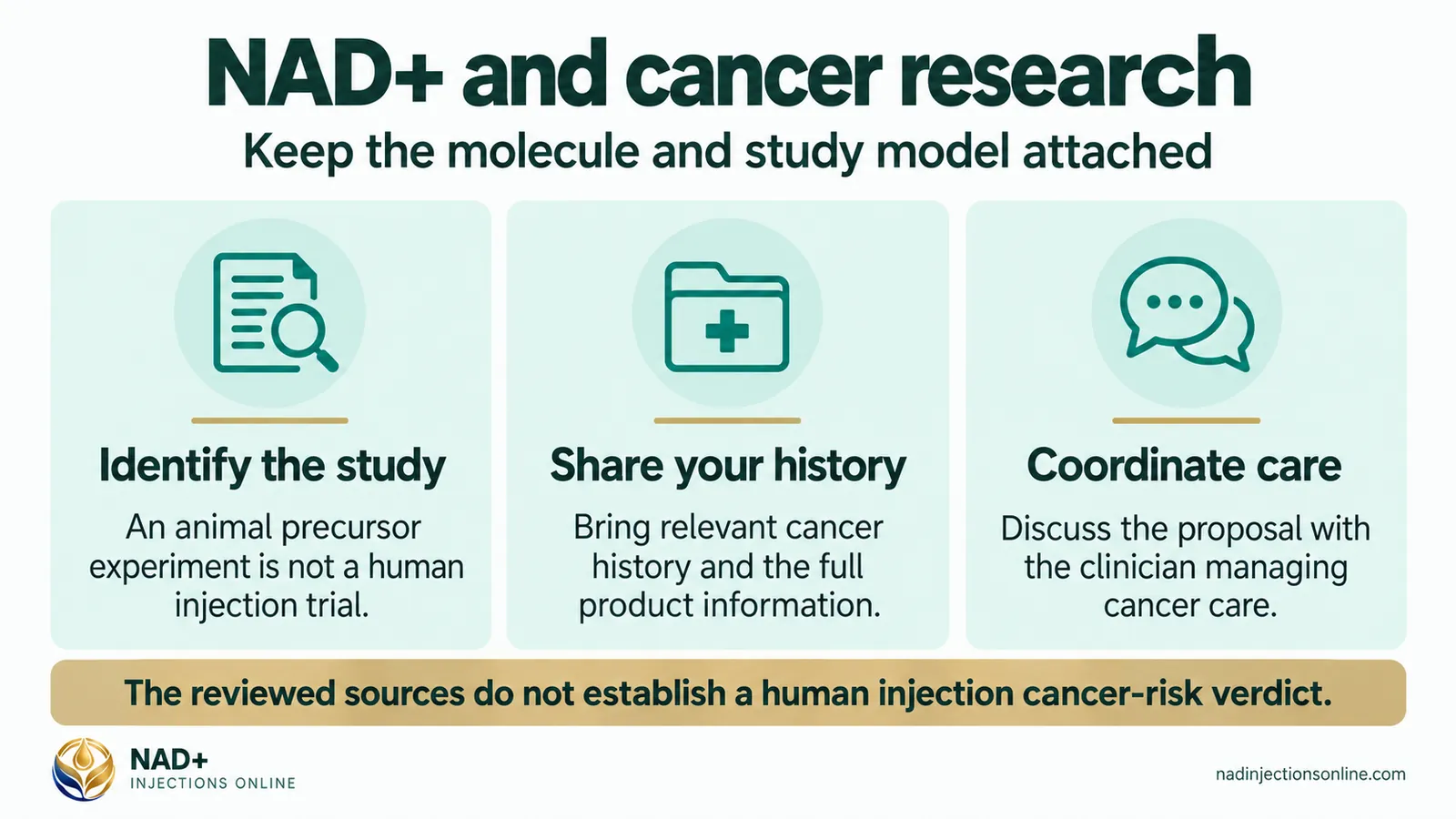
NAD and breast cancer searches often mix normal NAD biology, precursor experiments and personal treatment questions. The reviewed sources do not establish a human cancer-risk verdict for nicotinamide adenine dinucleotide (NAD+) injections. If you have a cancer history or current treatment, bring the proposed product to the clinician responsible for that care.
- Your question: what the proposed preparation means for your own care.
- The animal paper: NR supplementation in a particular breast-cancer model.
- Background biology: why NAD pathways interest researchers.
- The prescribing decision: the reason for use, relevant history and remaining uncertainty.
What should I tell my clinician?
Explain your relevant cancer history and which NAD product you are considering or already using. Give the ingredient name and route, not only the brand. FDA’s medicine-interaction guidance supports reviewing prescription products, nonprescription medicines and supplements together before adding something new.
Bring a current product list and the pharmacy or seller information. Ask whether the clinician managing cancer care should communicate with the NAD prescriber. Coordinating the question helps avoid a situation in which each professional assumes the other has already assessed the proposed preparation.
State the reason you were interested in NAD. A general wellness interest, an online recommendation and a symptom that needs evaluation are different reasons to start a conversation. Do not describe the product as cancer prevention or treatment unless an appropriately supported clinical recommendation actually concerns that use.
The prescribed NAD+ overview describes the product pathway, but it cannot give individual cancer clearance. Your history and the preparation need their own clinical discussion, especially when evidence from a general article does not answer the question directly.
Which study raised the breast-cancer concern?
An often-discussed experiment by Maric and colleagues used nicotinamide riboside, an NAD precursor, in a triple-negative breast cancer animal model. The researchers reported increased cancer prevalence and brain metastases in that model. This should be described as a preclinical finding, with the compound and species clearly stated.
It was not a trial of prescribed NAD+ injections in patients. That difference prevents the study from supplying a personal risk estimate for someone holding a pharmacy vial. It also prevents a conclusion that every NAD-related product has the same effect under all circumstances.
At the same time, a research concern should not be dismissed simply because it is inconvenient. You can ask your clinician how such findings affect their reasoning without pretending that the experiment answered the full human question. The useful discussion identifies what is relevant and what remains uncertain.
If you encounter a quotation from the paper, check whether the surrounding text still says NR and animal model. A headline that replaces both with a universal statement about NAD injections has changed the scope of the result. Keep the original scope when bringing it to a consultation.
Are NAD+ and NR the same intervention?
No. NAD+ is the coenzyme itself, while NR is a precursor connected to its synthesis. A study of one intervention does not establish all outcomes of the other. That distinction matters in cancer discussions because the ingredient is part of the research question, not a minor detail.
The route matters as well. Information about a supplemented precursor should not be presented as though it tested the exact injectable prescription under consideration. Ask what product was used, which population was studied and what outcome was observed before accepting the comparison.
A background review can explain NAD metabolism and why researchers investigate it. It cannot by itself establish that a particular injection changes cancer risk for a patient. Mechanistic plausibility and measured clinical outcomes are different kinds of information.
This does not mean you must ignore indirect evidence. It means the clinician should identify it as indirect when explaining a decision. A clear statement of uncertainty is more useful than confidence created by grouping several distinct preparations under the same acronym.
What does a cancer headline leave out?
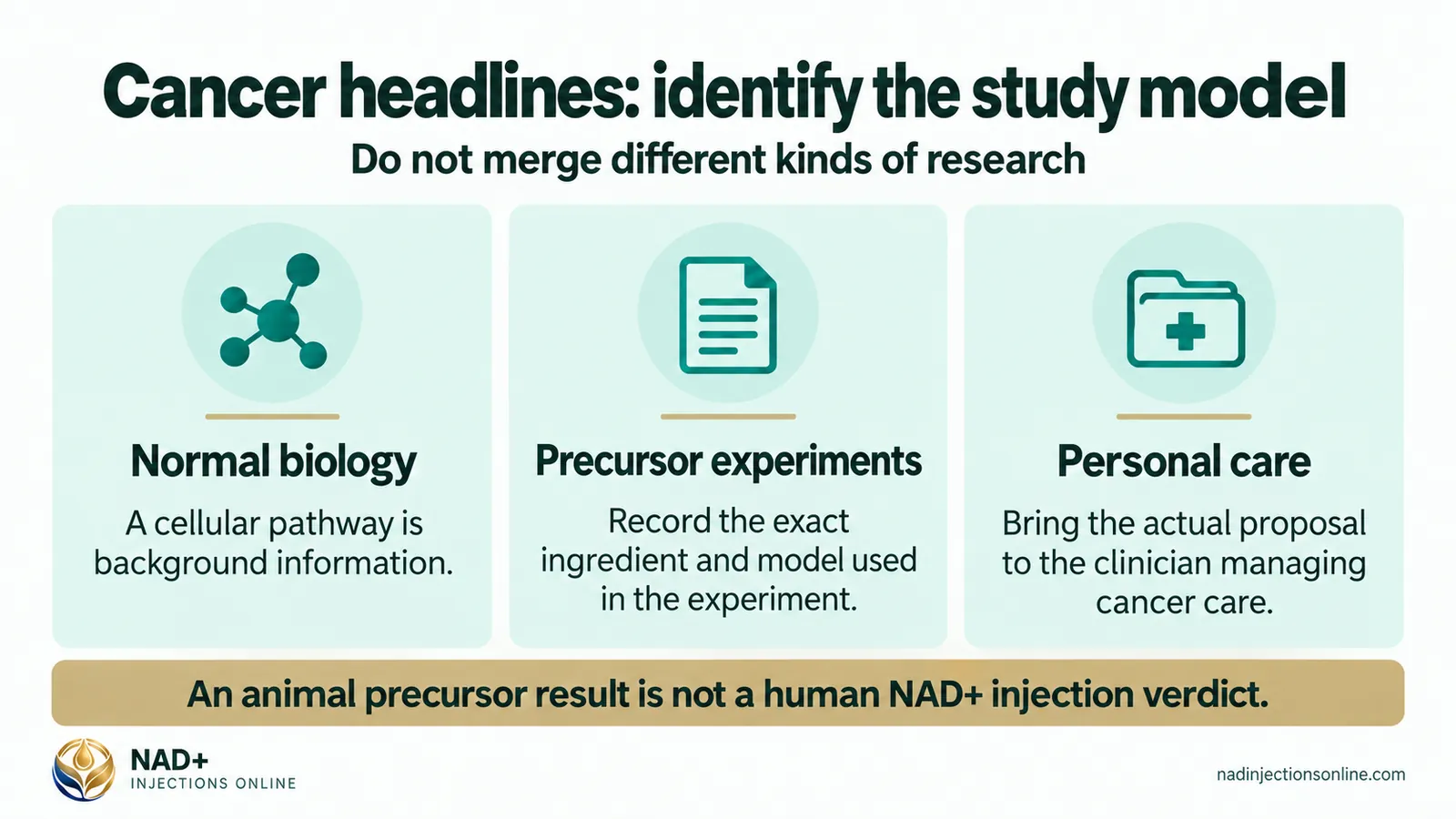
It may omit the compound, study model or endpoint that gives the finding its meaning. Cancer development, behavior of an existing cancer and an interaction with treatment are different questions. A paper about one cannot automatically answer all of them.
Look for a primary source rather than stopping at a summary. Check whether the claim concerns people, animals or cultured cells. Then ask whether the dose route and measured outcome match the prescription question you are trying to resolve, without copying any research protocol into your own use.
Be cautious about equally categorical reassurance. The fact that NAD is normally present in cells does not establish safety for every administered preparation. A statement about normal physiology needs clinical evidence before it becomes a conclusion about a patient’s risk.
Write down the specific claim that worries you and the source it cites. The clinician can then address that claim rather than guessing which version you have seen. This also makes it easier to distinguish an evidence-based concern from a conclusion that went beyond the study.
What if I’ve already received injections?
Tell the relevant clinicians and give them the actual product details. Ask how they want the information incorporated into your care and which professional should respond to further questions. A webpage cannot decide how to change an established cancer treatment.
Separate a concern about future cancer risk from symptoms occurring after use. They require different assessments. FDA’s NAD injectable alert describes severe chills, shaking, vomiting and fatigue, sometimes requiring treatment, and highlights possible endotoxin-related concerns from ingredients unsuitable for sterile compounding.
Those reports do not establish that the product caused cancer. They are important safety context for an injectable preparation and should not be repurposed into a cancer claim. If symptoms occurred, report them with the preparation information rather than waiting for the broader research debate to be settled.
The side-effects guide explains the difference between reported events and frequency estimates. The benefits guide addresses why a suggested benefit also needs evidence matching the preparation.
Keep a copy of the actual reference behind a breast-cancer claim, rather than only its headline. The selected paper tested NR in a triple-negative breast cancer animal model. Ask the clinician which part of that result is relevant to the proposed preparation and which part cannot be transferred to a person. A model-specific safety concern deserves an accurate explanation without turning it into either universal clearance or a measured human injection risk.
What general safety wording applies?
Compounded medications are prepared by a licensed pharmacy for an individual patient and are not FDA-approved. No approved label lists its uses or side effects, so the physician works from your history and clinical judgment, tells you what is known and what is uncertain, and sets how often you check in.
Any injectable can cause a reaction at the injection site or an allergic reaction, and NAD+ infusions are known for flushing and nausea when given quickly. Report anything unexpected to the physician the same day, and tell the physician about every medicine and supplement you take before anything is prescribed.
Treatment requires a prescription. A licensed clinician evaluates you by telehealth and decides whether any medication is appropriate. Booking does not guarantee a prescription.
Call 911 for severe allergic symptoms such as breathing difficulty or throat swelling. Emergency symptoms need emergency attention rather than a routine message asking whether the medicine is suitable. For other unexpected changes, contact the treating professional for an assessment.
The compounded-status disclosure describes regulatory status, not a result from a human cancer-risk study. Do not use it as proof that a preparation causes cancer or as assurance that its long-term risks have been measured. Keep those questions separate when reviewing the product.
What a physician weighs
Bring the actual preparation, your treatment history and the precise research claim to the consultation. Ask the clinician to explain whether the evidence is direct or indirect and how that affects the recommendation for your circumstances.
NAD and breast cancer: common questions
Was the animal study about every NAD product?
No. Its reported cancer findings concerned NR supplementation in a particular animal model.
Does it show that injections cause breast cancer?
It does not establish that human clinical conclusion for prescribed NAD+ injections.
Can normal cellular NAD settle safety?
Normal physiology does not replace evidence on an administered preparation in the relevant population.
Should supplements be included in my history?
Yes. FDA recommends reviewing them with other medicines when discussing a new product.
Does the FDA reaction alert concern cancer?
The reviewed alert concerns sterile-compounding ingredients and reported acute reactions, not a cancer-risk finding.
Can I use this guide as individual clearance?
No. Its purpose is to help you prepare evidence and product questions for the clinician.
Your cancer history deserves an individual answer tied to the actual preparation. Preserve the research’s limits and coordinate the question with the professionals responsible for your care.
Where this guide comes from
The register citations and the public sources behind the text.
Sources (6)
- Maric T, Bazhin A, Khodakivskyi P, et al. A bioluminescent-based probe for in vivo non-invasive monitoring of nicotinamide riboside uptake reveals a link between metastasis and NAD(+) metabolism. Biosens Bioelectron. 2023;220:114826. (pubmed.ncbi.nlm.nih.gov)
- Covarrubias AJ, Perrone R, Grozio A, Verdin E. NAD(+) metabolism and its roles in cellular processes during ageing. Nat Rev Mol Cell Biol. 2021;22(2):119-141. (pmc.ncbi.nlm.nih.gov)
- FDA: Compounding questions and answers (fda.gov)
- FDA: Drug interactions (fda.gov)
- FDA: ingredients suitable for sterile compounding (fda.gov)
- MedlinePlus: Anaphylaxis (medlineplus.gov)
Put the question to a physician
The guides explain; the physician decides. Start from home, with a wellness consultant explaining the steps and the cost first.
Currently available to adults physically located in Florida at the time of their consultation. For adults 18 and older. Contacting NAD Injections Online does not guarantee treatment and creates no obligation.