NAD+ while pregnant or breastfeeding: 2026 safety guide
NAD+ during pregnancy and breastfeeding: what to ask
NAD+ injections are not recommended while pregnant or breastfeeding, because their safety has not been studied in pregnancy or lactation. Tell the physician if you are pregnant, planning a pregnancy or breastfeeding before any NAD+ is prescribed.

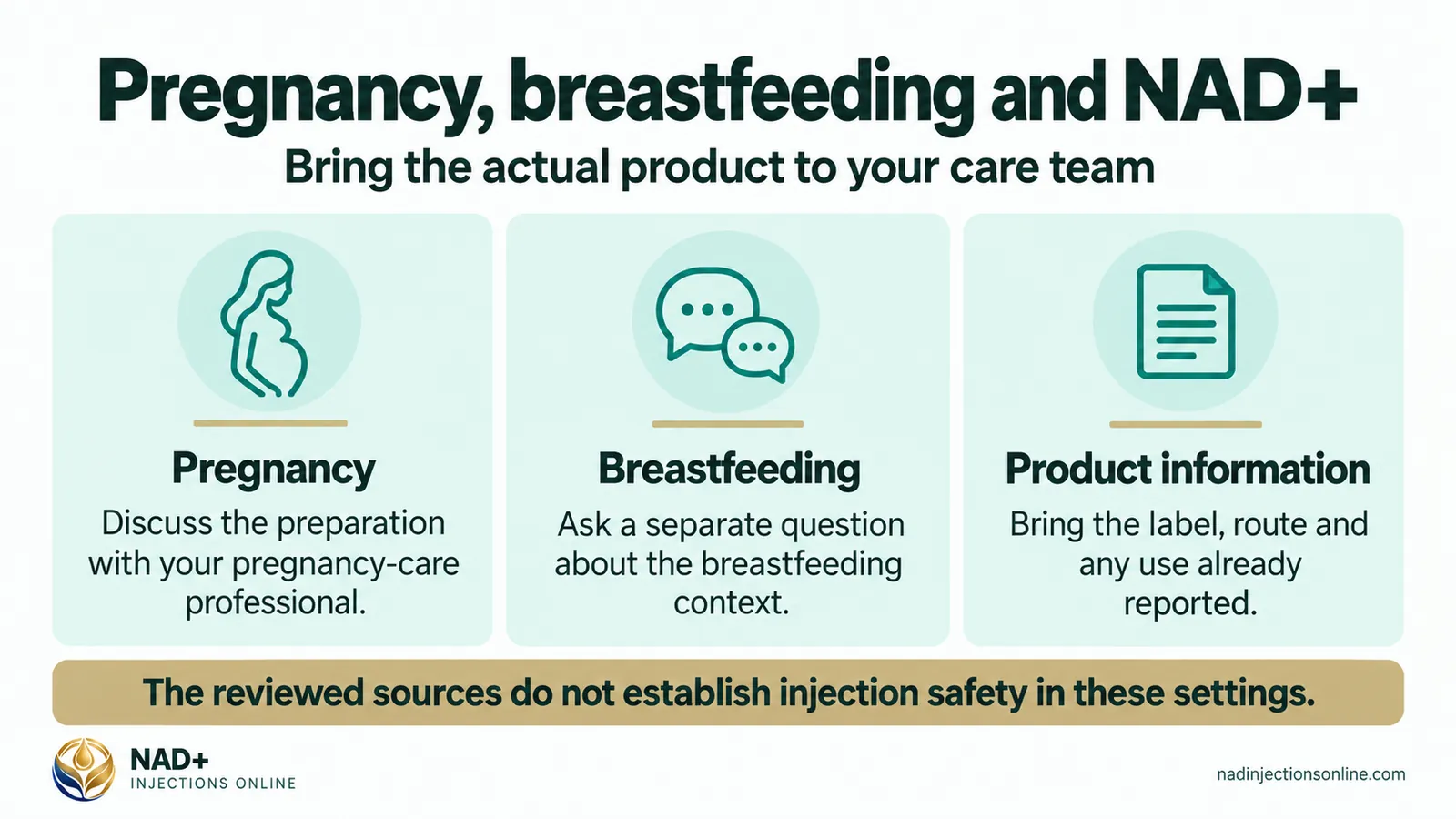
Can you take NAD while pregnant? Discuss the exact product with your pregnancy-care professional before considering it. The sources reviewed for this guide do not establish pregnancy or breastfeeding safety for prescribed nicotinamide adenine dinucleotide (NAD+) injections. Normal biological roles and mouse nutrient research do not supply a patient-specific safety answer.
- Before use: bring the ingredient list and ask about the proposed reason.
- After exposure: share the product, route and timing rather than drawing your own conclusion.
- While breastfeeding: request a separate assessment relevant to the infant and feeding situation.
- When reading research: distinguish dietary niacin in mice from injected NAD+ in people.
Who should answer my pregnancy question?
The professional responsible for your pregnancy care should be involved before you decide to use a new medicine or supplement. FDA recommends discussing these products with a healthcare professional and warns against assuming that natural establishes safety. Include NAD products in that conversation even if they were sold as a wellness item.
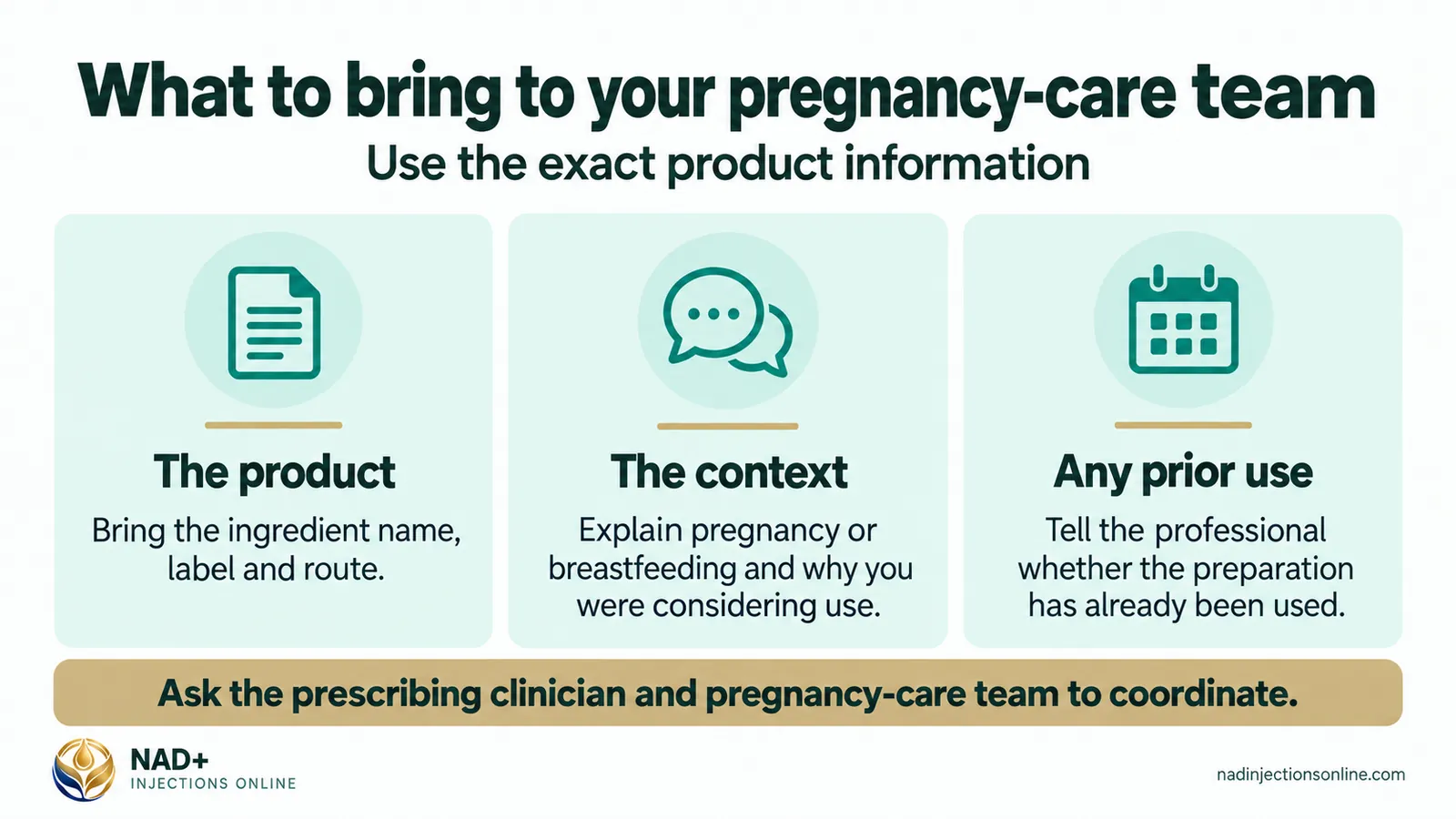
Bring the label, pharmacy information and any written recommendation you received. Explain why you were considering the preparation and whether use has already occurred. These details let the professional address the product you mean rather than a broad family of NAD-related ingredients.
If another clinician prescribed it, ask how that clinician and the pregnancy-care team should coordinate the assessment. You should not have to translate two different recommendations into a new plan yourself. Request clear instructions about what to do next and who to contact if the situation changes.
The overview of prescribed NAD+ describes the evaluation and pharmacy pathway. Pregnancy is a specific clinical context within that pathway, requiring an individual discussion rather than a conclusion from a general product description.
What information should I have ready?
Prepare the actual product information, not only the letters NAD. Include the ingredient name, the route, the dispenser and other ingredients shown on the packaging. An oral supplement, a nasal preparation and a prescribed injectable are different presentations, so name which one is involved.
Provide a list of all medicines, vitamins and supplements you use. FDA’s interaction guidance encourages discussing prescription and nonprescription products together. A product from a separate website or a previous prescription still belongs in the history if it is relevant to current use.
Say whether you are planning pregnancy, pregnant, breastfeeding or asking after an earlier exposure. If there is a known timing, write it down; if you are uncertain, say that instead of choosing an approximate detail that sounds more definite. The aim is an accurate account, not a perfect narrative.
Ask for the reasoning as well as the instruction. If the professional recommends avoiding, changing or reviewing a product, ask which facts informed that decision and how it relates to your own circumstances. This helps distinguish individual advice from a blanket statement about every reader.
Why isn’t normal NAD biology enough?
Biological importance does not establish that a particular administered preparation is suitable during pregnancy. A molecule’s role inside the body and the consequences of using a medicine are different questions. The label natural cannot answer the second one.
The rare-deficiency research sometimes discussed in this area examined defects in NAD synthesis in affected human families and mouse models. Its experimental gestational intervention used dietary niacin in mice. That is not a trial establishing safety or benefit from NAD+ injections during pregnancy.
The distinction also applies to prenatal nutrition. A recommendation concerning a nutrient does not automatically become a recommendation for a related compounded injection. Ask the pregnancy-care professional to explain which preparation and evidence a recommendation actually concerns.
An article should be able to describe these limits without claiming that every exposure causes harm. The reviewed research does not justify that claim either. The appropriate next step is a discussion of the actual preparation and your health context, rather than a universal conclusion from an appealing biological explanation.
What if I have already used it?
Contact the pregnancy-care professional with the product details and a factual account of use. Explain the route and timing you know, who supplied it and whether any symptoms occurred. Keep the packaging or pharmacy information available in case the clinician needs further clarification.
An exposure does not by itself determine an outcome. Avoid interpreting an online story as reassurance or proof of harm for your own situation. The reviewed sources do not provide a risk estimate that can be applied to every NAD preparation and every pregnancy.
Ask what further information would be useful and how the prescriber should be involved. If you cannot identify an ingredient or formulation, the dispenser may be able to clarify it. Do not make the information appear more complete than it is; uncertainties can be part of the assessment.
Keep unrelated prescribed treatments within their own clinical plan while you obtain advice. A general guide cannot decide which medicines are necessary for another condition or how a sudden change would affect you. Ask the clinician responsible for that condition before changing its treatment.
Does breastfeeding need its own advice?
Yes. Ask a question specifically about breastfeeding rather than assuming that a pregnancy answer covers it. FDA advises asking whether a medicine reaches milk and what that could mean for a baby. The answer needs to concern the actual product and your feeding circumstances.
Describe the preparation and any exposure already received. Ask whether the maternal prescriber and the baby’s healthcare professional should both be involved. If information is limited, request an explanation of the remaining uncertainty and how it affects the proposed decision.
A study on an oral precursor in nonbreastfeeding adults does not establish the milk-exposure profile of NAD+ injections. Nor can a mouse nutrient experiment supply an infant-safety conclusion. Keeping the population and formulation attached to a study prevents those substitutions.
Do not create a waiting period, milk-discarding instruction or restart rule from another product’s webpage. Ask for instructions relevant to your own preparation. For adjacent questions, the women’s evidence guide and hormone discussion address different research questions without replacing this assessment.
If a reference to niacin in pregnancy is offered as reassurance about NAD injections, ask for the actual intervention and research setting. The selected congenital-deficiency paper includes affected families and experimental mouse work; its dietary niacin intervention in mice is not a human injection safety assessment. Bring the proposed or already supplied product to the pregnancy-care professional so that the question concerns the real preparation and circumstances.
What safety context should I understand?
Compounded medications are prepared by a licensed pharmacy for an individual patient and are not FDA-approved. No approved label lists its uses or side effects, so the physician works from your history and clinical judgment, tells you what is known and what is uncertain, and sets how often you check in.
Any injectable can cause a reaction at the injection site or an allergic reaction, and NAD+ infusions are known for flushing and nausea when given quickly. Report anything unexpected to the physician the same day, and tell the physician about every medicine and supplement you take before anything is prescribed.
Treatment requires a prescription. A licensed clinician evaluates you by telehealth and decides whether any medication is appropriate. Booking does not guarantee a prescription.
FDA separately reports severe chills, shaking, vomiting and fatigue after NAD injectable drugs and warns about ingredients unsuitable for sterile compounding. Some reports required medical treatment. The agency relates these events to possible excessive endotoxins; the reports are not a pregnancy-specific risk study.
If you have breathing difficulty or throat swelling, seek emergency care and call 911. Give other unexpected symptoms to the treating professional along with the product information. A routine message about pregnancy safety should not delay emergency attention to severe symptoms.
What a physician weighs
Prepare the product label, the reason for considering it and an accurate list of other products. Ask how the available evidence applies to your reproductive situation and who should coordinate the next decision. If you have already received a product, focus on a clear account of exposure.
NAD while pregnant: common questions
Does natural establish pregnancy safety?
FDA advises against relying on that assumption. Discuss the actual product with the pregnancy-care professional.
Did the cited mouse study use injections?
Its gestational intervention involved dietary niacin, rather than a human NAD+ injection regimen.
Should I include supplements in my history?
Yes. FDA recommends discussing medicines, vitamins and dietary supplements with the healthcare professional.
What if I cannot identify the product?
Keep the packaging and contact the dispenser for clarification, then share that information with the clinician.
Does this guide declare every exposure harmful?
No. The reviewed sources do not establish that conclusion or supply an individual risk estimate.
Can I borrow another product’s breastfeeding rule?
Ask for preparation-specific professional advice instead of applying a waiting or feeding rule from another product.
The most useful pregnancy or breastfeeding question includes the actual preparation and your circumstances. Bring both to the professional responsible for the relevant care.
Where this guide comes from
The register citations and the public sources behind the text.
Sources (6)
- FDA: Medicine and Pregnancy (fda.gov)
- Shi H, Enriquez A, Rapadas M, et al. NAD Deficiency, Congenital Malformations, and Niacin Supplementation. N Engl J Med. 2017;377(6):544-552. (pubmed.ncbi.nlm.nih.gov)
- FDA: Compounding questions and answers (fda.gov)
- FDA: Drug interactions (fda.gov)
- FDA: ingredients suitable for sterile compounding (fda.gov)
- MedlinePlus: Anaphylaxis (medlineplus.gov)
Put the question to a physician
The guides explain; the physician decides. Start from home, with a wellness consultant explaining the steps and the cost first.
Currently available to adults physically located in Florida at the time of their consultation. For adults 18 and older. Contacting NAD Injections Online does not guarantee treatment and creates no obligation.