NAD+ nasal spray vs injection in 2026
NAD+ nasal spray or injection: comparing the routes
NAD nasal spray vs injection is a choice of route the evidence has not settled: the spray is absorbed through the nasal lining, the injection goes under the skin. Neither has strong human trials showing better results, so the physician weighs your history and preference.
NAD nasal spray and prescribed NAD+ injections need separate evidence assessments. Nicotinamide adenine dinucleotide (NAD+) research reviewed here does not establish a clinical winner between those routes. A preclinical intranasal experiment and a human intravenous pilot cannot tell you that a spray and a home injection produce equivalent results.
For a discussion of prescribed NAD+ treatment, bring the actual product information and explain why the route matters to you. This page helps prepare that conversation without giving spray instructions, injection training or a dosing comparison.
Which product are you asking about?
Name the actual preparation before comparing formats. A search result may describe a nasal product without fully identifying its ingredients. Ask whether it refers to NAD+ itself, a precursor or a combination. Use the ingredient information when you take the question to a clinician.
Do the same for the injection side of the comparison. A broad product category does not identify every preparation described within it. Ask which product and route the explanation concerns, rather than assuming that every page uses the same thing.
What if a page lists several forms?
Ask which form is being considered in your individual evaluation. A list of possible presentations should not be read as a prescription decision. Keep the question about availability separate from the question about what a clinician considers appropriate.
Useful information to collect includes:
- The complete ingredient name.
- The product presentation.
- The intended route.
- The exact claim that prompted your question.
- The source offered for that claim.
This information helps the clinician address a specific product. It is not a way to certify suitability from a website.
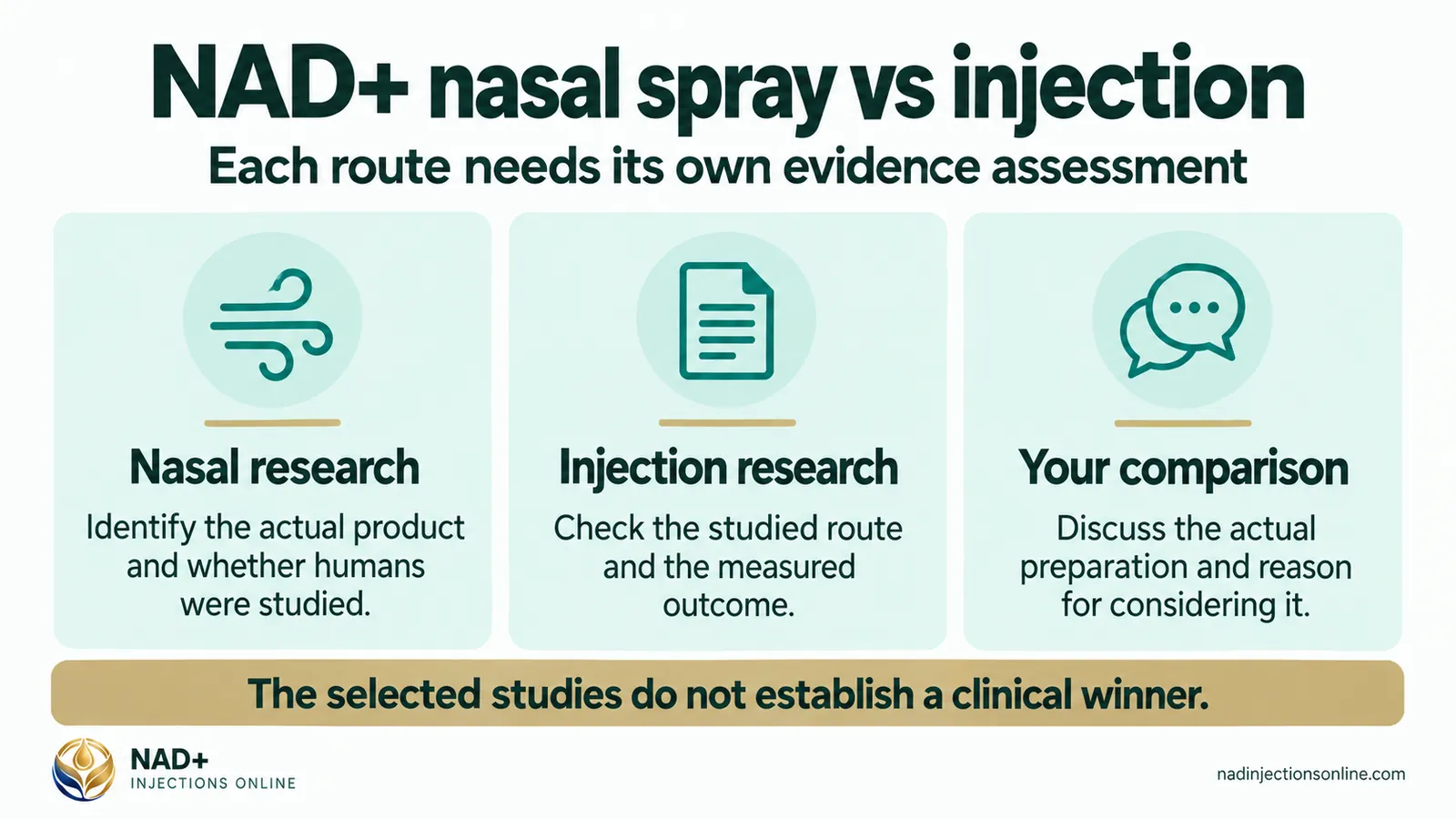
What matters about administration preferences?
Explain whether your question is about the format or a claimed effect. You may want to discuss a non-injected option, or you may want to understand what a prescribed injection would involve. A clear preference is easier to address than an unstated assumption that one route must work better.
Ask what information and support would accompany the actual preparation. If the discussion concerns an injection, ask what training would be needed. If it concerns a nasal product, ask who would explain its device and instructions. Do not use another product’s directions to fill an information gap.
Does avoiding a needle establish benefit?
It establishes a preference, not the answer to an effectiveness question. Keep the two discussions separate. You can say that you prefer a format while also asking what evidence supports the clinical claim being made about it.
If the answer focuses only on convenience, return to the outcome question you intended to ask. If your concern is administration alone, make that equally clear. Both are legitimate subjects, but they should not be treated as interchangeable evidence.
The guide to how injections are given addresses the prescribed route and setting. It should complement an explanation from the clinician and pharmacist, rather than become a universal tutorial.
What does the nasal study show?
An intranasal NAD study used cultured human olfactory cells and mice with induced smell loss; it did not establish wellness benefits or comparative absorption in people.1
That experiment included cultured human olfactory cells and mice with induced smell loss. Human cells in a laboratory are different from people receiving a treatment. The study therefore does not establish human wellness outcomes or a comparative absorption result for nasal spray versus injection.
Read summaries carefully when the word human appears. Ask whether it describes participants or the origin of cells used in an experiment. That small distinction changes how directly the research answers a patient question.
Does it prove a spray works in people?
The reviewed preclinical source does not establish that conclusion. It also does not supply a human safety comparison or a ranking against a prescribed injection. Those are questions outside the experimental scope described here.
Ask for the source that matches the actual product and intended result. If the answer relies on a different preparation or model, request an explanation of the remaining uncertainty. An interesting experiment can be relevant background while leaving your question open.
Why does IV research not settle it?
A small pilot study measured how a six-hour intravenous NAD+ infusion changed NAD+ and related metabolites in blood and urine.2
The pilot used an intravenous infusion, not a nasal product or a home injection into tissue. Its measurements concern the studied route. They cannot establish the amount absorbed, the onset or the clinical effect of a different preparation.
If a product page quotes the infusion study, ask which claim the author intends it to support. Do not assume that an IV observation supplies the missing result for every other route. A useful explanation should state the mismatch in the same passage as the research.
Can I compare timelines across routes?
The selected infusion study does not validate a nasal-spray timeline or a home-injection timeline. Its metabolite observations are not a direct comparison of those preparations.
The existing route-overview guide covers the separate IV comparison. Use that overview to distinguish the categories, then return to the narrower nasal-versus-injection question when discussing your product.
When asking about timing, specify what you mean. A claim about measured body handling should not silently become a promise about when you will notice a result.
How should the evidence be compared?
Compare the ingredient, formulation, route, study population and endpoint. A closer match makes the source more relevant to the claim, though it does not remove the need to assess the study itself. If one of those details changes, ask what the change means for interpretation.
Avoid tables that assign a simple winner without showing the basis for the ranking. Ask whether the comparison measured the actual products or assembled observations from unrelated studies. A table can be clear and attractive while still comparing different questions.
What can remain uncertain?
The sources reviewed here do not provide a direct human nasal-versus-home-injection effectiveness comparison. That statement is limited to these sources. It does not claim that the entire research literature has been exhausted.
A clinician may explain uncertainty rather than offer a route ranking. Ask what information would be needed to answer your question more confidently. Understanding the limit is useful when the alternative is an unsupported conclusion.
What does a physician weigh?
Describe the reason you are considering the preparation, your format preferences and the claim you encountered. Ask how the clinician interprets the actual evidence and what product-specific information the pharmacist would provide. Keep a complete account of medicines and supplements available for the evaluation.
Compounded medications are prepared by a licensed pharmacy for an individual patient and are not FDA-approved. No approved label lists its uses or side effects, so the physician works from your history and clinical judgment, tells you what is known and what is uncertain, and sets how often you check in.
Any injectable can cause a reaction at the injection site or an allergic reaction, and NAD+ infusions are known for flushing and nausea when given quickly. Report anything unexpected to the physician the same day, and tell the physician about every medicine and supplement you take before anything is prescribed.
For severe allergic symptoms such as breathing difficulty or throat swelling, seek emergency care and call 911. Emergency care takes priority over a routine same-day report.
The infusion statement above belongs to an infusion discussion, rather than establishing a frequency for nasal or home-injection reactions.
Treatment requires a prescription. A licensed clinician evaluates you by telehealth and decides whether any medication is appropriate. Booking does not guarantee a prescription.
NAD nasal spray vs injection: common questions
Is the selected nasal research a human trial?
It used cultured human cells and mice, not a clinical trial establishing wellness outcomes in people.
Does an IV study establish spray absorption?
No. The selected infusion pilot studied a different route.
Are the routes established as equivalent?
The reviewed sources do not establish equivalence between a nasal product and a home injection.
Can I use one product’s instructions for another?
Ask for instructions for the actual dispensed preparation. Do not fill unclear directions with information from another product page.
Does a prescription mean FDA approval?
Compounded drugs are not FDA-approved; a prescription does not change that status.
What should I say about my preference?
Explain the practical concern directly, then ask separately about the evidence for the proposed preparation.
Where this guide comes from
The register citations and the public sources behind the text.
Sources (8)
- Yoo SH, Jang JY, Bae JS, et al. Therapeutic effect of intranasal nicotinamide adenine dinucleotide in the restoration of olfactory dysfunction. Exp Mol Med. 2026;58(7):2155-2167.
- Grant R, Berg J, Mestayer R, et al. A Pilot Study Investigating Changes in the Human Plasma and Urine NAD+ Metabolome During a 6 Hour Intravenous Infusion of NAD. Front Aging Neurosci. 2019;11:257.
- Yoo SH, Jang JY, Bae JS, et al. Therapeutic effect of intranasal nicotinamide adenine dinucleotide in the restoration of olfactory dysfunction. Exp Mol Med. 2026;58(7):2155-2167. (pubmed.ncbi.nlm.nih.gov)
- Grant R, Berg J, Mestayer R, et al. A Pilot Study Investigating Changes in the Human Plasma and Urine NAD+ Metabolome During a 6 Hour Intravenous Infusion of NAD. Front Aging Neurosci. 2019;11:257. (frontiersin.org)
- FDA: Compounding questions and answers (fda.gov)
- FDA: Drug interactions (fda.gov)
- FDA: buying medicine online (fda.gov)
- MedlinePlus: Anaphylaxis (medlineplus.gov)
Put the question to a physician
The guides explain; the physician decides. Start from home, with a wellness consultant explaining the steps and the cost first.
Availability depends on your state: you must be located in a state where an independent physician is licensed to treat you at the time of your consultation. For adults 18 and older. Contacting NAD Injections Online does not guarantee treatment and creates no obligation.