Do NAD+ patches work? What 2026 evidence shows
NAD+ patches: delivery claims and what to check
NAD+ patches have no published human studies showing they raise NAD+ levels. NAD+ is a large, charged molecule that passes through skin poorly, so look for independent absorption data before trusting a patch’s delivery claims.
NAD patches need evidence for the actual patch, ingredient and claimed result. The oral-precursor and intravenous studies discussed in this guide do not answer whether a consumer patch delivers NAD+ through skin or produces a meaningful benefit. Research on another preparation should stay attached to that preparation.
If you are comparing a patch with prescribed NAD+ injections, begin by identifying what you want the comparison to answer. This guide helps you organize the information to request before a consultation, without ranking one route as better.
What exactly is the patch promising?
Start with the sentence that persuaded you to look at the product. Does it describe an ingredient, promise absorption or claim a change you would notice? Those are different statements. Write the claim down in the seller’s own wording so you can ask about it precisely.
Next, decide what would count as a useful answer. If your concern is avoiding needles, the question is about the format. If your concern is a clinical result, the answer needs evidence about that result. A convenient presentation does not resolve an evidence question by itself.
What if the page just says works?
Ask the seller to name the outcome and the method used to measure it. An answer about the patch staying in place does not address a question about a health effect. Likewise, an explanation of why NAD is biologically interesting is not a measurement of what the patch delivered.
You can use these labels to keep the discussion clear:
- Ingredient question: what is actually listed in the product?
- Delivery question: what did a relevant experiment measure?
- Outcome question: what result is being promised?
- Applicability question: does the cited preparation match this one?
- Decision question: who can address your individual medical concerns?
These are questions to ask, not a checklist that certifies a product. A page can contain all the expected headings and still leave the evidence connection unexplained.
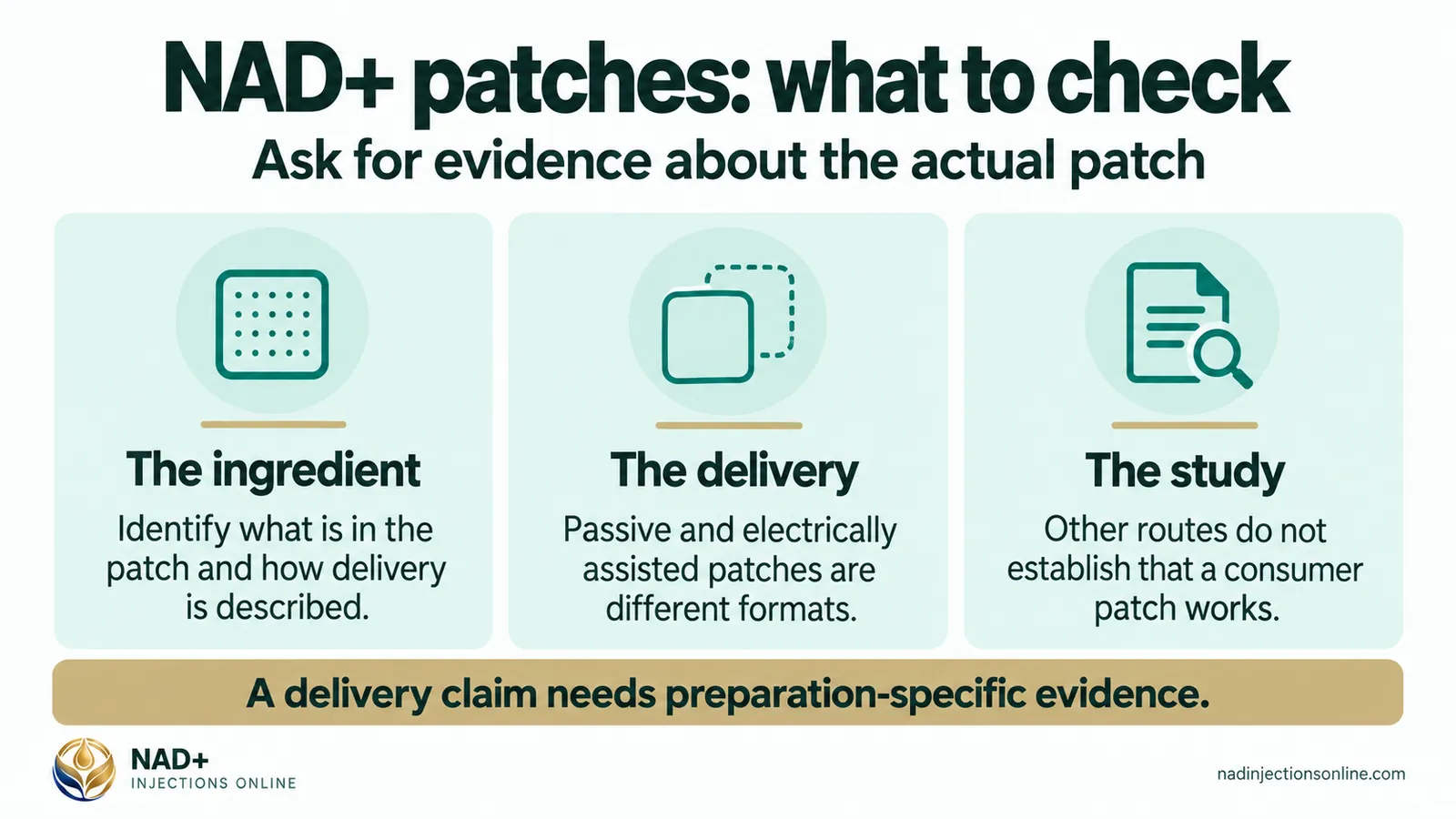
Is it passive or electrically assisted?
An ordinary adhesive patch and an iontophoresis device are different systems. The FDA technical description reviewed for this guide includes electrodes and an electronic module in a particular assisted-delivery device. That device example should not be assumed to describe a passive consumer patch.
Look for a concrete explanation of the product’s construction. If the sales page mentions electrical assistance, ask which device it means. If it shows only an adhesive patch, ask how the cited device research relates to the product in the photograph.
Does a cleared device approve the ingredient?
FDA device materials do not establish that NAD+ itself has been approved for the proposed use. They also do not demonstrate a clinical benefit from whichever patch a shopper is considering. The device question and the ingredient question need separate answers.
Avoid accepting an answer that moves between them without explanation. You can ask whether the regulatory document names the exact device, whether the study used the exact ingredient and whether the claim concerns the same result. Keep any unresolved difference visible in your notes.
A technical-sounding delivery description is useful only when you can connect it to the actual product. If the seller cannot explain that connection plainly, bring the uncertainty forward rather than deciding that the product must use the studied technology.
What do the cited studies test?
In a study of healthy middle-aged and older adults, oral supplementation with an NAD+ precursor (nicotinamide riboside) raised blood NAD+ levels and was well tolerated.1
That research used oral nicotinamide riboside, an NAD+ precursor. It did not test a patch containing nicotinamide adenine dinucleotide. Its blood measurements and tolerability findings cannot supply the missing evidence for a passive patch’s delivery or your intended clinical result.
A small pilot study measured how a six-hour intravenous NAD+ infusion changed NAD+ and related metabolites in blood and urine.2
The infusion pilot used an intravenous route. It cannot show how much of a patch ingredient crosses skin, and it cannot establish the same timing for a different preparation. The distinction is about applying the study accurately rather than dismissing the research.
What should I look for in a paper?
Find the preparation, route, population and measured outcome. Compare each with the claim you saved from the product page. You do not need to understand every technical term to notice that a capsule, an infusion and an adhesive patch are different presentations.
The guide to what NAD+ research measures offers a broader explanation. For your patch question, stay with the exact evidence connection. If the source only provides background, ask what separate research supports the product-specific promise.
A careful answer can acknowledge that a study is relevant to the wider subject while saying it does not answer this particular question. That is more informative than treating every NAD-related paper as interchangeable support.
How should I read the ingredients?
Read the complete ingredient information rather than relying on the largest word on the package. Note whether the page names NAD+, a precursor or a blend. If an abbreviation is unclear, request its full name and ask which ingredient the cited evidence actually concerns.
Some online descriptions use patch language for cosmetic products. Clarify whether the seller is describing an effect on the skin’s surface, a delivery claim or something else. Your comparison should follow the actual intended use rather than the broad search term that brought you to the page.
What about a multi-ingredient patch?
Ask whether the seller has evidence for the complete product or only for an individual component. A reference attached to one ingredient should not silently answer a question about the whole blend. Request that distinction in writing if the page leaves it ambiguous.
Record these product details for the conversation: the full name, ingredient list, delivery-system description and the claim you want explained. A screenshot can help preserve the wording you encountered. It is a way to make the question specific, rather than proof that the claim is correct.
If the discussion changes to a different ingredient or route, ask why. You should be able to follow the explanation from your original question to the source being offered. A long list of scientific terms is not a substitute for that connection.
What if I prefer a patch?
Say that preference directly during a consultation. Explain whether it comes from the format, uncertainty about injections or the claims you have read. A clinician can discuss the question you actually have more clearly when it is separated from an assumption that all NAD-related products provide the same result.
Ask which uncertainties would remain even if you chose another route. Changing the presentation does not remove the need to identify the preparation and the evidence supporting it. The conversation should address your reason for considering a prescription rather than use an uncertain patch claim as the reason to recommend one.
Can a comparison establish the best route?
The selected oral NR and IV NAD+ studies do not rank a consumer patch against a prescribed home injection. Their findings cannot establish that an injection is superior merely because the patch was not studied in those experiments.
Use the guide to injections and supplements to organize the product categories. Then ask for the preparation-specific explanation that applies to your situation. An unresolved comparison is a reason to clarify the evidence, not a reason to fill the gap with a sales claim.
What does a physician weigh?
Bring the product information, your reason for considering it and a complete account of what you already take. Ask which parts of the patch claim the clinician can evaluate and what remains uncertain. Keep that discussion separate from a decision about whether a prescribed preparation is appropriate.
Compounded medications are prepared by a licensed pharmacy for an individual patient and are not FDA-approved. No approved label lists its uses or side effects, so the physician works from your history and clinical judgment, tells you what is known and what is uncertain, and sets how often you check in.
Any injectable can cause a reaction at the injection site or an allergic reaction, and NAD+ infusions are known for flushing and nausea when given quickly. Report anything unexpected to the physician the same day, and tell the physician about every medicine and supplement you take before anything is prescribed.
For severe allergic symptoms such as breathing difficulty or throat swelling, seek emergency care and call 911. Emergency care takes priority over a routine same-day report.
The infusion reference in that safety wording concerns a different route from a patch. It should not be interpreted as an incidence estimate for either a consumer patch or a home injection.
Treatment requires a prescription. A licensed clinician evaluates you by telehealth and decides whether any medication is appropriate. Booking does not guarantee a prescription.
NAD+ patches: common questions
Are all NAD patches electrically assisted?
No. Iontophoresis is a distinct device category; identify the system used by the actual product.
Does a reference list prove delivery?
Ask whether a listed study measured delivery from that patch. Background references may leave the product-specific question unanswered.
Can the IV pilot predict patch timing?
No. That pilot measured intravenous NAD+ and related metabolites, not delivery through an adhesive patch.
What if a seller cites oral NR?
Oral NR is a different preparation from a NAD+ patch. Its trial findings cannot establish the patch’s performance.
Should I assume every patch fails?
The sources reviewed here do not support that universal conclusion. Request evidence for the specific product and intended result.
What should I bring to an appointment?
Bring the actual ingredient information and the precise claim you want explained. Include your reasons for preferring the patch format.
Where this guide comes from
The register citations and the public sources behind the text.
Sources (10)
- Martens CR, Denman BA, Mazzo MR, et al. Chronic nicotinamide riboside supplementation is well-tolerated and elevates NAD(+) in healthy middle-aged and older adults. Nat Commun. 2018;9(1):1286.
- Grant R, Berg J, Mestayer R, et al. A Pilot Study Investigating Changes in the Human Plasma and Urine NAD+ Metabolome During a 6 Hour Intravenous Infusion of NAD. Front Aging Neurosci. 2019;11:257.
- Martens CR, Denman BA, Mazzo MR, et al. Chronic nicotinamide riboside supplementation is well-tolerated and elevates NAD(+) in healthy middle-aged and older adults. Nat Commun. 2018;9(1):1286. (pubmed.ncbi.nlm.nih.gov)
- Grant R, Berg J, Mestayer R, et al. A Pilot Study Investigating Changes in the Human Plasma and Urine NAD+ Metabolome During a 6 Hour Intravenous Infusion of NAD. Front Aging Neurosci. 2019;11:257. (frontiersin.org)
- FDA: iontophoresis device classification (accessdata.fda.gov)
- FDA 510(k) device description: ActivaPatch (accessdata.fda.gov)
- FDA: Compounding questions and answers (fda.gov)
- FDA: Drug interactions (fda.gov)
- FDA: buying medicine online (fda.gov)
- MedlinePlus: Anaphylaxis (medlineplus.gov)
Put the question to a physician
The guides explain; the physician decides. Start from home, with a wellness consultant explaining the steps and the cost first.
Availability depends on your state: you must be located in a state where an independent physician is licensed to treat you at the time of your consultation. For adults 18 and older. Contacting NAD Injections Online does not guarantee treatment and creates no obligation.