Does insurance cover NAD+ injections in 2026?
NAD+ injection insurance coverage: what to ask your plan
Insurance usually does not cover NAD+ injections, because compounded NAD+ is not FDA-approved and is rarely treated as medically necessary. Most people pay cash or use an HSA card, so confirm the per-vial price and any extra fees before you start.

Does insurance cover NAD injections? Check the actual prescription and service with your own plan before assuming reimbursement. A provider’s payment arrangements do not decide every plan’s benefits. Compounded nicotinamide adenine dinucleotide (NAD+) is not FDA-approved. This guide separates coverage, receipts and account-payment questions without predicting a particular insurer’s decision or giving tax advice.
Who can answer my coverage question?
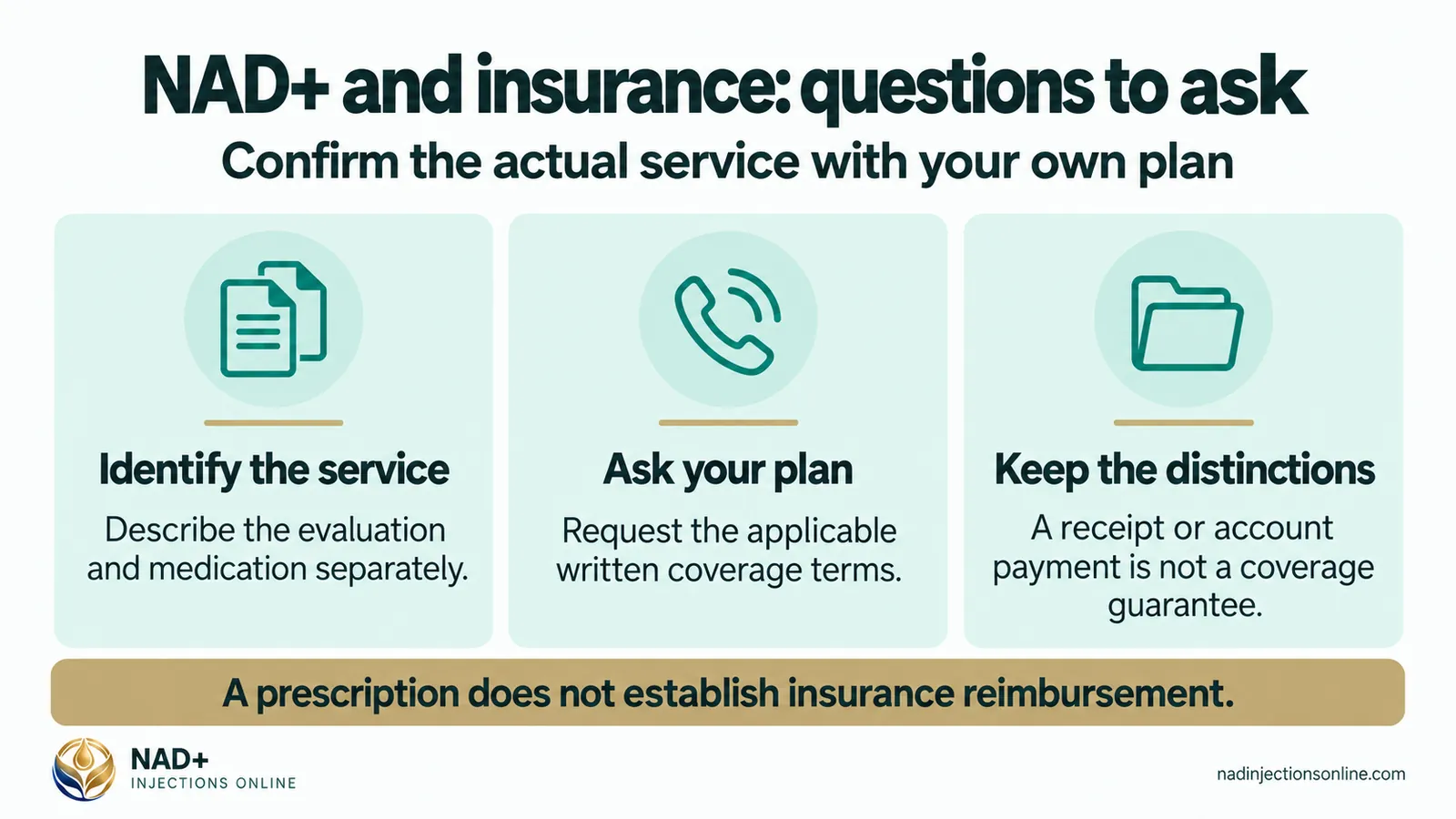
Ask the insurer or plan administrator about the exact service and medication being considered. Do not ask only whether NAD therapy is covered, because that phrase may leave the preparation, route and encounter unclear. Identify the proposed prescribing evaluation separately from the medicine and any administration service. Request the applicable written terms rather than relying on an assumption drawn from a general educational page.
A service can explain whether it bills a plan and what documentation it can provide. That is different from the plan deciding whether an expense falls within your benefits. Ask both questions when they matter. Do not treat a cash-payment description as a universal statement about every insurer, and do not treat a plan answer about an appointment as an answer about the medication. Record the date and the scope of each response. If the answer refers to a particular document or condition, request that information so you can understand which part of the proposed purchase it addresses.
Compounded drugs are not FDA-approved; FDA does not verify their safety, effectiveness or quality before marketing.
Does a prescription establish coverage?
A prescription and a coverage determination answer different questions. The physician decides whether a medication is appropriate in an individual clinical discussion. The plan answers questions about its own benefit terms. Ask about the actual proposal without assuming that one decision automatically supplies the other. A medicine can be discussed accurately as prescribed and compounded while its payment and reimbursement questions remain separate.
FDA explains that compounded drugs are not FDA-approved and that the agency does not verify their safety, effectiveness or quality before marketing. That status belongs in the discussion, but this guide does not use it to invent a universal rule for every public or private plan. Ask the relevant administrator how its terms apply to the proposed preparation. If the response depends on the purpose of the prescription or another clinical detail, ask what information is needed and whether the responsible professional can provide it. Do not change a clinical description simply to fit a payment assumption.
Telehealth lets patients connect with a healthcare provider remotely; costs depend on the service and coverage.
What should I ask about receipts?
Before paying, ask what an itemized receipt would identify and whether the service provides any additional documentation. Then ask the plan what it would require if you want a coverage decision or intend to request reimbursement. A receipt records a transaction; it should not be treated as an assurance of payment by another party. Keep the distinction visible when comparing a seller’s explanation with the plan’s instructions.
If a plan mentions a claim process, ask which expense the process concerns, what documents are requested and how its decision will be communicated. This guide does not supply a billing code or say that a claim will be accepted. If a service cannot provide a requested document, identify that issue before assuming you can obtain it later. Keep copies of the documents actually provided, alongside the plan response. A written record helps you understand the question that was answered without turning a preliminary conversation into a promise about the result.
Is account payment the same as insurance?
Keep an HSA, FSA or other account question separate from an insurance-coverage question. Ask the relevant administrator about the proposed expense and the documentation it requests. Ask the service which payment methods it currently accepts. Acceptance of a payment method should not be presented as a determination about the expense under the account’s rules. This guide does not decide your eligibility or interpret tax consequences.
Before using an account, describe the actual prescription and service rather than a broad wellness category. Request the applicable written guidance and keep the response with the receipt and relevant prescription documentation. If the administrator needs clinical information, ask which information it needs and discuss that request with the physician. Do not assume a general statement on a seller’s page answers your account-specific question. If uncertainty remains, seek advice from the administrator or an appropriately qualified professional before relying on an expected reimbursement or account treatment.
What belongs in a payment decision?
Ask for the current written total, the quoted unit, included services and the conditions that could change the proposal. Ask when payment would be collected, what happens if no prescription is issued and which cancellation or refund terms apply. These questions are useful even if you plan to pay directly. They concern the actual transaction and should be answered by the responsible service contact.
Read the cost companion for the distinction between a supply quote and an infusion appointment. Do not invent a personal dosing schedule to convert unlike quotes into a common budget. Keep the service terms, the clinical decision and any plan response in separate records. If an expected reimbursement is essential to your decision, identify exactly what remains unconfirmed before proceeding. An educational guide can organize the questions, but the current written proposal and the relevant administrator must supply the answers for the expense you are considering.
If a response is incomplete, ask which part of the proposed expense has actually been addressed. A general reply about compounded medicines may not identify an evaluation service, and a reply about office visits may not address pharmacy dispensing. Request clarification without changing the clinical facts to fit an expected answer. Keep the original question with the response so that a later review can distinguish the information you supplied from assumptions someone else made about the purchase.
What a physician weighs
Put the specific question from this guide into your own words when discussing does insurance cover nad injections. Explain what you want clarified, identify the actual preparation and bring the written information you have been given. Ask the physician to separate what the selected evidence supports from what remains a clinical judgment. If the answer depends on a product detail, ask how that detail will be confirmed with the pharmacist.
Compounded medications are prepared by a licensed pharmacy for an individual patient and are not FDA-approved. No approved label lists its uses or side effects, so the physician works from your history and clinical judgment, tells you what is known and what is uncertain, and sets how often you check in.
Any injectable can cause a reaction at the injection site or an allergic reaction, and NAD+ infusions are known for flushing and nausea when given quickly. Report anything unexpected to the physician the same day, and tell the physician about every medicine and supplement you take before anything is prescribed.
For severe allergic symptoms, including breathing difficulty or throat swelling, seek emergency care and call 911. This emergency advice takes priority over a routine same-day report.
Treatment requires a prescription. A licensed clinician evaluates you by telehealth and decides whether any medication is appropriate.
The current NAD+ product information explains this site’s prescribed pathway. For related questions, read nad injections cost and do nad injections require a prescription.
Does insurance cover NAD injections: common questions
Does a prescription promise insurance payment?
No. Ask the plan about its actual terms for the proposed service and medication; the prescribing decision does not answer that question.
Does paying directly mean a receipt is unavailable?
Ask the service what documentation it provides and ask the plan which documents it needs. Do not assume either answer from the payment format.
Will an itemized receipt secure reimbursement?
A receipt does not establish the plan decision. Confirm the applicable terms and documentation with the administrator.
Can an HSA card decide expense eligibility?
Payment-method acceptance should not be treated as an account determination. Ask the relevant administrator about the actual expense.
Are evaluation and medication the same coverage question?
Describe them separately when asking the plan. An answer about one should not silently become an answer about the other.
Who should explain the current payment terms?
The responsible service contact should explain the proposal, while the insurer or administrator addresses its own terms.
Where this guide comes from
The register citations and the public sources behind the text.
Sources (4)
- FDA: Compounding questions and answers (fda.gov)
- HHS: telehealth for patients (telehealth.hhs.gov)
- FDA: medicine benefits and risks (fda.gov)
- MedlinePlus: Anaphylaxis (medlineplus.gov)
Put the question to a physician
The guides explain; the physician decides. Start from home, with a wellness consultant explaining the steps and the cost first.
Availability depends on your state: you must be located in a state where an independent physician is licensed to treat you at the time of your consultation. For adults 18 and older. Contacting NAD Injections Online does not guarantee treatment and creates no obligation.