Do NAD+ injections require a prescription in 2026?
NAD+ prescriptions: approval, compounding and telehealth
Yes, NAD+ injections require a prescription. Injectable NAD+ is a compounded drug, so a licensed pharmacy can only prepare it for a named patient after a physician writes an order, and a telehealth evaluation can provide that review from home.

NAD+ injections require an individualized prescription in the pathway described here, but that does not make compounded nicotinamide adenine dinucleotide (NAD+) FDA-approved. Prescribing, pharmacy credentials and conditional compounding policy address separate questions. This guide helps you understand those distinctions and check the actual dispensing source and instructions.
Why is a prescription not FDA approval?
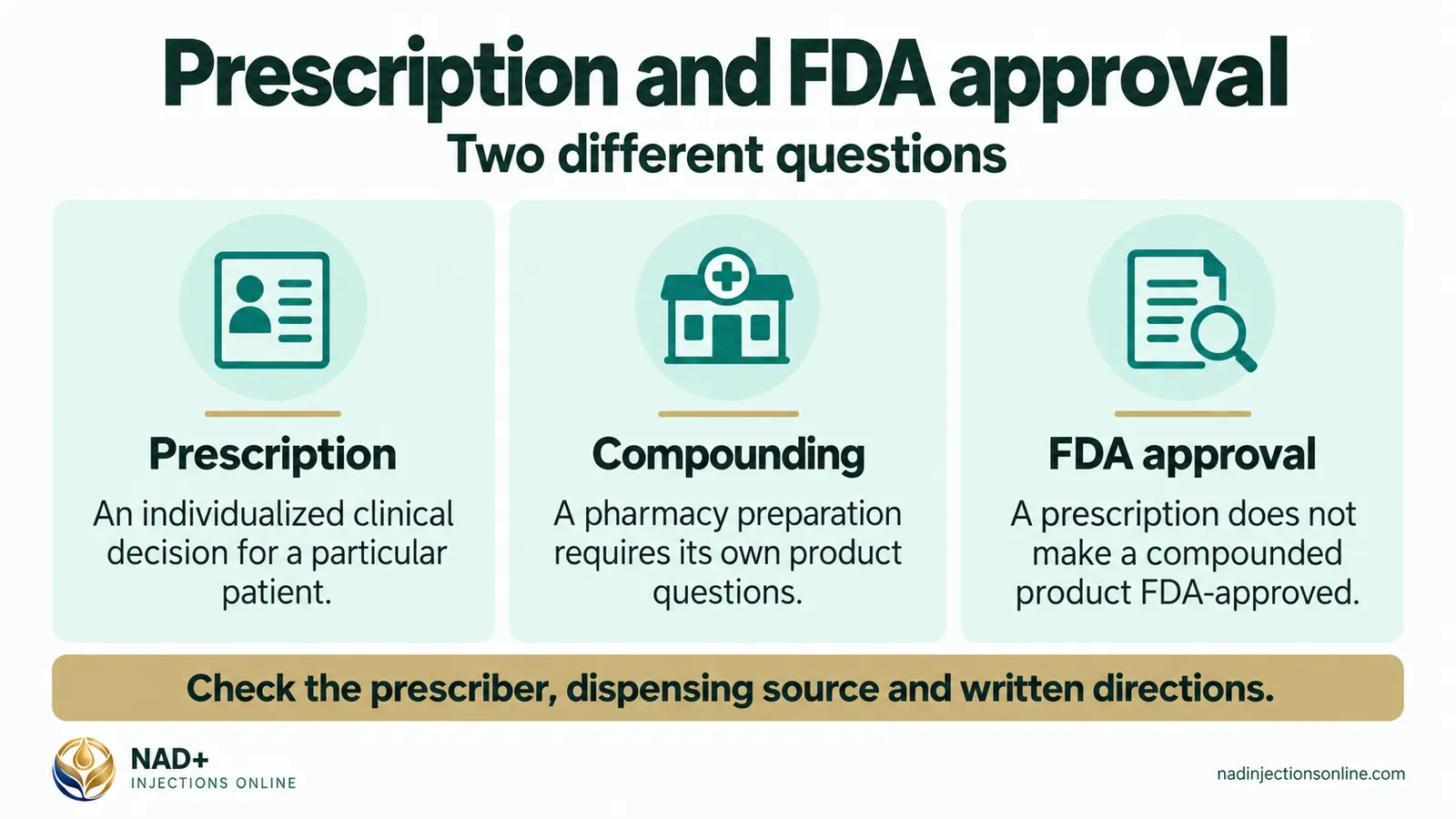
A prescription concerns an individual clinical decision; FDA approval concerns a product’s regulatory status. Compounded NAD+ preparations discussed here remain outside FDA product approval even when a physician prescribes them. Ask the physician about the reason for the decision and the relevant evidence without assuming the prescription itself proves a clinical outcome.
The physician and pharmacy have separate accountable roles. The pharmacy answers questions about the dispensed medicine and its instructions, while the prescribing professional answers the clinical question about whether it is appropriate.
Check the subject of a regulatory statement. It may describe a clinician, a pharmacy, an ingredient, a statutory category or a finished medicine. These are different subjects even when they appear in the same paragraph. Ask what exact record supports the claim and what it establishes. A professional credential should not be used as shorthand for approval of the preparation, and a named ingredient should not be mistaken for an approved treatment indication.
Compounded drugs are not FDA-approved; FDA does not verify their safety, effectiveness or quality before marketing.
What does FDA say about compounding?
FDA explains that compounded drugs are not FDA-approved and that it does not verify their safety, effectiveness or quality before marketing. That statement should remain clear in a patient-facing explanation. A familiar ingredient, licensed pharmacy or professional service description is not a replacement for the product-status statement.
When a page claims approval, ask for the exact product and the supporting record. Do not substitute a mention of the ingredient, a facility credential or a professional license for the answer. The different descriptions may all matter, but each performs a different job. Clear language prevents one true statement from implying a stronger unsupported one.
For a Category 1 statement, retain the date and the conditional nature of the interim policy. The list is not a finished-product approval label or a finding that every proposed use is effective. Ask whether the exact substance and relevant conditions are being described. If someone relies on a later version, review that original document rather than assuming the wording remains the same. A dated account is more useful than an undated claim of permanent authorization.
Category 1 is a conditional interim enforcement policy while FDA evaluates nominated bulk substances; it is not FDA approval.
What is the conditional 503A policy?
Category 1 under FDA’s interim 503A policy is conditional while nominated substances are evaluated. It is not FDA approval of a finished NAD+ medicine. The current list, its conditions and the exact named substance matter. This guide does not interpret the category as permanent permission for every formulation or facility.
The list retrieved for this review includes nicotinamide adenine dinucleotide in Category 1. Keep that as a dated observation rather than a permanent product endorsement. A later decision relying on the category should recheck the original FDA document and exact identity. Do not automatically transfer a statement about one statutory pathway to another.
When several entities are involved, ask each to explain its role. The coordinating service can address its arrangements; the physician addresses the individual clinical decision; the pharmacist addresses the dispensed medicine and instructions. Keep contact information with the current documents. This helps a later question reach the responsible professional instead of being answered by an unrelated credential or a general statement that the service follows a prescribing process.
The FDA category list retrieved for this review includes nicotinamide adenine dinucleotide in Category 1.
How can I check the supply pathway?
FDA recommends checking an online pharmacy’s state license, prescription requirement and access to a licensed pharmacist. Ask which pharmacy will dispense the actual prescription and keep its contact information. A consultation brand may not be the dispensing entity, so identify the responsible parties rather than assuming their roles from a website logo.
Those checks do not establish efficacy or FDA approval of a compounded preparation. Ask about the evidence separately from the credentials. If you cannot identify the pharmacist contact or prescription requirement clearly, request clarification. A public article cannot verify a seller or review the future medicine on your behalf.
What should I ask before proceeding?
Ask what the proposed preparation is, why it is being considered, what evidence supports the intended purpose and which uncertainties remain. Then ask how the current instructions will be provided and which contact handles later questions. A clear prescribing discussion should distinguish the regulatory facts from clinical judgment and product information.
Keep dates with any policy or category statement used in the explanation. If the answer relies on an old screenshot or an unspecified FDA list, ask for the original source and relevant conditions. The decision should not rest on the most reassuring interpretation of an incomplete label. The objective is a specific, understandable account of the actual prescription pathway.
- Professional credential: identify the clinician or pharmacy record being described.
- Policy category: check the exact substance, conditions and date.
- Product approval: ask whether the statement concerns the finished medicine itself.
Suppose a page says a pharmacy is licensed and then describes the medicine as approved. Ask for the separate support for the second statement. A record supporting the pharmacy description does not answer the finished-product approval question. Likewise, an ingredient’s appearance in a dated policy document does not establish a clinical indication. Read each assertion on its own terms and ask which original record supports it. This prevents several accurate fragments from being combined into a broader claim none of the documents makes.
If the proposed prescription changes, ask which preparation is now being considered and what information goes with it. Do not assume that the earlier explanation covered every future formulation merely because the ingredient name is familiar. The physician should address the individual clinical reasoning, and the pharmacist should clarify the actual dispensed medicine. Keep the current documents together so that a later question can be answered using the relevant preparation rather than an outdated service description.
What a physician weighs
Put the specific question from this guide into your own words when discussing do you need a prescription for nad injections. Explain what you want clarified, identify the actual preparation and bring the written information you have been given. Ask the physician to separate what the selected evidence supports from what remains a clinical judgment. If the answer depends on a product detail, ask how that detail will be confirmed with the pharmacist.
Compounded medications are prepared by a licensed pharmacy for an individual patient and are not FDA-approved. No approved label lists its uses or side effects, so the physician works from your history and clinical judgment, tells you what is known and what is uncertain, and sets how often you check in.
Any injectable can cause a reaction at the injection site or an allergic reaction, and NAD+ infusions are known for flushing and nausea when given quickly. Report anything unexpected to the physician the same day, and tell the physician about every medicine and supplement you take before anything is prescribed.
For severe allergic symptoms, including breathing difficulty or throat swelling, seek emergency care and call 911. This emergency advice takes priority over a routine same-day report.
Treatment requires a prescription. A licensed clinician evaluates you by telehealth and decides whether any medication is appropriate.
The current NAD+ product information explains this site’s prescribed pathway. For related questions, read what is nad and nad injection dosage.
Do NAD injections require a prescription: common questions
Is compounded NAD+ an FDA-approved drug?
No. FDA states that compounded drugs are not FDA-approved and that it does not verify their safety, effectiveness or quality before marketing.
Does a prescription change FDA approval status?
No. An individual prescription does not confer FDA approval on a compounded finished medicine.
Is Category 1 the same as approval?
No. Category 1 describes a conditional interim policy for certain nominated bulk substances, rather than approval of a finished formulation or proposed use.
Does a pharmacy license prove efficacy?
No. A pharmacy license is a credential, not a clinical efficacy finding or FDA approval of the compounded product.
Should the current list be checked again?
Yes. Check the exact substance, current FDA document and applicable conditions rather than relying on an undated summary.
What online-pharmacy checks does FDA suggest?
FDA recommends checking a state pharmacy license, a requirement for a prescription and access to a licensed pharmacist.
Where this guide comes from
The register citations and the public sources behind the text.
Sources (6)
- FDA: medicine benefits and risks (fda.gov)
- FDA: Compounding questions and answers (fda.gov)
- FDA: buying medicine online (fda.gov)
- FDA: Bulk substances under section 503A (fda.gov)
- FDA: 503A nomination categories (fda.gov)
- MedlinePlus: Anaphylaxis (medlineplus.gov)
Put the question to a physician
The guides explain; the physician decides. Start from home, with a wellness consultant explaining the steps and the cost first.
Availability depends on your state: you must be located in a state where an independent physician is licensed to treat you at the time of your consultation. For adults 18 and older. Contacting NAD Injections Online does not guarantee treatment and creates no obligation.