NAD+ injection vs IV in 2026: comparing the routes
NAD+ injection vs IV drip vs nasal spray
NAD+ injection vs IV comes down to route: an injection delivers a small dose in seconds at home, while an IV drip infuses a larger dose into a vein over hours in a clinic. No study has shown one route gives better results, so the physician chooses based on your history.
NAD injections vs IV compares administration routes and service arrangements, not established equal results. Nicotinamide adenine dinucleotide (NAD+) given intravenously was studied in a small metabolite pilot; that is not a home-injection protocol. This guide explains the comparison, summarizes other forms and helps identify which instructions and evidence apply to the actual preparation.
What route is being compared?
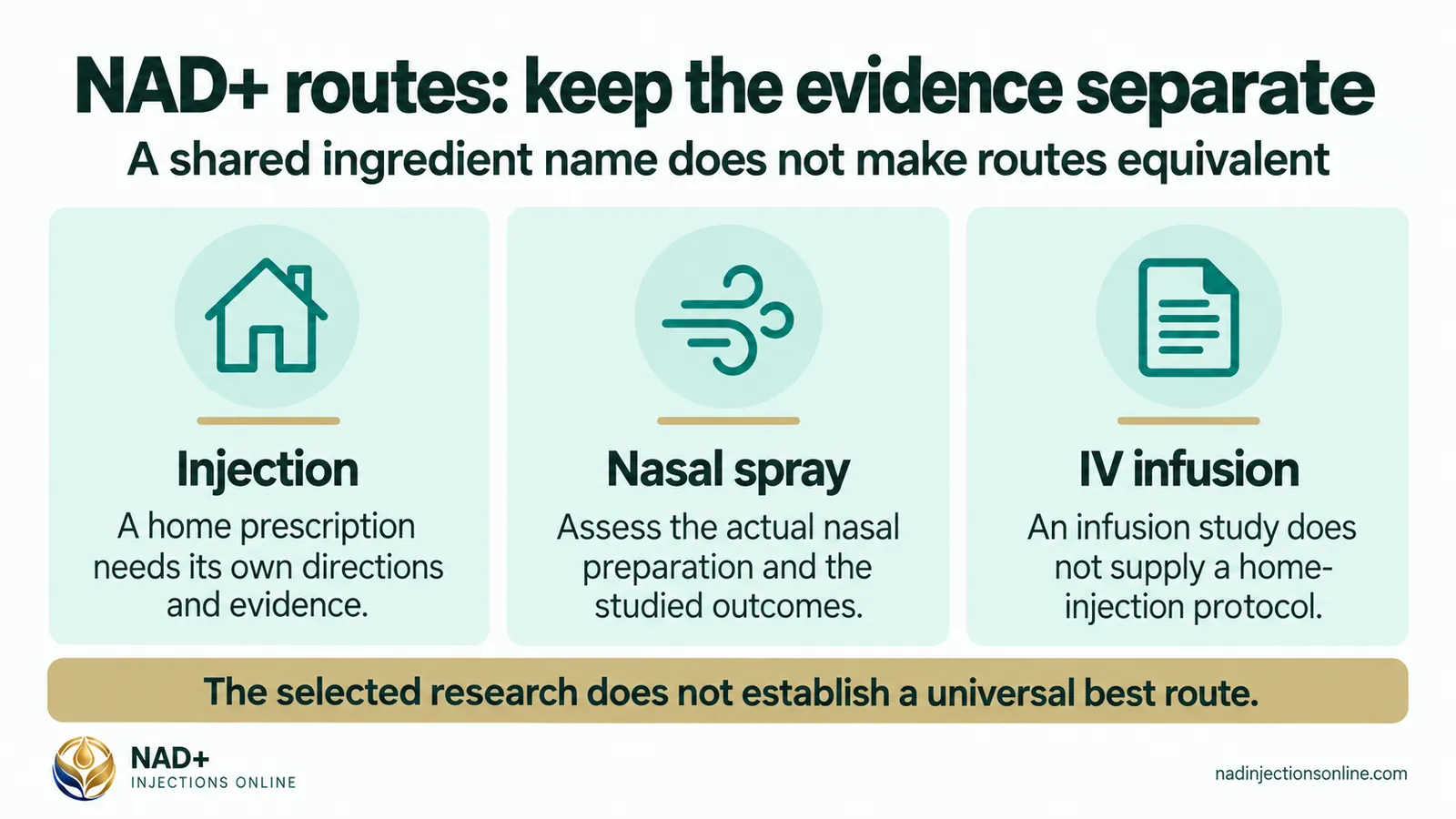
Identify the route before borrowing a research finding or instruction. Intravenous infusion enters a vein, while a subcutaneous prescription uses a tissue route. A service can discuss several formats educationally without offering all of them. This site describes prescribed forms coordinated with physician and pharmacy involvement; it does not provide IV treatment.
A nasal spray is another administration form and needs its own evidence assessment; the related nasal comparison addresses that question in detail. Here the central comparison is a home prescription and an infusion setting. Keep the setting, route and preparation distinct instead of treating the general term NAD therapy as a complete description.
A nasal spray, an oral capsule and a troche also need to be identified by their actual ingredients and route. The fact that several forms appear on one website does not make them interchangeable preparations. Ask which form is being proposed and which reference applies to it. If a comparison concerns nasal delivery, use the dedicated nasal guide alongside the original research, rather than treating an IV result as a finding about a spray.
A small pilot study measured how a six-hour intravenous NAD+ infusion changed NAD+ and related metabolites in blood and urine.1
What does the infusion pilot establish?
The selected pilot measured NAD+ and related metabolites around an intravenous infusion in healthy volunteers. It does not give a home-use dosing schedule or establish comparative benefits for another administration route. When a page cites it, ask whether the claim concerns the study’s actual endpoint or a symptom result added by the writer.
The study includes safety observations, but its small monitored setting cannot define every other preparation’s safety profile. This is a scope limit, not a reason to say nobody observed the participants clinically. A useful summary describes both the research contribution and the questions it leaves unanswered for a person considering a different product.
Separate the practical comparison into encounter, supply and follow-up. Where would the evaluation happen? Who would dispense or administer the preparation? Which professional would answer a question afterward? Those details can matter to a person’s choice without establishing superior clinical outcomes. Ask the providers to describe their actual arrangements. A remote prescription pathway and an infusion appointment should each be understandable on their own terms before you try to compare them.
FDA has received reports of severe chills, shaking, vomiting and fatigue after NAD+ injectable drugs, sometimes requiring medical treatment, and warns about ingredients unsuitable for sterile compounding.
Is one route demonstrated better for me?
The selected infusion paper is not a head-to-head trial of home injections and IV treatment. It cannot establish a universal ranking of effectiveness, duration or absorption for the outcome you want. Ask what the proposed comparison actually measures. A practical preference about appointments is different from a clinical conclusion about results.
If a page uses the word better, ask better for which purpose and in which people. Convenience, price structure and studied clinical outcomes require different information. A clear comparison may explain the practical differences without deciding every clinical question. You do not need an unsupported ranking to have a useful prescribing discussion.
An absorption claim also needs a defined endpoint and relevant evidence. Ask whether the page is describing administration into a particular compartment, a laboratory measurement afterward or a clinical outcome. Those descriptions answer different questions. Do not infer how long an effect will last or which symptoms will change from the route name alone. If the offered paper does not make the advertised comparison, ask the physician what additional support informs the proposed choice.
How should I read the safety information?
Keep infusion wording attached to infusion observations. The standing safety statement mentions flushing and nausea with rapid infusions, but that is not a measured home-injection frequency. FDA also warns about unsuitable sterile-compounding ingredients and serious reported events. Do not treat that separate quality concern as something an administration-rate adjustment has necessarily resolved.
The alert does not identify the risk for every patient or establish that any particular pharmacy caused an event. Ask the physician how the actual proposed preparation and your circumstances should be assessed. For product-quality or storage questions, ask the pharmacist. For severe allergic symptoms such as breathing difficulty or throat swelling, call 911 rather than waiting for a routine response.
What should I clarify before choosing?
Ask which form the physician is considering, why it is being considered and what evidence supports the intended purpose. Then ask about the written directions, dispensing source and access to later questions. Do not copy an infusion advertisement into a home-use plan or assume the two formats carry identical instructions.
Bring the current product descriptions when comparing offers. A quote per session and a quote per supply are different units, and an educational route comparison does not establish that the offers are clinically equivalent. Ask the service contact about the terms and the physician about clinical reasoning. This keeps the comparison accountable to the actual proposal.
- Route: identify how the proposed preparation is administered.
- Setting: identify where the relevant encounter and any administration take place.
- Evidence: check whether the study tested the comparison you want answered.
A comparison can also be incomplete because it leaves the intended purpose unnamed. Ask whether you are comparing convenience, access to a professional or a claimed clinical response. You may obtain a clear answer about appointment arrangements while the evidence question remains open. Keep the unresolved question visible in your notes instead of allowing the easiest practical difference to decide the clinical comparison by default.
What a physician weighs
Put the specific question from this guide into your own words when discussing nad injections vs iv. Explain what you want clarified, identify the actual preparation and bring the written information you have been given. Ask the physician to separate what the selected evidence supports from what remains a clinical judgment. If the answer depends on a product detail, ask how that detail will be confirmed with the pharmacist.
Compounded medications are prepared by a licensed pharmacy for an individual patient and are not FDA-approved. No approved label lists its uses or side effects, so the physician works from your history and clinical judgment, tells you what is known and what is uncertain, and sets how often you check in.
Any injectable can cause a reaction at the injection site or an allergic reaction, and NAD+ infusions are known for flushing and nausea when given quickly. Report anything unexpected to the physician the same day, and tell the physician about every medicine and supplement you take before anything is prescribed.
For severe allergic symptoms, including breathing difficulty or throat swelling, seek emergency care and call 911. This emergency advice takes priority over a routine same-day report.
Treatment requires a prescription. A licensed clinician evaluates you by telehealth and decides whether any medication is appropriate.
The current NAD+ product information explains this site’s prescribed pathway. For related questions, read nad nasal spray vs injection and nad injections vs supplements.
NAD+ injection vs IV: common questions
Are NAD+ injections and IV the same procedure?
No. Grant studied intravenous NAD+ infusion, which is a different administration route from the home-injection pathway described here. Do not substitute its administration instructions for an individual prescription.
Does the IV pilot prove home-injection benefits?
No. The pilot measured metabolites during monitored intravenous administration rather than clinical benefits from home injections.
Can this article rank their absorption?
Grant’s pilot was not a head-to-head absorption comparison of intravenous and home-injection routes. It cannot supply a comparative absorption ranking for them.
Is IV treatment offered by this site?
No. This site describes a prescribed physician-and-pharmacy pathway and does not provide intravenous treatment.
Does slower delivery eliminate ingredient concerns?
FDA’s alert concerns suitability of ingredients for sterile compounding and reported reactions. A change in delivery speed should not be assumed to resolve the separate ingredient-quality concern.
Can I substitute one route for another?
Do not substitute routes based on a general comparison. Ask the physician about the prescribed form and the pharmacist about its actual dispensing instructions.
Where this guide comes from
The register citations and the public sources behind the text.
Sources (5)
- Grant R, Berg J, Mestayer R, et al. A Pilot Study Investigating Changes in the Human Plasma and Urine NAD+ Metabolome During a 6 Hour Intravenous Infusion of NAD. Front Aging Neurosci. 2019;11:257.
- Grant R, Berg J, Mestayer R, et al. A Pilot Study Investigating Changes in the Human Plasma and Urine NAD+ Metabolome During a 6 Hour Intravenous Infusion of NAD. Front Aging Neurosci. 2019;11:257. (frontiersin.org)
- FDA: ingredients suitable for sterile compounding (fda.gov)
- MedlinePlus: Anaphylaxis (medlineplus.gov)
- FDA: medicine benefits and risks (fda.gov)
Put the question to a physician
The guides explain; the physician decides. Start from home, with a wellness consultant explaining the steps and the cost first.
Availability depends on your state: you must be located in a state where an independent physician is licensed to treat you at the time of your consultation. For adults 18 and older. Contacting NAD Injections Online does not guarantee treatment and creates no obligation.