NAD+ injections before and after: what to expect in 2026
NAD+ before and after results: what studies can and cannot show
NAD+ injections before and after photos cannot show what the injection itself did. Published studies measure blood NAD+ levels and short-term markers, not visible changes, so judge results against your own starting point with your physician rather than against someone else’s photos.

NAD+ injections before and after examples do not show by themselves that a treatment caused a change. Nicotinamide adenine dinucleotide (NAD+) research needs to be read by ingredient, route and measured outcome. Here you can learn what to ask about images, personal accounts and laboratory results before treating them as evidence for your own prescription.
What can a photograph tell me?
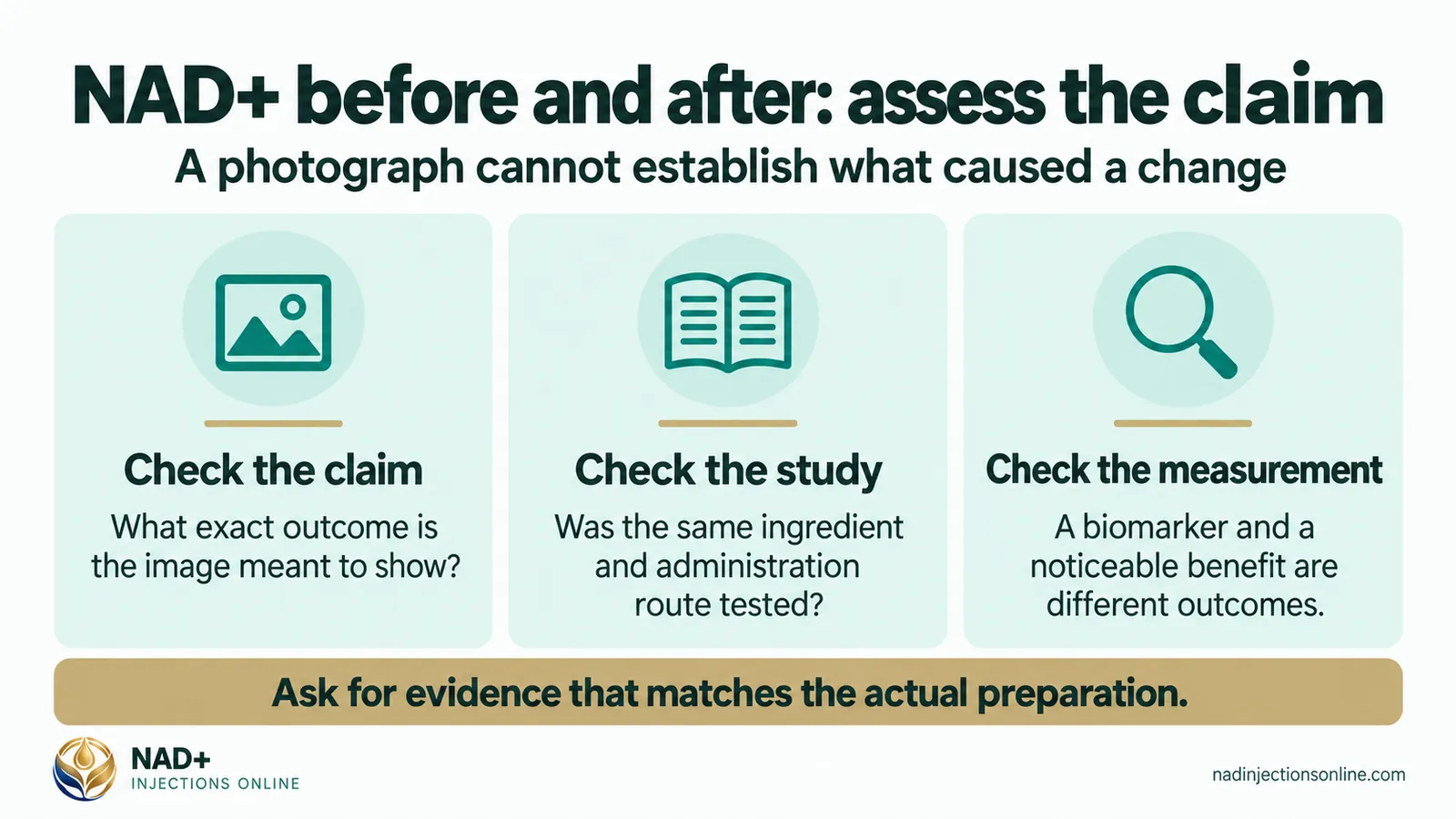
A photograph can show appearance at a particular moment, but it cannot identify what caused a later difference. Ask whether lighting, position, camera settings and image selection were comparable. Then ask which claimed outcome the image is meant to demonstrate. A result caption can make a stronger assertion than the image itself could support.
A personal comparison cannot separate a product from everything else that changed between observations. A sincere account does not become a controlled treatment estimate merely because it is detailed. Read the exact claim and the evidence beside it, instead of treating a convincing presentation as proof of causation.
Read the dates carefully. A before date and an after date establish the order in which two observations were recorded; they do not establish why the observations differ. Ask what happened between them and whether the page reports all relevant changes. If the claimed result is not visible in the image, identify the additional evidence offered for it. A caption about an internal biological process cannot be assessed simply by looking more closely at a photograph.
In a study of healthy middle-aged and older adults, oral supplementation with an NAD+ precursor (nicotinamide riboside) raised blood NAD+ levels and was well tolerated.1
What did the selected studies measure?
The selected oral-precursor study concerned blood NAD+ findings, and the intravenous pilot concerned NAD+ and related metabolites in blood and urine. Neither validates a photo transformation from a home prescription. Keep the ingredient and administration route attached to each result so an oral finding is not silently retold as an injection outcome.
Ask whether the paper measured the feature or symptom that attracted your attention. A reference can be genuine and still not support the accompanying claim. That is an applicability question, not an accusation that the paper is worthless. Understanding the difference helps you ask the physician about a specific evidence gap rather than accepting or rejecting an entire page at once.
A laboratory result needs its own context. Ask which measurement was taken, how the samples were compared and whether the research linked that measurement to the outcome being advertised. Do not assume that a result is a treatment goal merely because a page calls it improved. Bring the actual report or the quoted study passage to the physician so the question can be discussed specifically, without treating every change in a measurement as an established clinical benefit.
A small pilot study measured how a six-hour intravenous NAD+ infusion changed NAD+ and related metabolites in blood and urine.2
Why do the study participants matter?
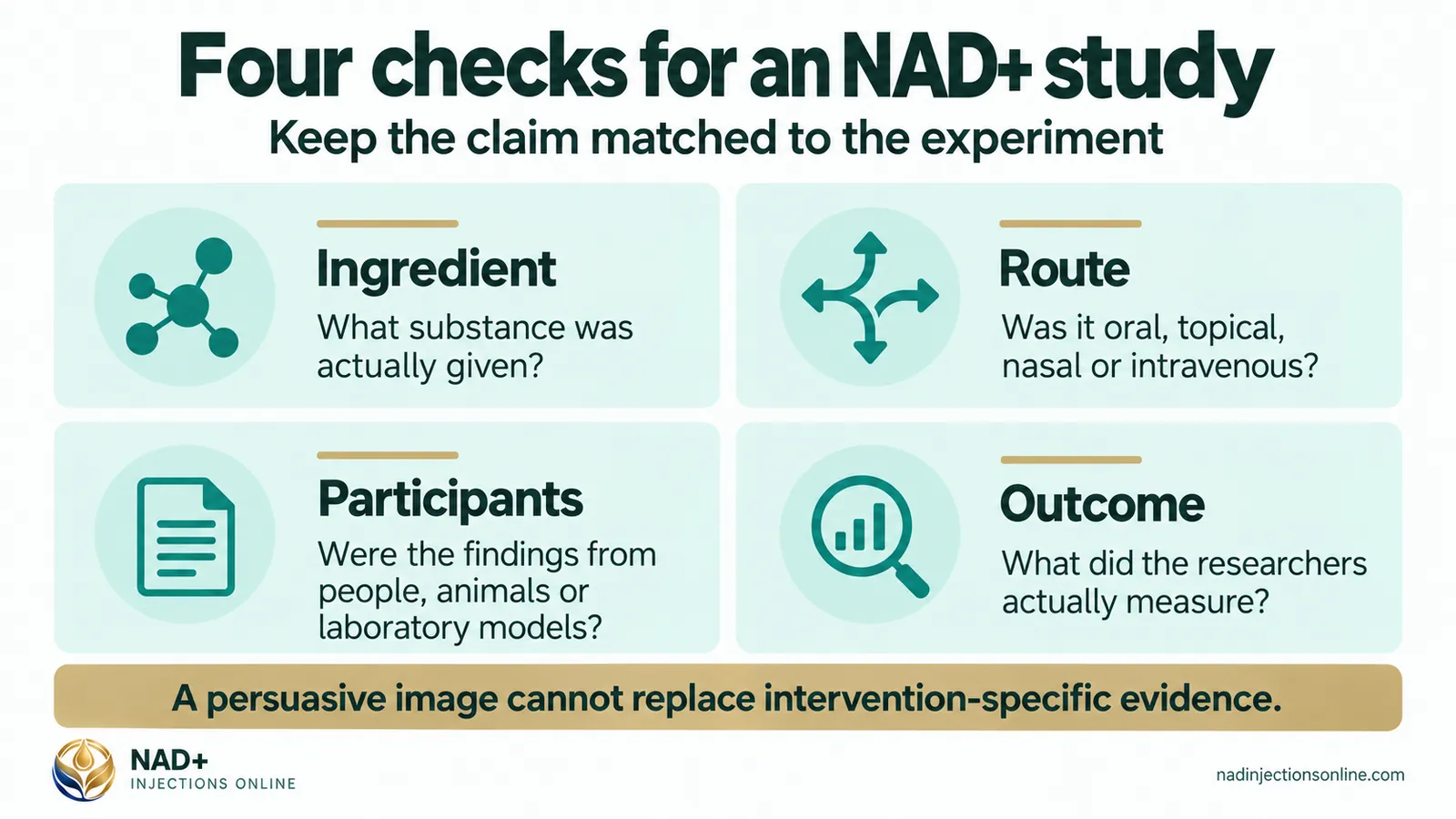
A study’s participant description tells you who was actually observed. The oral-NR study involved healthy middle-aged and older adults, while the infusion pilot used healthy volunteers. A page should not drop those details when it quotes a result. Ask what supports applying the finding to your circumstances rather than treating every adult as an interchangeable study participant.
The conclusions here concern the references actually reviewed, rather than every paper that might address a related question. If someone offers a different paper, ask the same questions about preparation, participants, outcome and limitations. A new citation should be assessed on its own terms, not accepted simply because its title includes NAD.
For a personal account, distinguish the writer’s own words from the seller’s interpretation. The person may report feeling different while the surrounding page claims a predictable treatment effect. Those are separate assertions. Ask what evidence supports the stronger claim and whether the preparation matches the one under discussion. A useful conversation can acknowledge someone’s experience without making that experience a forecast for another person or an instruction for a different medicine.
Can personal accounts help with any decision?
They can suggest practical questions about service or communication, but they cannot isolate a clinical treatment effect. Ask whether the account describes understandable directions, a clear pharmacy identity or access to answers. Those questions concern the experience of obtaining care; they do not establish the magnitude or cause of a reported health change.
Look for the difference between what the person said and what the page concludes. A statement about feeling different can be expanded by a seller into a claim about a particular mechanism or a predictable result. The additional claim still needs an applicable source. Do not let the emotional force of an account hide that extra step.
What should I bring to the physician?
Bring the original caption, quotation or webpage and identify the result you want assessed. Ask whether its cited source used the actual preparation and measured the relevant outcome. If you bring only a photograph or only a paper title, the key link between them can be missed. The exact assertion is the most useful unit for discussion.
Also ask about risk and the reasons for considering treatment in your own circumstances. A favorable account does not supply a safety label, and a before-and-after date does not supply a personal schedule. Keep research interpretation separate from written prescription directions. This makes the discussion more useful than asking when you should expect someone else’s result.
- Image: ask what it records and what it cannot show about the cause.
- Account: separate the speaker’s description from the seller’s added conclusion.
- Study: check the preparation, participants and measured outcome before applying the finding.
What a physician weighs
Put the specific question from this guide into your own words when discussing nad injections before and after. Explain what you want clarified, identify the actual preparation and bring the written information you have been given. Ask the physician to separate what the selected evidence supports from what remains a clinical judgment. If the answer depends on a product detail, ask how that detail will be confirmed with the pharmacist.
Compounded medications are prepared by a licensed pharmacy for an individual patient and are not FDA-approved. No approved label lists its uses or side effects, so the physician works from your history and clinical judgment, tells you what is known and what is uncertain, and sets how often you check in.
Any injectable can cause a reaction at the injection site or an allergic reaction, and NAD+ infusions are known for flushing and nausea when given quickly. Report anything unexpected to the physician the same day, and tell the physician about every medicine and supplement you take before anything is prescribed.
For severe allergic symptoms, including breathing difficulty or throat swelling, seek emergency care and call 911. This emergency advice takes priority over a routine same-day report.
Treatment requires a prescription. A licensed clinician evaluates you by telehealth and decides whether any medication is appropriate.
The current NAD+ product information explains this site’s prescribed pathway. For related questions, read nad benefits and nad injection side effects.
NAD+ injections before and after: common questions
Do photos prove NAD+ caused a change?
No. A pair of images records appearances without isolating the cause of a change.
Do higher blood NAD+ findings prove visible benefits?
No. Martens measured blood NAD+ after oral nicotinamide riboside in healthy middle-aged and older adults, not visible results from home NAD+ injections.
Did the IV pilot validate transformation claims?
No. Grant measured blood and urine metabolites during an intravenous NAD+ infusion, not photographic transformations from home injections.
Are all personal accounts dishonest?
No. A sincere personal account can describe an experience without establishing what caused it or how often another person would experience it.
Can this article supply an expected results timeline?
The oral-precursor study and intravenous pilot discussed here do not establish a personal home-injection results timetable.
What should I ask about a cited study?
Ask which ingredient, route, population and outcome the study examined, and whether those details match the claim. Bring the original page or caption to the discussion.
Where this guide comes from
The register citations and the public sources behind the text.
Sources (8)
- Martens CR, Denman BA, Mazzo MR, et al. Chronic nicotinamide riboside supplementation is well-tolerated and elevates NAD(+) in healthy middle-aged and older adults. Nat Commun. 2018;9(1):1286.
- Grant R, Berg J, Mestayer R, et al. A Pilot Study Investigating Changes in the Human Plasma and Urine NAD+ Metabolome During a 6 Hour Intravenous Infusion of NAD. Front Aging Neurosci. 2019;11:257.
- Covarrubias AJ, Perrone R, Grozio A, Verdin E. NAD(+) metabolism and its roles in cellular processes during ageing. Nat Rev Mol Cell Biol. 2021;22(2):119-141. (pmc.ncbi.nlm.nih.gov)
- Martens CR, Denman BA, Mazzo MR, et al. Chronic nicotinamide riboside supplementation is well-tolerated and elevates NAD(+) in healthy middle-aged and older adults. Nat Commun. 2018;9(1):1286. (pubmed.ncbi.nlm.nih.gov)
- Grant R, Berg J, Mestayer R, et al. A Pilot Study Investigating Changes in the Human Plasma and Urine NAD+ Metabolome During a 6 Hour Intravenous Infusion of NAD. Front Aging Neurosci. 2019;11:257. (frontiersin.org)
- FDA: buying medicine online (fda.gov)
- FDA: medicine benefits and risks (fda.gov)
- MedlinePlus: Anaphylaxis (medlineplus.gov)
Put the question to a physician
The guides explain; the physician decides. Start from home, with a wellness consultant explaining the steps and the cost first.
Availability depends on your state: you must be located in a state where an independent physician is licensed to treat you at the time of your consultation. For adults 18 and older. Contacting NAD Injections Online does not guarantee treatment and creates no obligation.