NAD injection side effects in 2026: what is reported
NAD+ injection side effects and what to tell your physician
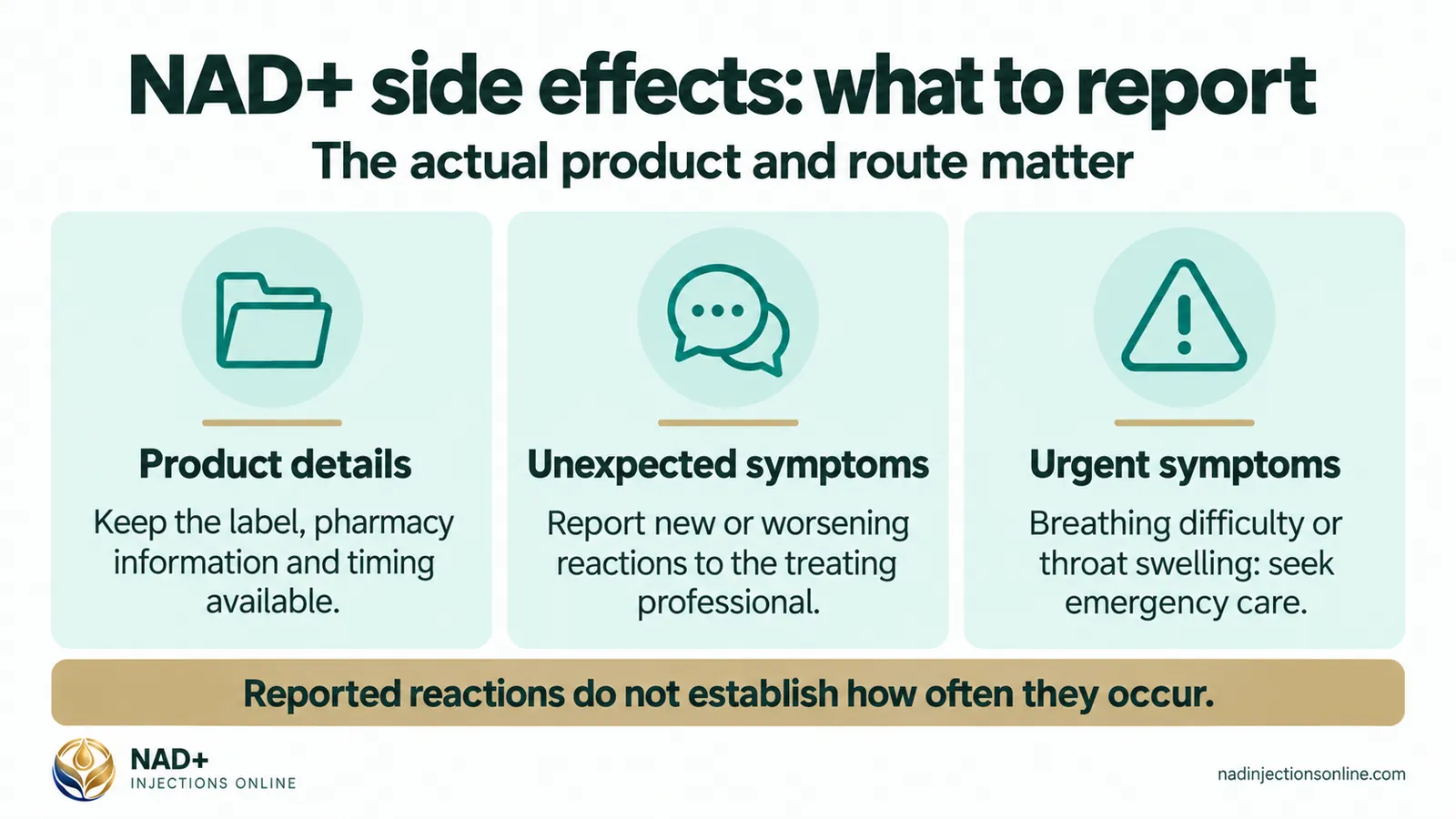
The NAD injection side effects reported most often are redness, swelling or soreness where the needle goes in, plus flushing, nausea, headache or lightheadedness. Serious reactions appear rare in the limited data, but the evidence is thin, so report anything unexpected to the physician the same day.

NAD injection side effects should be discussed using the actual preparation and administration route. FDA has received serious reports after nicotinamide adenine dinucleotide (NAD+) injectable drugs and raised sterile-ingredient concerns. Breathing difficulty or throat swelling requires emergency care. This guide distinguishes the reports, the uncertainties and the questions to raise with a physician or pharmacist.
What does the FDA warning say?
FDA describes serious reports after NAD+ injectable drugs and highlights ingredients unsuitable for sterile compounding. Its reminder discusses food-grade NAD+ used for IV products and symptoms possibly consistent with excessive endotoxins. This is a product-quality concern, not simply a description of the molecule’s normal role in cells. It belongs in the safety conversation even when a seller emphasizes the familiarity of NAD+.
The reports do not tell us how often each event occurs in every preparation or route. They also do not establish that a particular pharmacy caused an event or that another pharmacy is exempt from the concern. When you read an alert summary, look for the actual scope of the agency’s statement rather than a blanket reassurance or a universal prediction.
When reading a side-effect list, ask where each item came from. A report received by an agency, an observation during a monitored study and a general warning about injectables are different evidence types. None should be presented as a precise probability without the data needed for that estimate. An honest list may leave the frequency unknown. That limitation should appear beside the symptom discussion, where it can inform the question you bring to the physician.
FDA has received reports of severe chills, shaking, vomiting and fatigue after NAD+ injectable drugs, sometimes requiring medical treatment, and warns about ingredients unsuitable for sterile compounding.
Which symptoms should not wait?
Difficulty breathing or throat swelling may indicate a severe allergic reaction. Call 911 and obtain emergency care rather than waiting for a routine message to be answered. This emergency distinction comes from general anaphylaxis guidance; it is not a claim about how frequently NAD+ causes allergy. The routine contact route for a prescription question does a different job.
For other unexpected symptoms, obtain appropriate professional advice and give a precise account. Do not decide from a forum that shaking or vomiting is a normal stage of treatment. FDA’s alert includes severe chills, shaking, vomiting and fatigue, sometimes requiring medical treatment. It provides no universal waiting window that makes those symptoms appropriate to ignore.
Avoid combining several people’s accounts into an apparent recovery timetable. One person’s preparation, route and circumstances may differ from yours, and a brief post may leave important details out. If you are seeking advice about your own event, describe the event itself rather than asking whether it fits an online pattern. State what happened and which product was involved. The clinical assessment needs to address that account, not an average assembled from unrelated stories.
A small pilot study measured how a six-hour intravenous NAD+ infusion changed NAD+ and related metabolites in blood and urine.1
Does infusion experience describe my injection?
Not automatically. The standing safety wording identifies flushing and nausea with rapid infusions, and that qualifier should remain visible. A monitored intravenous experiment is a different setting from a home prescription. Neither its observations nor an infusion service’s experiences provide measured subcutaneous or intramuscular reaction frequencies for your dispensed product.
The selected references do not establish a universal home-use symptom timetable or a standard response to every reaction. The useful answer is to distinguish the route and describe the uncertainty. A professional assessment of an event cannot be replaced by assuming that all preparations produce the same reactions for the same duration.
If a response uses reassuring language, ask what specific concern it addresses. An explanation about ingredient identity does not answer a question about product quality. A description of a monitored infusion does not supply a safety label for a home injection. A customer-service reply may help locate the responsible contact without resolving the medical question. Keeping these answers separate helps you recognize when further professional clarification is still needed.
Severe allergic reactions with breathing difficulty or throat swelling require emergency care; call 911.
How can I describe a reaction clearly?
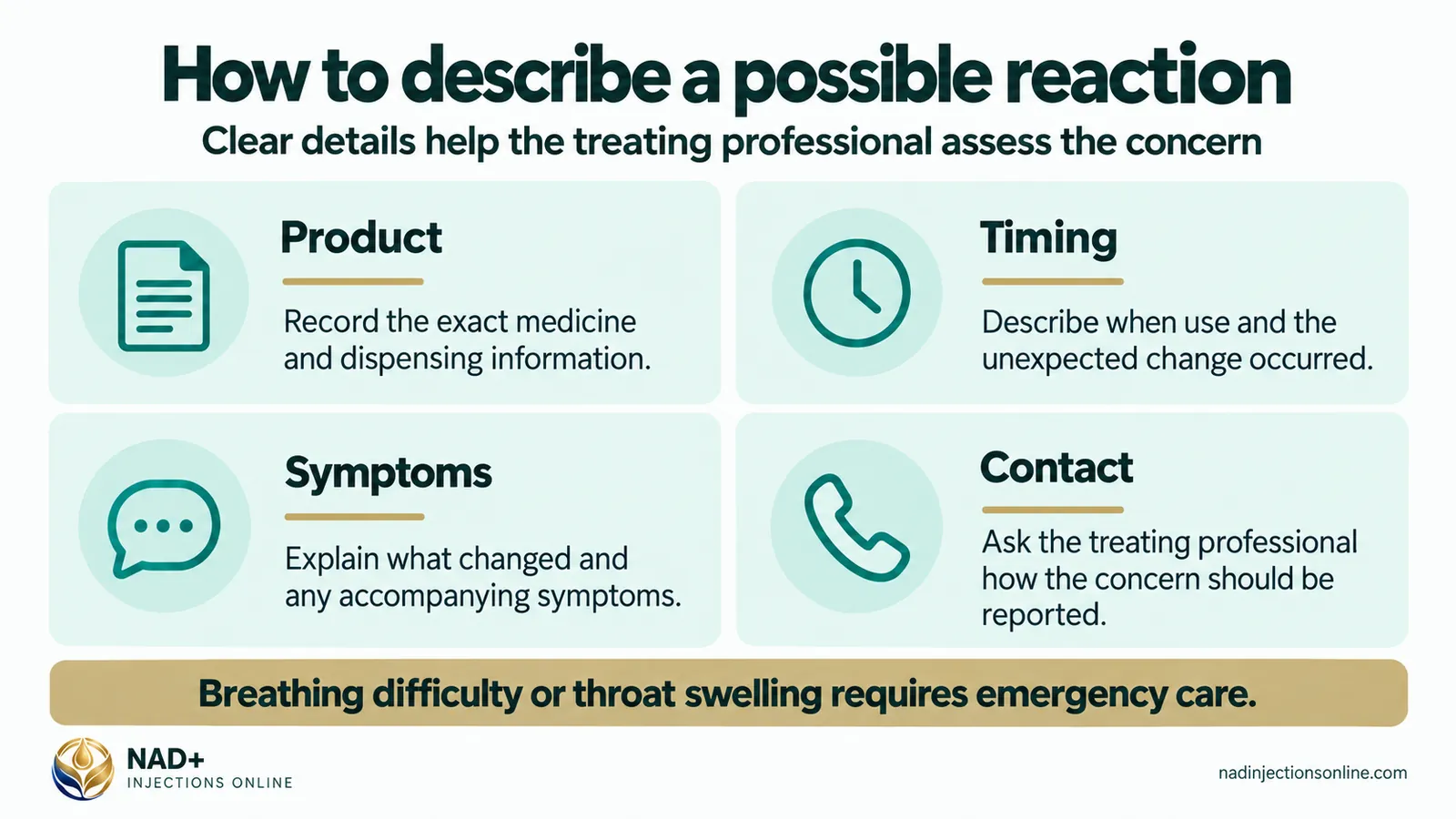
State what you noticed, when it started, how it changed and what product was used. Include the route and dispensing details, and identify other medicines or supplements used around the event. Separate the observation from your interpretation: a symptom after use is something to report, while an assumption about its cause still needs assessment.
Keep the label and relevant packaging information available for the professional reviewing the event. A product name remembered from an advertisement may not identify the exact preparation. Ask whether a product question should go to the pharmacist and a clinical symptom question to the physician. Do not let uncertainty about administrative contacts delay emergency care.
Who answers product and storage questions?
Ask the dispensing pharmacist about the actual medicine’s storage instructions, label or a concern about the vial. Ask the physician about the clinical significance of a symptom. A customer-service answer may help route the question, but it should not be mistaken for a pharmacist’s product instruction or a clinician’s assessment.
There is no dependable home-injection reaction countdown in the references reviewed for this guide. The absence of a duration estimate is deliberate, because a precise number would imply evidence this review does not have. Describe persistent or changing symptoms to the responsible professional rather than using another person’s experience to decide how long to wait.
- Agency report: ask what event and product-quality concern were actually described.
- Study observation: retain the route, participants and monitored setting.
- Personal symptom: seek advice about the actual event rather than a frequency inferred from stories.
What a physician weighs
Put the specific question from this guide into your own words when discussing nad injection side effects. Explain what you want clarified, identify the actual preparation and bring the written information you have been given. Ask the physician to separate what the selected evidence supports from what remains a clinical judgment. If the answer depends on a product detail, ask how that detail will be confirmed with the pharmacist.
Compounded medications are prepared by a licensed pharmacy for an individual patient and are not FDA-approved. No approved label lists its uses or side effects, so the physician works from your history and clinical judgment, tells you what is known and what is uncertain, and sets how often you check in.
Any injectable can cause a reaction at the injection site or an allergic reaction, and NAD+ infusions are known for flushing and nausea when given quickly. Report anything unexpected to the physician the same day, and tell the physician about every medicine and supplement you take before anything is prescribed.
For severe allergic symptoms, including breathing difficulty or throat swelling, seek emergency care and call 911. This emergency advice takes priority over a routine same-day report.
Treatment requires a prescription. A licensed clinician evaluates you by telehealth and decides whether any medication is appropriate.
The current NAD+ product information explains this site’s prescribed pathway. For related questions, read how nad injections are given and nad injection dosage.
NAD injection side effects: common questions
Does NAD+ avoid injection risks because it occurs naturally?
No. A biological ingredient’s presence in the body does not establish the quality or clinical risks of a compounded injectable product.
Are chills and shaking mentioned by FDA?
Yes. FDA reported severe chills, shaking, vomiting and fatigue after compounded NAD+ injections, with some patients requiring medical treatment. The report does not estimate how often these events occur with every preparation.
When should I call 911?
Breathing difficulty or throat swelling can indicate a severe allergic reaction. Call 911 and obtain emergency care rather than waiting for a routine message response.
Do IV observations establish home-injection safety?
No. Grant’s small monitored intravenous pilot does not establish reaction frequencies for home injections or a different preparation.
Can this article predict how long nausea lasts?
The FDA alert and Grant pilot do not establish a reliable nausea-duration estimate for an individual’s home injection. Tell the physician about your actual symptoms instead of assuming a duration.
Who answers a storage or vial question?
Ask the dispensing pharmacist about the actual vial, label and storage instructions. Describe any temperature excursion or uncertainty before using the medicine.
Where this guide comes from
The register citations and the public sources behind the text.
Sources (7)
- Grant R, Berg J, Mestayer R, et al. A Pilot Study Investigating Changes in the Human Plasma and Urine NAD+ Metabolome During a 6 Hour Intravenous Infusion of NAD. Front Aging Neurosci. 2019;11:257.
- MedlinePlus: Anaphylaxis (medlineplus.gov)
- FDA: ingredients suitable for sterile compounding (fda.gov)
- Grant R, Berg J, Mestayer R, et al. A Pilot Study Investigating Changes in the Human Plasma and Urine NAD+ Metabolome During a 6 Hour Intravenous Infusion of NAD. Front Aging Neurosci. 2019;11:257. (frontiersin.org)
- FDA: expired medicines and storage (fda.gov)
- FDA: temperature-sensitive medicines (fda.gov)
- FDA: medicine benefits and risks (fda.gov)
Put the question to a physician
The guides explain; the physician decides. Start from home, with a wellness consultant explaining the steps and the cost first.
Availability depends on your state: you must be located in a state where an independent physician is licensed to treat you at the time of your consultation. For adults 18 and older. Contacting NAD Injections Online does not guarantee treatment and creates no obligation.